


Over the past seven years, the price of each chip at SMIC has risen by 60%!
SMIC has always been the strongest chip manufacturer in Chinese mainland, currently mastering the 7nm process and one of only four major chip companies worldwide with processes below 10nm.
The other three are TSMC, Samsung, and Intel. Besides these four, all other chip manufacturers are still above 10nm.
But everyone knows that SMIC's entry into 7nm is truly not easy, because the US, together with Japan and the Netherlands, has blocked our chip equipment, and advanced equipment has never been allowed to be sold to us.
For example, EUV lithography machines are strictly guarded by the U.S., firmly forbidding ASML from selling to Chinese mainland companies. Even advanced immersion DUV lithography machines are locked. According to ASML, being able to sell lithography machines to Chinese mainland is at least a decade behind those sold to Western countries.
Under these circumstances, SMIC can only use DUV lithography machines to perform multiple exposures below 10nm, which is more complex, yield lower, and the entry barrier is higher.
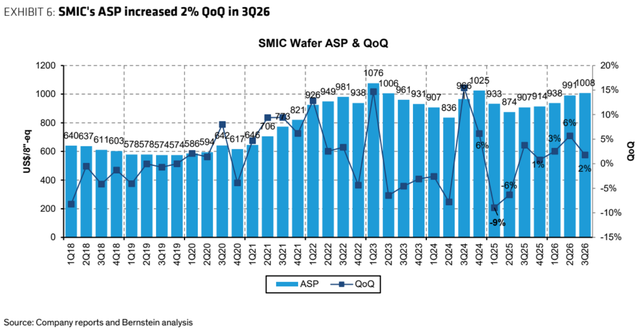
Of course, after entering advanced processes, performance is also visible: the overall wafer price has significantly increased, because the more advanced the process, the higher the price. The prices of 7nm chips and 28nm chips are definitely different.
So we see that the price of each wafer at SMIC keeps rising.
As shown in the chart above, in 2019, the price per wafer was still around $600, or even below $600, but by Q3 2026, SMIC's average price per wafer has reached $1,008, an increase of over 60% compared to the previous price below $600.
Some might think a 60% increase in 7 years isn't a huge increase, but in fact, if the process remains unchanged, wafer prices have actually declined over the past 7 years, because the more advanced the technology, the lower the chip cost.
It is precisely because it has entered advanced processes and chip prices have risen, leading to increased revenue. As a result, SMIC's revenue has continued to grow in recent years, and its global ranking has also steadily increased.
SMIC was once ranked fifth, ahead of TSMC, Samsung, UMC, and GlobalFoundries, but because UMC and GlobalFoundries were unwilling to move toward 10nm and stubbornly stuck to mature technology, SMIC advanced rapidly, surpassing GlobalFoundries and UMC, rising from fifth to third globally.
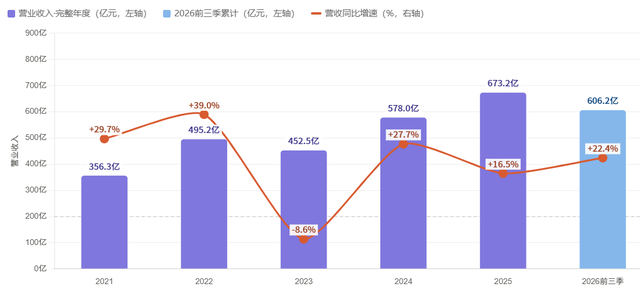
By the second quarter of 2026, SMIC will be only 0.5% behind second-place Samsung, and in the third quarter, this gap may be even smaller, or even catch up.
It is clear that improving chip processes and then raising chip prices is a hurdle any chip foundry must overcome on their way forward. If they only focus on mature processes, they may gradually be overtaken by other companies. For example, GlobalFoundries and UMC were overtaken by SMIC, right?
