


Is America's concern real? 45% of mature chips are manufactured in Chinese mainland
Recently, an institution released a report on the distribution of mature chip production capacity.
As shown in the chart below, it shows the market share of mature chip foundries in five major countries and regions: Taiwan Province, Chinese mainland, the United States, South Korea, and Japan.
As you can see, in 2022, Taiwan Province was the strongest, with 49%, nearly half of the global total.
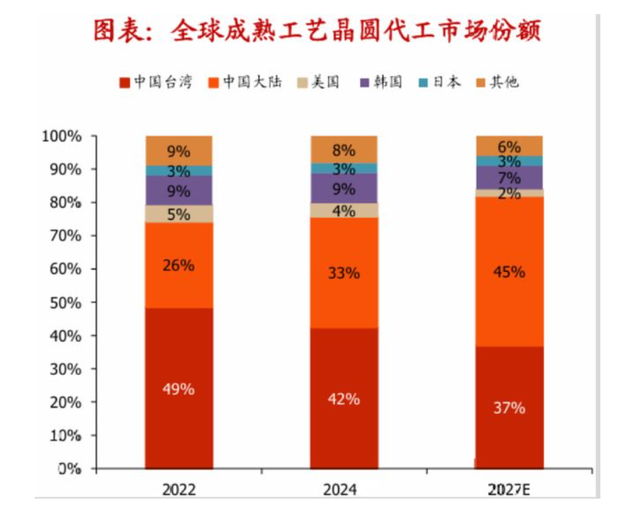
However, it has since declined steadily, dropping to only 42% in 2024 and projected to 37% in 2027, a drop of 12 percentage points.
Meanwhile, Chinese mainland has been rising steadily, from 26% in 2022 to 45% in 2027, an increase of 19 percentage points. The US has also been falling, dropping from 5% to 2%. South Korea is also falling, from 9% to 7%, Japan remains unchanged at 3%, and other regions are also falling from 9% to 6%.
This means that global mature chip production capacity is gradually shifting to Chinese mainland, and the trend is quite clear. In the future, mature chip manufacturing may truly be decided by Chinese mainland.

In fact, this situation was once anticipated by American media, which had been suppressing China's advanced chip processes, restricting EUV lithography machines from being sold to Chinese companies, and even banning some advanced immersion DUV lithography machines.
At the time, American media believed that China would vigorously develop mature chips, first increasing production capacity for mature chips, then moving on to breakthroughs in advanced processes.
The other party believes that improvements in mature processes will also have a significant impact on the global chip industry landscape. On one hand, China's chip costs will be lower, and once capacity increases, large-scale exports will be made to overseas markets, which will inevitably impact the chip industries of other countries, such as the United States.
Second, to increase China's mature chip production capacity, we need to drive the development of China's semiconductor equipment industry. These companies should start with mature process equipment, gradually substitute domestic products, and then slowly explore advanced processes. Quantitative changes lead to qualitative changes.
The ultimate result is a sharp rise in China's mature chips, followed by an increase in the domestic production rate of chip equipment, driving progress in the entire semiconductor industry. Rapid growth in semiconductor equipment, materials, and various supporting industries reduces dependence on the US and Western countries.
This situation has truly happened: China's chip production capacity has increased, exported overseas, and the domestic production rate of chip equipment has risen and continuously broken through, threatening the U.S. chip dominance. But the U.S. is powerless to restrict it. For mature chips, we don't need to rely on U.S. technology or equipment.
