


The U.S. Department of Commerce issues new export control regulations for advanced AI chips: Five Southeast Asian countries included in the licensing list, China's overseas computing power channels blocked
On November 16, U.S. time, the Bureau of Industry and Security (BIS) of the U.S. Department of Commerce issued the Interim Final Rule 'Control of Remote Access to Advanced Semiconductors,' extending the focus of control from the physical flow of chips to the remote supply of computing power.
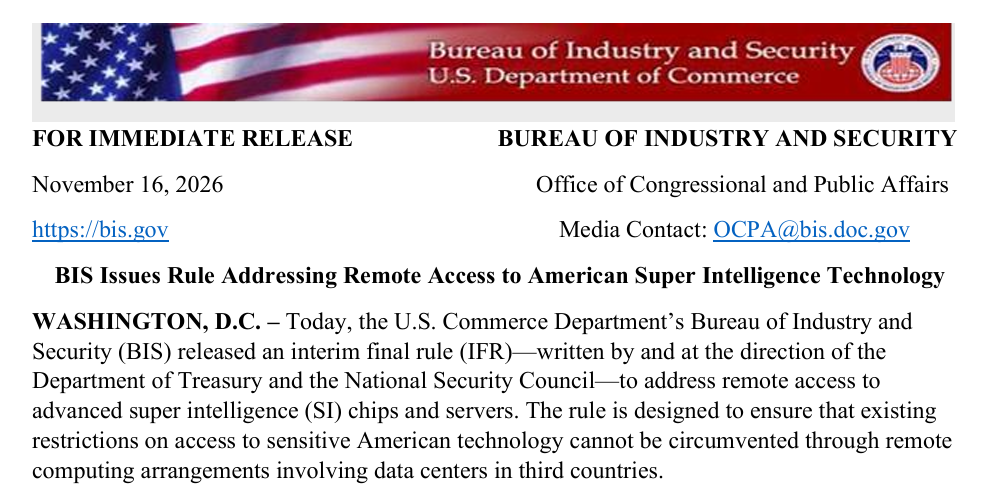
(Excerpt from the beginning section of the new BIS regulations)
The most crucial rule is that it sets a quantitative red line for 'large amounts of computing power': regardless of where the data center is located in the world, as long as it provides a total computing power of over 12 million TPP (total processing performance) to a company whose headquarters or ultimate parent company is in Macau, China, or in a D:5 country group (including China, Russia, Iran, North Korea, etc.), the export, re-export, or domestic transfer of advanced semiconductors (covering advanced computing chips under export classification codes 3A090 and 4A090 as well as servers equipped with such chips) must apply for a license and will be reviewed on a case-by-case basis.
According to estimates by the U.S. technology media TechCrunch, 12 million TPP is roughly equivalent to the peak computing power of about 750 NVIDIA H100 or H200 chips.
The rule also adds Indonesia, Malaysia, Singapore, Thailand, and Brazil as destinations subject to licensing requirements, citing that these five countries "present transit risks higher than the usual level." However, chips ultimately supplied to U.S. headquarters companies and meeting specific reporting requirements may be exempt from licensing, and the Secretary of Commerce may, in consultation with the Secretary of State or the President's National Security Advisor, designate additional countries.
Existing data centers that have already provided computing power to relevant Chinese entities must apply for a license within 90 days after the rules take effect, otherwise they will face subsequent export restrictions. The text of the rules was published on the Federal Register website on the afternoon of November 16, and is scheduled to be officially released and take effect on November 19. The public can submit comments within 60 days after the publication.
Chip Investigation and Political Game
The timing of the new regulations almost completely coincides with this global upheaval involving NVIDIA, the core of which is the Singaporean data center company Megaspeed. A letter from the U.S. Senate Banking Committee on November 11 revealed that Megaspeed has purchased over $4.8 billion worth of NVIDIA's advanced AI chips since June 2024 and is under investigation by the U.S. Department of Justice for allegedly shipping chips to China. According to The Wall Street Journal, Megaspeed arranged chip orders for Chinese companies totaling nearly $12 billion between March 2024 and June 2025.
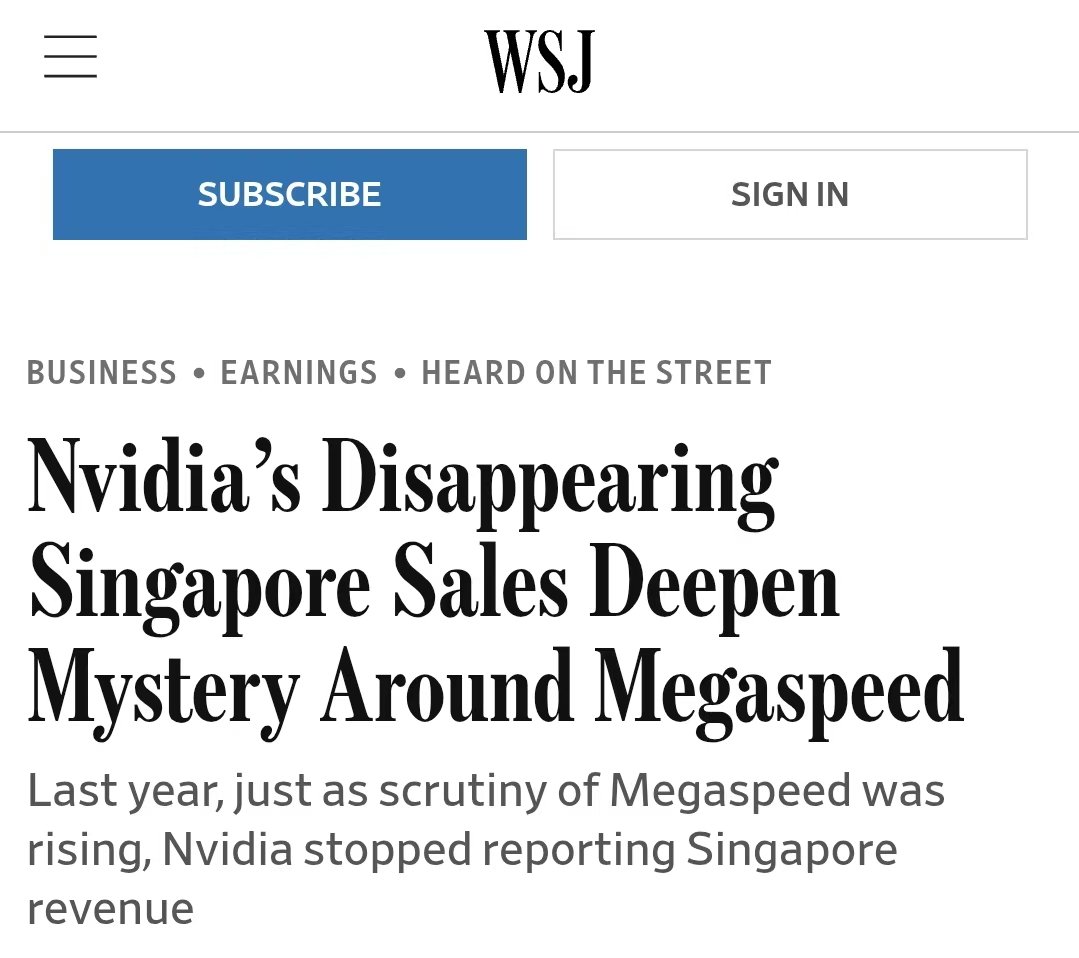
(Wall Street Journal report on Megaspeed)
Conflicts within the U.S. government have also become public. Treasury Secretary Mnuchin publicly criticized the Commerce Department for acting too late in restricting Megaspeed, while President Trump admitted on November 16 at the White House that there were differences between the two departments, suggesting that Commerce Secretary Ross may have delayed regulatory measures to avoid a 'blowup' in U.S.-China relations, while also stating, 'I understand both positions.' On the same day, Trump departed for a trip to Asia, expected to meet Xi Jinping for the third time this year, as China and the U.S. are in a sensitive period of trade truce. Bloomberg reported on November 14 that China had issued a warning regarding the U.S. intensifying chip restrictions.
The overseas computing power leasing model is under pressure
For China's AI industry, this new regulation targets precisely the most important 'detour' methods for computing power used in recent years. The U.S. bans the export of the most advanced AI chips to China, but Chinese companies can remotely use these chips to train models by renting computing power from data centers in Southeast Asia and other regions. Reuters reported on November 12, citing three informed sources, that Chinese AI companies are rushing to rent NVIDIA computing power overseas; a large Chinese cloud provider has internally discussed locking in overseas capacity, while smaller AI labs have approached computing power suppliers in Southeast Asia. Another Reuters report on November 13 outlined Chinese computing power projects valued at over $3 billion that are built around restricted NVIDIA chips and stated that tightening regulations are putting these projects at risk.
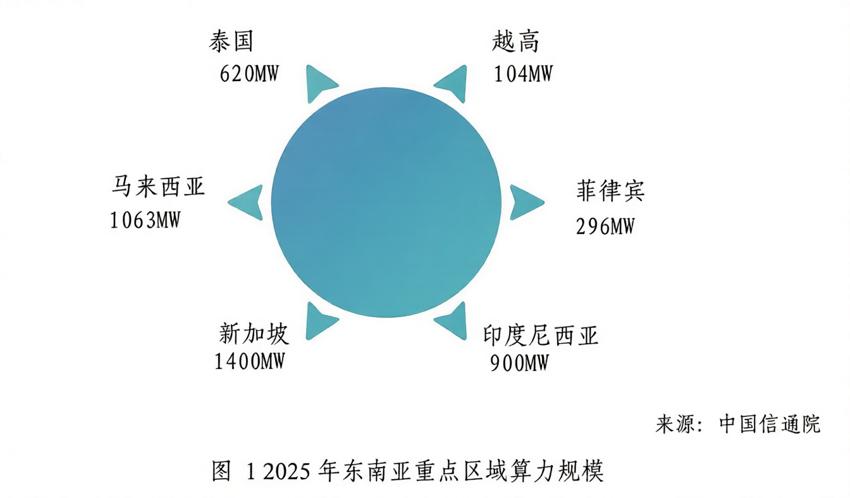
Southeast Asia is precisely the hub of this corridor. According to a report released by the China Academy of Information and Communications Technology in May 2026, the total capacity of key computing infrastructure in Southeast Asia exceeded 4.4 gigawatts in 2025, with more than 2,000 data centers, and it is expected that total capacity will surpass 10 gigawatts by 2030. Among them, Singapore leads with over 1.4 gigawatts, followed by Malaysia, Indonesia, and Thailand with 1,063 megawatts, 900 megawatts, and 620 megawatts, respectively. Caixin cited industry insiders saying that among the approximately 1.5-gigawatt data center projects approved in Thailand, projects with Chinese investment background or primarily serving major Chinese clients account for as much as 60% to 70%.
In the short term, the actual impact of the new regulations may be weaker than it appears on paper. Yuan Jinhui, CEO of Silicon Mobility, stated at the Caixin Summit on November 12 that training cutting-edge large models requires clusters with tens of thousands to even hundreds of thousands of GPUs, and the threshold of 750 GPUs is 'a drop in the bucket' for training, affecting more the inference scenarios that can run with only about a hundred GPUs. In other words, what the U.S. is targeting is the inference computing power of Chinese AI companies and some medium-sized training needs, while the overseas channels for cutting-edge model training have long been limited.
In the long term, pressure will be transmitted along the industry chain. The new regulations require data centers and chip exporters to conduct 'due diligence' on the equity structure of their clients, and also bring third parties that provide contract training for D:5 enterprises under control. Compliance costs will force overseas data centers to 'keep a respectful distance' from Chinese clients. The market's immediate reaction is negative: on the day the new regulations were issued, U.S. chip and AI cloud sectors mostly fell, with the Philadelphia Semiconductor Index dropping more than 4% intraday.
Relevant countries are also being forced to pick sides. On November 16, Singapore's Ministry of Communications and News and Ministry of Trade and Industry issued a joint statement saying they are "carefully studying" the details of the new regulations, communicating with U.S. authorities, and exploring ways to secure "trusted access" channels for Singaporean companies. Malaysia's Ministry of Investment, Trade, and Industry previously stated that it "welcomes data center investments but will not allow itself to be used to circumvent export controls," and plans to legislate to require data centers to disclose the number of GPUs imported.
China, on the other hand, holds two cards: negotiation and countermeasures. On November 13, Chinese Foreign Ministry spokesperson Mao Ning responded that China 'consistently opposes the abuse of export control measures,' calling on China and the U.S. to jointly maintain the stability of economic and trade relations. On October 16, China’s Ministry of Commerce and Ministry of Science and Technology announced plans to implement export controls on 23 artificial intelligence technologies and initiate pre-export registration. The suspension period of export control measures on key items such as rare earths to the U.S. was just extended for another two months on November 10, reflecting the fragile consensus reached in the eighth round of China-U.S. economic and trade consultations.
