


Storage chips experience a 'contrast of extremes': DRAM continues to rise, NAND spot prices plummet 20%
Over the past three quarters, DRAM and NAND have been breaking price records together; however, in November, the two curves diverged for the first time. According to the latest report from Bank of America, the upward trend in DRAM prices has not changed, but the NAND spot market has shown clear signs of weakening: spot prices have fallen by about 20% cumulatively since mid to late October, 512Gb wafers have dropped more than 10% in a single week, and 1Tb wafers have also fallen close to single-digit percentages, becoming the first category to face a price reassessment in this cycle of rising memory chip prices; during the same period, 16Gb DDR5 spot prices remained flat. In the same upcycle, memory chips are exhibiting opposing price trends for the first time.
DRAM and NAND are respectively the operating memory and large-capacity data storage of computing systems, and are the two main categories in the storage chip market. The current divergence in the storage market can be summarized into four key judgments:
1. Price re-evaluation first appeared in the NAND spot market:512Gb wafer spot price reported at $14.3, down 12% weekly and 32% quarterly, while 16Gb DDR5 spot price remained flat and stable;
2. BofA's estimate unusually diverges from market consensus:The DRAM price increase is expected to continue until the fourth quarter of 2026 and the first quarter of 2027, rising by another 5%, while the overall average price of NAND may see a low single-digit decline in the first quarter of 2027; sellers generally expect it to still have an increase of over 10%.
3. The two pricing logics diverge:DRAM is supported by the dual factors of AI data center demand and HBM capacity constraints, while NAND is dragged down by weaker orders from PCs, smartphones, and Chinese cloud providers.
4. The contract price negotiation in the first quarter of 2027 is a watershed:The shortage of urgent orders may delay price negotiations, and the pricing control of NAND is shifting to buyers. The valuation and profit gap between the two major product lines will consequently widen.
The cracks in the spot market are first torn open by NAND
The changes in the spot market are the most direct. According to DRAMeXchange data, the spot price of a 512Gb NAND wafer is $14.3, down 12% week-on-week, down 32% quarter-on-quarter, but still up 121% year-on-year; the quote for a 1Tb wafer is $24.9, down 4% week-on-week, down 19% quarter-on-quarter, and up 194% year-on-year. In comparison, the spot price of a 16Gb DDR5 is $60.2, unchanged week-on-week, and up 150% year-on-year.
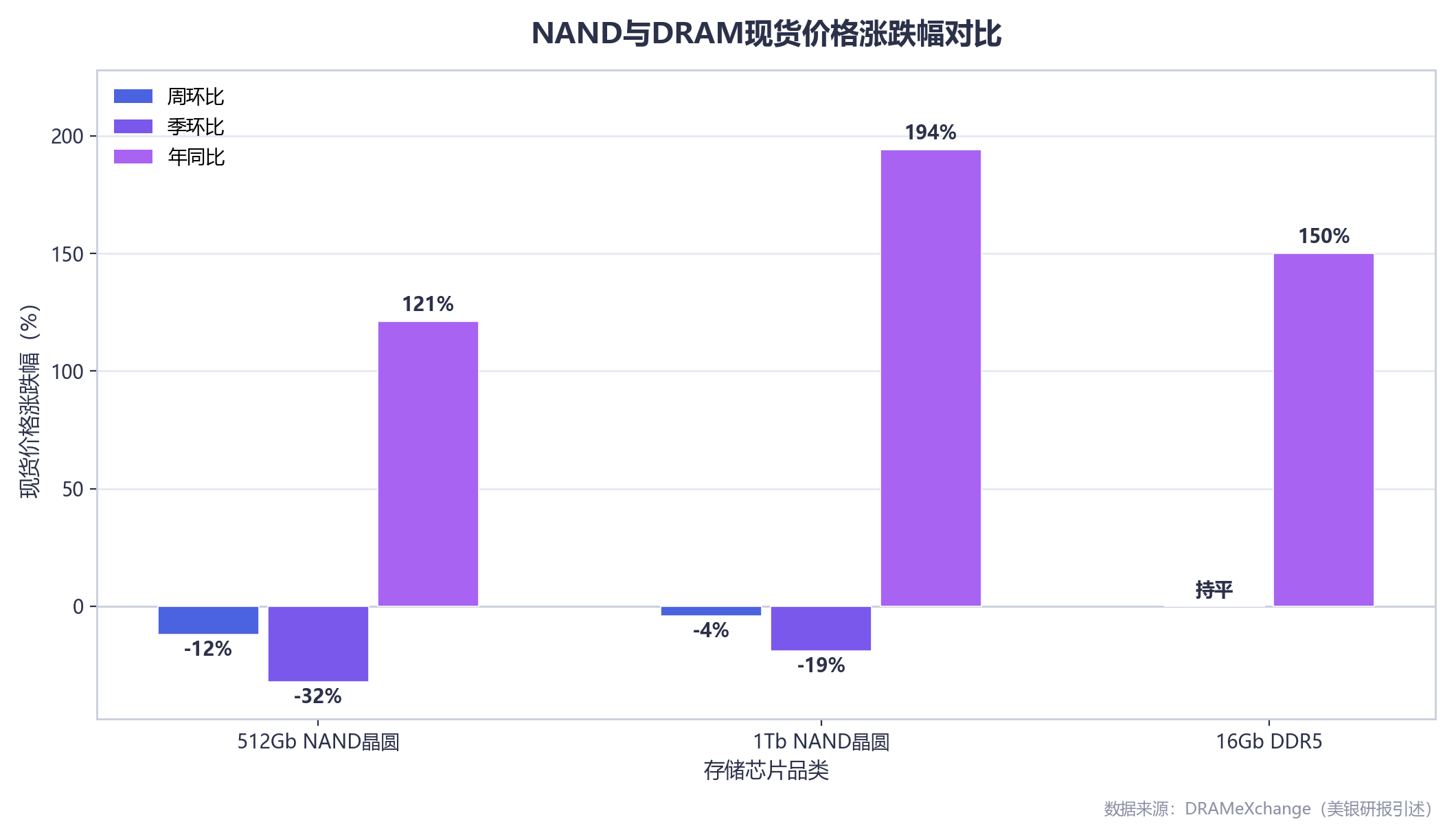
The differentiation trajectory in the chart is quite clear: the decline of the two main NAND specifications amplifies layer by layer over time. The 512Gb wafers fell from a 12% weekly drop to a 32% quarterly drop, while 1Tb wafers increased from a 4% to a 19% drop over the same period, and DDR5 spot prices remained unchanged. On an annual growth basis, NAND still maintains increases of 121% to 194%, indicating that the current pullback is a marginal loosening of a high-level market and has not yet broken the bottom logic of this cycle, but the direction has already changed.
This is not an isolated case. Observations from the industry side corroborate this: by the fourth quarter of 2026, spot prices for consumer SSDs and NAND wafers in the channel continued to ease, with 512Gb TLC wafer spot prices falling nearly 30% from the March peak. Module manufacturers were reluctant to stock up, and transactions sharply contracted; although original manufacturers’ contract prices remained relatively firm, downstream purchasing acceptance continued to decline, further widening the price gap between contract and spot markets. The tracking of the CFM flash memory market also shows that the spot market has experienced structural divergence since the end of March 2026.
BofA's divergence forecast: DRAM will continue to rise for two more quarters, NAND may turn down first
Faced with the same set of market data, Bank of America drew completely different slopes for the two product lines. For DRAM, it expects the price increase trend to continue until the fourth quarter of 2026, with a quarterly increase of 8%, and another 5% increase in the first quarter of 2027. For NAND, Bank of America maintains a conservative estimate for the average selling price in the first quarter of 2027: IT NAND prices are expected to decline 5% to 10% quarter-on-quarter, enterprise applications are roughly flat or slightly up, and the overall average price shows a low single-digit percentage decline.
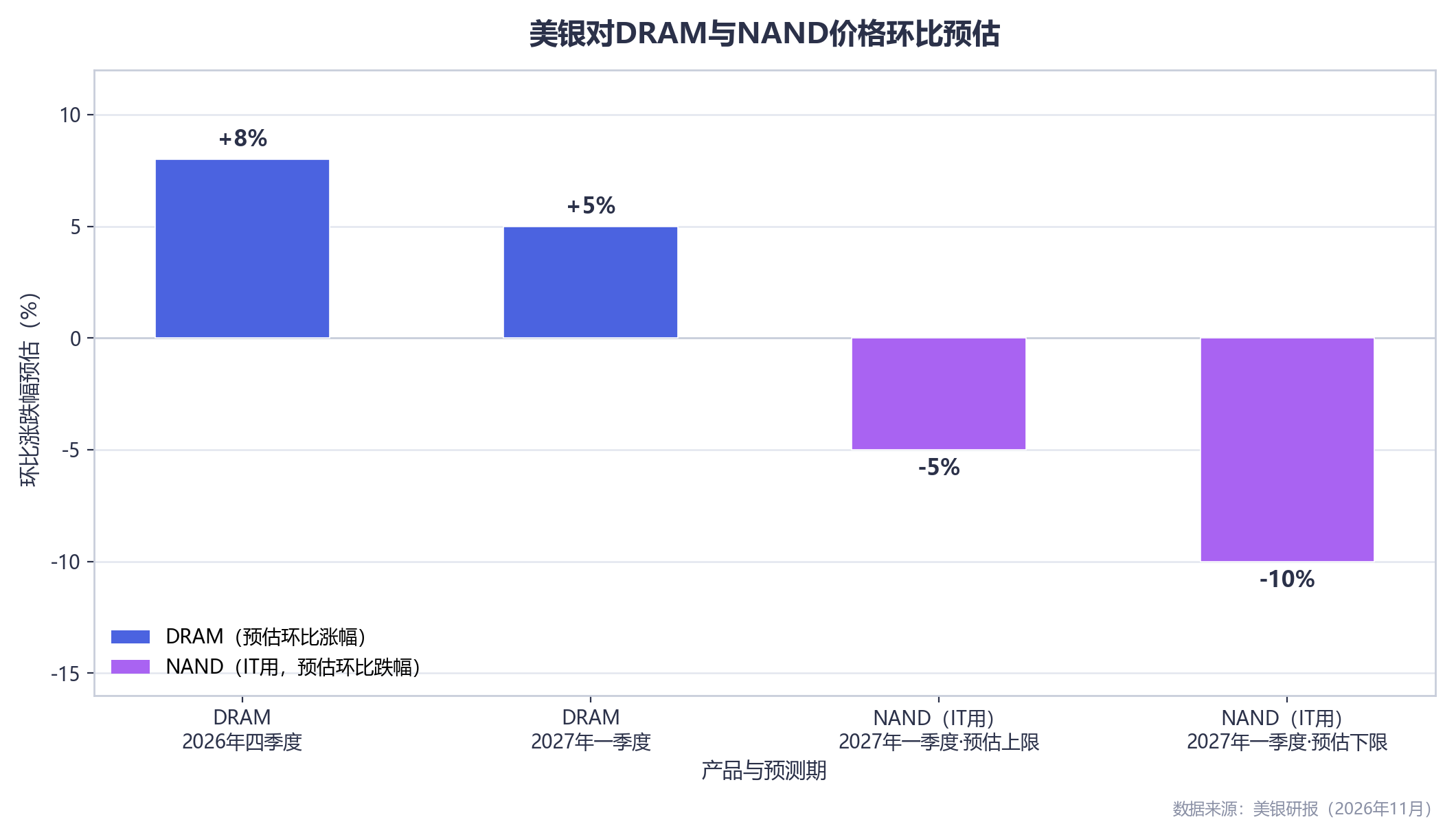
Also pointing to the first quarter of 2027, the projected quarter-on-quarter increase for DRAM and NAND differs by more than 10 percentage points. What is even more noteworthy is the expectation gap itself: market sellers generally expect the average selling price of NAND to still rise by about 10%, while Bank of America gives a judgment of a slight single-digit decline, which is quite a gap.
This divergence is not without reason. In the first quarter of 2026, the NAND Flash market still saw a month-on-month increase of 81.8%, reaching $42.815 billion, and the DRAM market also grew by 81.5% month-on-month, reaching $94.325 billion; however, the growth clearly slowed in the second half of the year. TrendForce estimated that in the third quarter, the month-on-month increase in contract prices for mainstream DRAM would narrow to 13%–18%, and for NAND to 10%–15%. The logic of slowing growth and stratified demand, with the spot market loosening first, aligns with the conservative forecasts of institutions.
The Divergence of Two Pricing Logics: AI Data Centers and Consumer Electronics
The support logic for DRAM is almost entirely reliant on AI. According to information summarized by Bank of America after discussions with Samsung Electronics, there are two points that directly benefit DRAM: strong demand for chips in U.S. AI data centers, with no signs of order cuts; and continuously rising prices for long-term supply agreements (LTA) for DRAM, which helps maintain higher prices and gross margins for a longer time. Structural constraints on production capacity are an even tougher limitation: Samsung, SK Hynix, and Micron have already sold out DRAM and HBM capacity through 2027 in advance, and the market generally expects tight supply to continue at least until 2028; SK Hynix further stated in its earnings briefing that as of 2029, its DRAM and HBM capacity for the next three years is effectively completely sold out. HBM occupies advanced capacity with 3D stacked packaging, and the three major manufacturers collectively hold more than 91% of global DRAM market revenue; any adjustment in capacity by one company is enough to impact the entire market. Micron has even announced its exit from the Crucial consumer business to allocate supply resources to faster-growing strategic customers. SK Hynix previously also believed that the global memory industry has fully shifted to a seller’s market, and price increases in 2026 will persist throughout the year.
Samsung's attitude toward HBM is intriguing. The company has set an HBM market share target of about 30% to 40%, rather than over 50%; even by the end of 2027, the profitability of LPDDR5 will still be better than HBM, so Samsung is unlikely to excessively expand HBM capacity and erode the market share of traditional DRAM. In terms of technology, HBM4E and HBM4 share the same 1c process node and 4nm logic base. This restraint, in turn, means that the tight supply of traditional DRAM is unlikely to ease in the short term, and prices are easy to rise but hard to fall.
The other end of NAND logic lies in consumer electronics. In the warning pointed out by BofA, there are two aspects directly indicating the demand side: weakening orders from PC and smartphone manufacturers as well as large Chinese cloud service providers; negotiations for contract prices in the first quarter of 2027 may be delayed, and the market has not yet shown urgency to place orders. Pressure on the supply side also has a structural nature: about 20% to 30% of global wafer capacity comes from old production lines, which are not suitable for producing advanced NAND and enterprise-class SSDs, yet still need to continuously supply IT NAND, creating structural pressure on prices. Strong demand for enterprise-class SSDs can partially offset the weakness of IT NAND; the per-bit prices of high-capacity NAND above 2Tb and eSSDs above 30TB have also been slightly adjusted downward recently, but BofA believes this is more like a proactive promotion by manufacturers to promote the new generation of QLC products, and the NAND prices for most eSSDs still show a slight upward trend.
The distinction between the two pricing logics can be condensed into a comparison table:
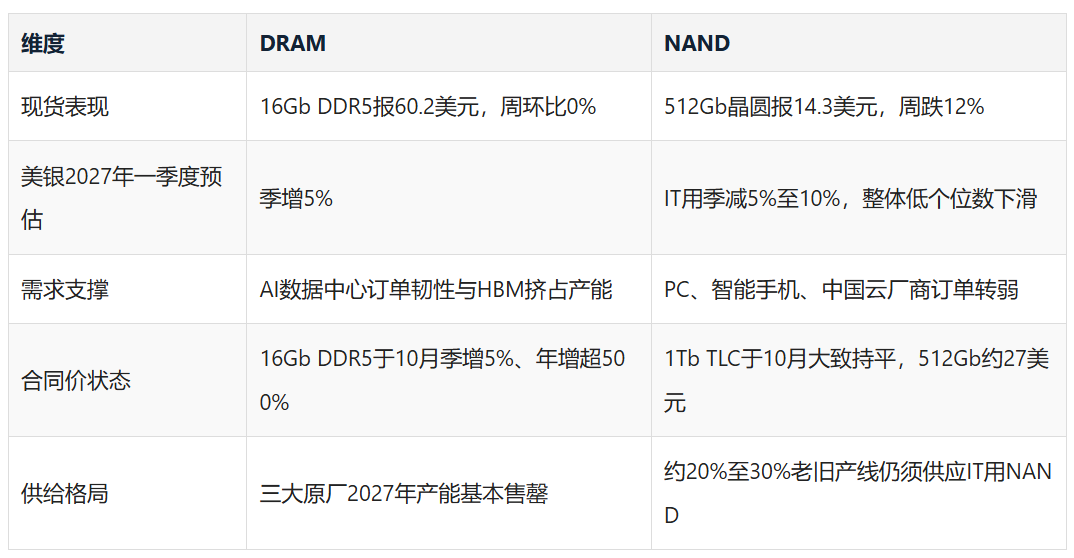
The contract price remains high, and the bargaining power has quietly shifted.
The easing in the spot market has not yet transmitted to contract prices. According to TrendForce data, the October contract price for 1Tb TLC wafers remained roughly flat, continuing the consolidation trend from the second to the third quarter; the contract price for 512Gb wafers is about $27, close to historical highs, roughly 10 times the $2.5 low in February 2025. DRAM contract prices continue to surge: the contract prices for 64GB DDR5 and DDR4 server modules rose about 15% month-on-month, breaking $1,000 to reach $1,600 and $1,500, respectively.
However, the firmness of contract prices more reflects previously locked-in long-term agreements and lagged price adjustments. Upstream memory manufacturers have issued a 'friendly reminder' to module makers that supply quotas for 2027 will be significantly reduced, and most of the capacity from 2027 to 2028 has already been sold out. The proportion of capacity locked in through long-term supply agreements continues to rise among major manufacturers: Kioxia about 50%, two major South Korean manufacturers about 70%, and Micron about 60%, with the agreement term also extended from the usual three years to five years. A high proportion of locked capacity means that less and less spot supply is available on the open market, making price signals more easily captured first by the spot market — this is the deep reason behind the recent decline in NAND spot prices. Kioxia's CEO previously issued a rare cooling signal, bluntly stating that NAND prices 'have already risen enough'; the supply chain generally also judges that after cumulative contract price increases of about 30% to 40% over two quarters in the second half of 2026, weak PC and smartphone demand is limiting the speed of subsequent price increases.
The bargaining situation highlighted by Bank of America is thus not hard to understand: spot prices have dropped by about 20%, orders are weakening, and negotiations may be delayed. The combination of these three signals indicates that the pricing power for NAND contracts in the first quarter of 2027 is shifting from manufacturers to buyers. On the DRAM side, manufacturers still hold sold-out capacity and long-term agreements with rising prices, so the momentum for price increases remains.
In the valuation gap, differentiation has already been priced in.
The capital market has begun to price in differentiation. Despite a weakening in NAND spot prices, memory chip stocks still rebounded overall last week, with most stocks rising more than 100% year-to-date. Among them, SanDisk and Kioxia have increased by over 250% cumulatively. In terms of valuation, SK Hynix's estimated P/E ratio for 2026 is 3.6x, Samsung Electronics 4.7x, Micron Technology 10.7x, and Nanya Technology 5.1x; SanDisk's estimated P/E ratio for 2027 is 4.3x, Western Digital 13.2x, Silicon Motion 16.4x, and Phison 7.7x. Most DRAM manufacturers have a P/E ratio of only about 3 to 5 times based on 2026–2027 earnings, significantly lower than peers in the AI semiconductor sector.
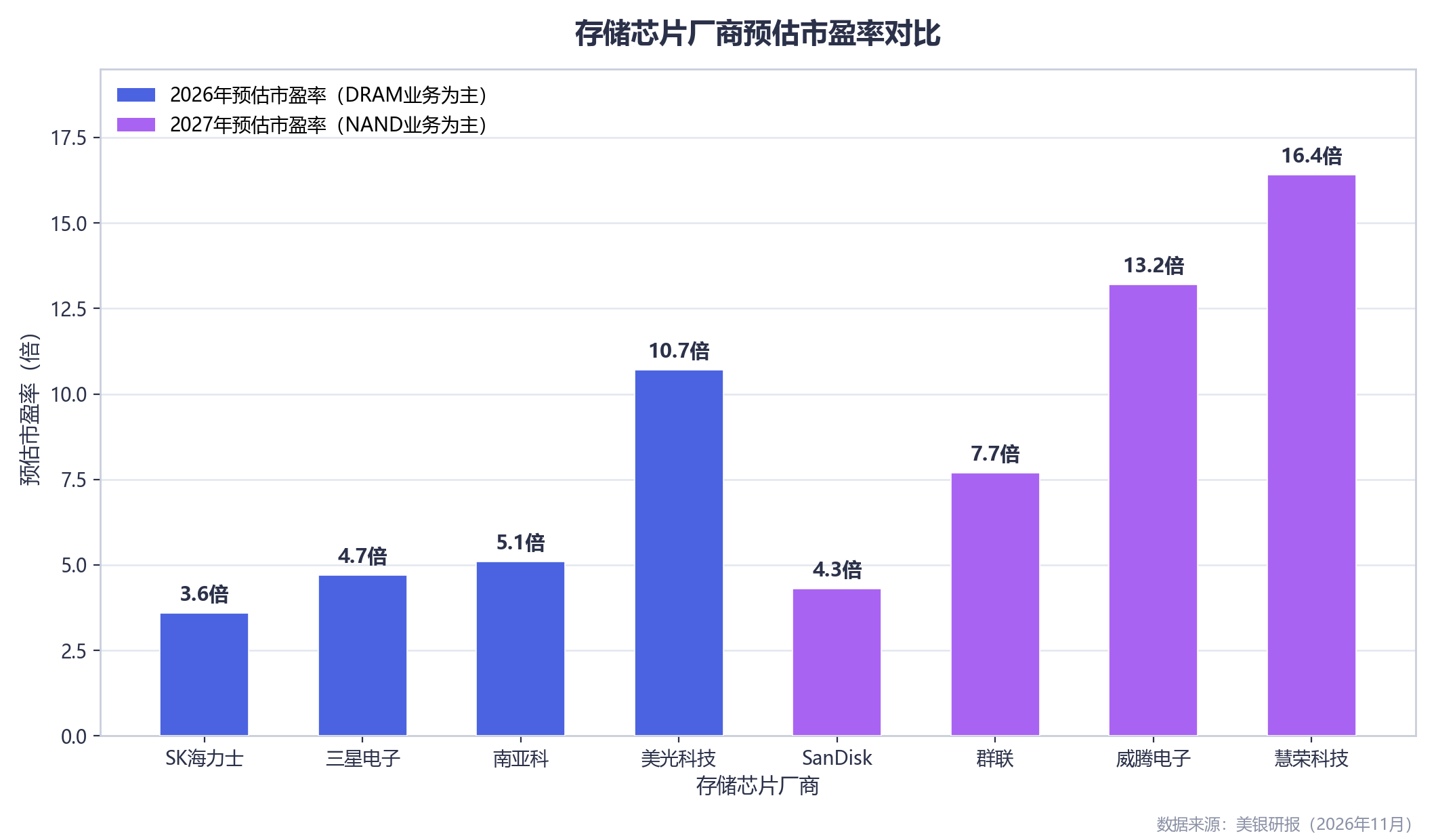
It can be seen in the chart that the valuations of the DRAM camp are generally lower than those of the NAND camp: SK Hynix at 3.6 times, Samsung Electronics at 4.7 times, corresponding to a more certain price increase path and sold-out capacity; the overall P/E ratio of the NAND camp is higher, implying the market's higher expectation for its demand resilience. The impressions of Bank of America after communicating with investors are consistent with this: most people believe that the stock price downside of companies with a higher proportion of DRAM business is limited, for reasons including resilient AI data center chip orders after the U.S. midterm elections, continued DRAM price increase, and the sector's P/E ratio remaining relatively low. Compared with peers in AI semiconductors, the valuation of the storage chip industry is still relatively moderate.
Bank of America's conclusion brings together two clues in one place: the supply and demand as well as price trends of DRAM are still supported by AI data center demand and the effect of HBM production crowding out other DRAM capacity; the pricing dominance of the NAND market is gradually shifting to buyers. The future valuation gap and profit performance of the two major product lines will depend on whether the contract price negotiations in the first quarter of 2027 can proceed as scheduled.
The observation window left for the market is not long: whether urgent orders appear, the original manufacturers' insistence on fourth-quarter contract prices, the ramp-up pace of HBM4E, and the output flexibility of old NAND production lines—any change in one of these variables could cause this newly diverging price curve to take a completely different slope.
