Jensen Huang's Departure Shakes Up the Computing Power Landscape: The Window of Opportunity for Domestic GPUs and the Real Work Ahead
Jensen Huang's departure has intensified supply chain risk expectations, prompting customers to accelerate the search for alternative solutions; a management vacuum at Nvidia may affect the pace of product delivery, also providing a time window for domestic GPUs to undergo cluster verification and scale-up, and decisions on domestic replacement are expected to accelerate.
The positive impact of the event is mainly on sentiment and expectations. NVIDIA's ecosystem will not collapse due to a change in leadership, and the actual impact is limited. Third-quarter reports show that Moore Threads and Muxi both achieved single-quarter net profits excluding non-recurring items, indicating a turning point in the industry, but most manufacturers are still losing money, and the quality still needs to be tested.
The localization of GPUs is a systematic project, with its core driving force coming from the combined effects of policies, demand, industrial chain, and technological routes: external regulations are the external factor, order demand is the traction, and production capacity yield and software ecosystem are the core variables that ultimately determine how far it can go.
On the evening of November 12, Beijing time, NVIDIA announced that Jensen Huang would step down from his positions as President, CEO, and Board Member, ending a 33-year leadership career, with Chief Financial Officer Colette Kress appointed as interim CEO. On the day of the announcement, NVIDIA's stock closed down 4.34% at $166.19, with a single-day market value loss of about $182 billion. The news has become the hottest topic in the industry recently. At the same time, the view that "with Jensen Huang leaving, the biggest beneficiary is obviously China" has circulated in the Chinese investment community. Some believe that this leadership change will be favorable to the process of domestic GPU localization in mainland China. A comparable fact is that, as of November 2026, domestic GPUs have reached over 41% market share in the domestic market, shifting the landscape from "absolute import dependence" to "one dominant plus several strong competitors." How substantial this window of opportunity truly is remains to be seen.
Triple Catalysis: How Resignation Events Drive Up Expectations for Domestic Substitution
(1) Strengthening expectations of supply chain risks, accelerating domestic substitution decisions
The reason Jensen Huang's resignation is seen as a catalyst for domestic substitution lies primarily in the reassessment of supply chain risks. Against the backdrop of the U.S. continuously tightening export controls, NVIDIA's market share in China has declined from about 95% at the beginning of the Biden administration to around 50% by May 2025. At the same time, the market is concerned that, with changes in the U.S. political landscape, export management rules may be further tightened, increasing the uncertainty of NVIDIA's business in China. For buyers, continuing to rely on a single overseas supplier for computing power supply chains is a risk that cannot be ignored.
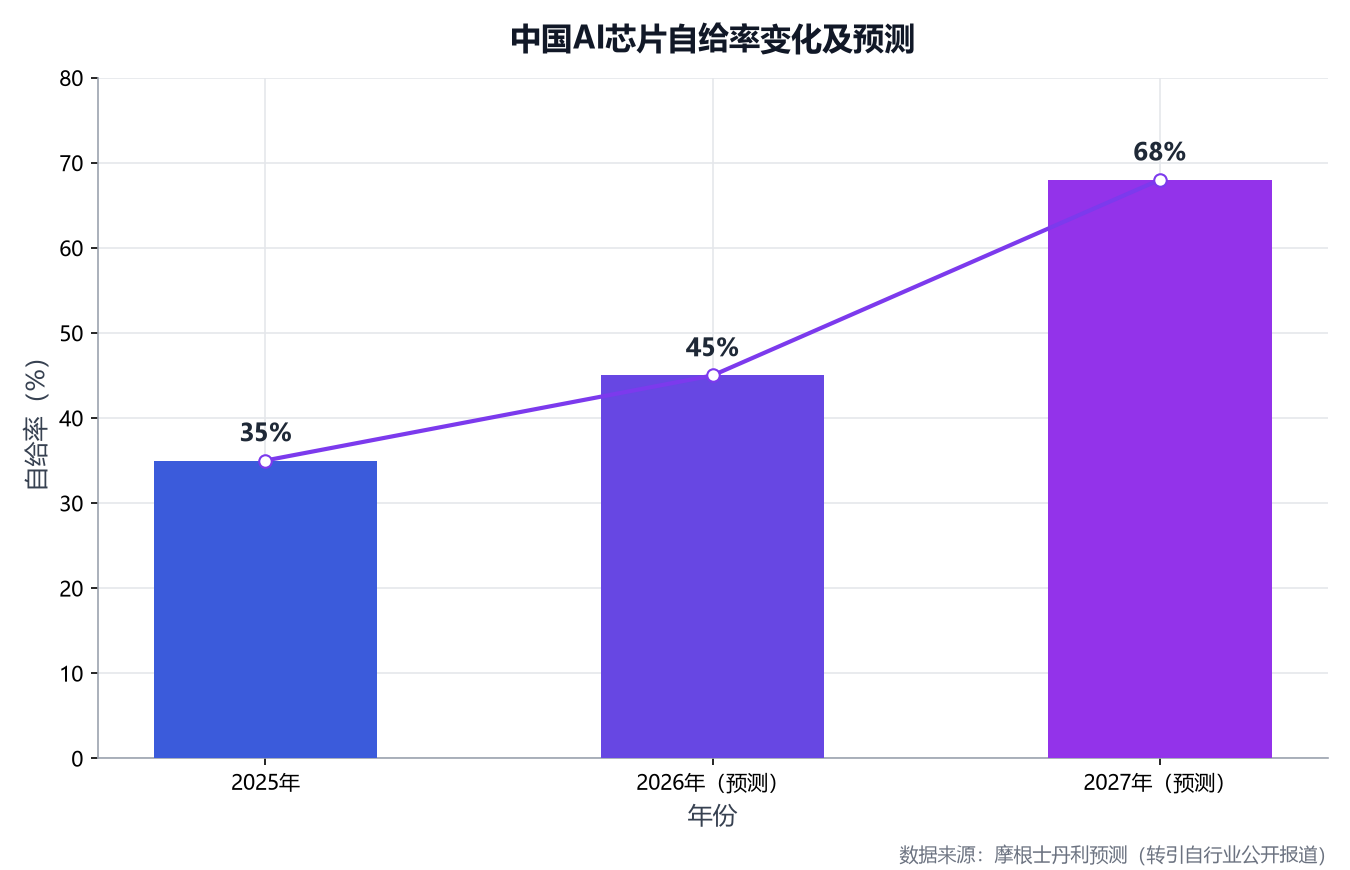
Data also supports this shift: in 2025, the overall shipment of AI acceleration cards in China is expected to be about 4 million units, of which NVIDIA accounts for about 2.2 million units, or approximately 55%, leaving ample room for domestic substitutes. Morgan Stanley expects China's AI chip self-sufficiency rate to increase from 35% in 2025 to 45% in 2026, and reach 68% in 2027. As a result, customers no longer 'dare not switch,' but 'must try.'
(2) Nvidia's short-term strategy fluctuates, leaving a brief window period
The second logic lies in NVIDIA's own short-term fluctuations. Despite over 1,600 internal messages of support for NVIDIA and 97% of employees voting for Jensen Huang to remain in his position, a managerial transition gap still objectively exists. Analysts believe that this transition period may affect NVIDIA's product delivery and customer response rhythm, providing Chinese manufacturers with a brief window to compete for pilot clients and market share. It is important to emphasize that this is a 'window,' not a 'gap.' NVIDIA's technology system and ecosystem will not collapse due to a leadership change, and the length of the window depends on how smoothly the transition is handled.
(3) Industrial and capital resources tilt towards domestic tracks
The third layer of logic is that the event has amplified the convergence of industry and capital resources toward domestic tracks. Just two days before Jensen Huang stepped down, the domestic GPGPU manufacturer Jinglin Technology was listed on the main board of the Hong Kong Stock Exchange on November 10, raising a net amount of approximately HKD 1.312 billion at an issue price of HKD 231 per share, all of which will be used to boost GPU research and development. Earlier, Biren Technology had been listed on the Hong Kong Stock Exchange on January 2, raising a total of about HKD 5.583 billion through its IPO, and in September it raised an additional HKD 4.02 billion through allocation to seize the production window; Moore Threads and Muxi Co., Ltd. were both listed on the Sci-Tech Innovation Board in December 2025, completing the listing or registration of all the "four little dragons" of domestic GPUs, while successors such as Hanbo Semiconductor have already started listing guidance. Loongson Technology simultaneously plans a private placement to raise up to RMB 1.621 billion, directed at projects including the research, development, and industrialization of key core technologies for general-purpose GPUs.
More importantly is the shift of the valuation anchor: the valuation logic of domestic computing power companies is switching from 'NVIDIA mapping' to 'independently controllable certainty.' Under event-driven disturbances, the speed at which capital, orders, and talent tilt toward the domestic track may further accelerate.
Beyond Emotions: Ten Companies' Financial Reports Outline the True Quality of Domestic GPUs
Institutions such as Jiufang Zhitao have reminded that Jensen Huang's departure does not mean that domestic GPUs can immediately take over market share. Some comments bluntly state, 'There has never been a shortcut in the chip industry.' In other words, the logic of the event remains more at the level of sentiment and expectations, and the actual impact is still limited. The real progress of domestic GPUs ultimately depends on the operational quality of the companies themselves. Coinciding with the intensive disclosure of third-quarter reports, the financial statements of ten manufacturers constitute a concentrated test.
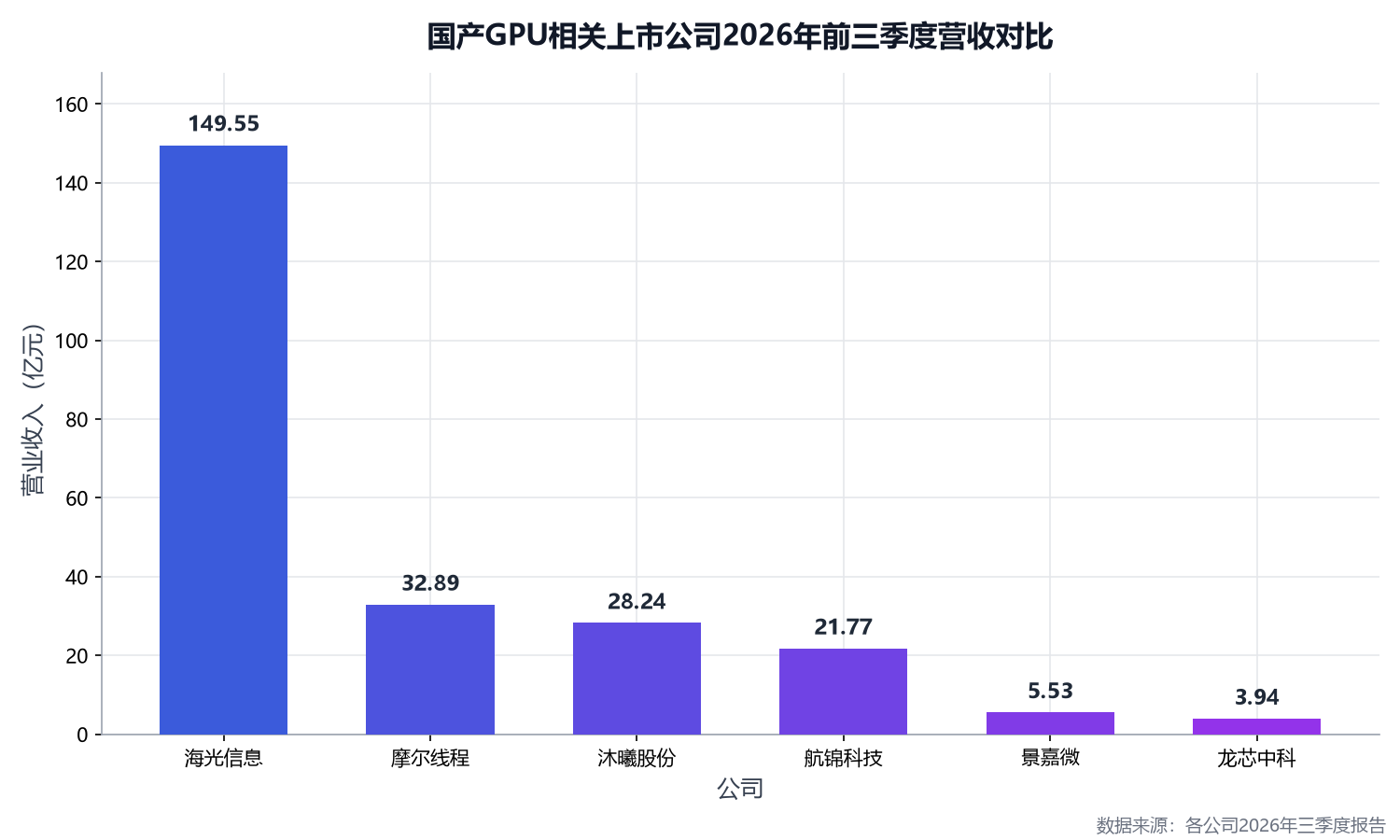
Muxi Co., Ltd. achieved revenue of 2.824 billion yuan in the first three quarters, a year-on-year increase of 128.45%; net profit attributable to shareholders was 639 million yuan, and net profit after deducting non-recurring items was 259 million yuan, both turning from losses to profits. In the third quarter alone, revenue was 1.5 billion yuan, a year-on-year increase of 367.12%, with single-quarter income exceeding the total of the first half of the year, and net profit after deducting non-recurring items reached 308 million yuan, achieving non-recurring profitability for two consecutive quarters, making it the first among the 'Four Little Dragons' to successfully run a single-quarter main business profit model. Dragged down by a single-quarter loss of about 383 million yuan due to changes in the fair value of financial assets, its net profit attributable to shareholders in the third quarter was 26.5271 million yuan; as of the end of September, the company had 3.875 billion yuan in cash, with ample liquidity on hand. As of October 30, Muxi's market value was approximately 180 billion yuan. On the product side, the Xiyun C600 started mass production and was launched in May, achieving a fully domestic supply chain; the MXMACA software stack now supports more than 6,000 CUDA applications and is natively compatible with over 1,000 mainstream large models.
Moore Threads' revenue for the first three quarters reached 3.289 billion yuan, a year-on-year increase of 319.15%; Q3 alone recorded revenue of 1.552 billion yuan, soaring 1773.92% year-on-year, with net profit attributable to shareholders of 49.26 million yuan and net profit excluding non-recurring items of 20.072 million yuan, achieving its first quarterly profit since listing, becoming the second 'Little Dragon' member to cross the single-quarter profit threshold after Muxi. R&D investment for the first three quarters amounted to 1.34 billion yuan, up 55.7% year-on-year, exceeding the total for 2025; cumulative R&D investment since listing has approached 6.5 billion yuan. As of November 4, Moore Threads had a market value of approximately 157.8 billion yuan. Its next-generation full-featured GPU MTT S5000 has been delivered at scale and, in cooperation with JD Cloud, plans to build a 100,000-card full-featured GPU cluster.
Haiguang Information's revenue for the first three quarters was 14.955 billion yuan, a year-on-year increase of 57.58%, and net profit attributable to the parent company was 2.847 billion yuan, a year-on-year increase of 45.12%, with R&D investment amounting to 4.472 billion yuan, a year-on-year increase of 52.39%. Its DCU uses a GPGPU architecture and is compatible with the 'CUDA-like' ecosystem, making it one of the most commercially mature domestic computing power chip companies.
Suiyuan Technology's revenue for the first half of the year was 1.12 billion yuan, a year-on-year increase of 279.08%, with a net loss of 632 million yuan; the company expects a loss of 700 million to 860 million yuan for the first three quarters, with profitability likely between 2026 and 2027. Biren Technology's revenue for the first half of the year was 1.236 billion yuan, a year-on-year increase of 1997.6%, with a loss of 377 million yuan, narrowing 76.4% year-on-year, and a gross profit margin increase of 10.8 percentage points to 42.7%. Tensai Zhixin's net profit on the books for the first half of the year was 106 million yuan, achieving a turnaround, but approximately 756 million yuan of this came from the cumulative unrealized fair value gains of its holdings in Shenghe Jingwei; excluding this, the main business is still at a loss.
Jingjia Micro (300474.SZ) Revenue for the first three quarters was 553 million yuan, an increase of 11.71% year-on-year, with a net loss attributable to the parent company of 185 million yuan. R&D investment was 441 million yuan, continuing to bet on both high-performance GPUs and AI SoCs. Loongson Zhongke (688047.SH) In the first three quarters, revenue was 394 million yuan, a year-on-year increase of 12.46%, with a net loss of 413 million yuan. R&D investment was 364 million yuan, accounting for as much as 92.29% of revenue.
Denglin Technology (09917.HK) In the first four months of 2026, revenue reached 200 million yuan, already exceeding the full-year revenue of 2025 (171 million yuan). Adjusted net profit turned positive at 20.579 million yuan, with a gross margin of 50.9%. Based on 2025 revenue, its market share in China's enterprise-level AI GPGPU market is 1.0%, ranking third, with the top two positions occupied by international companies. Hangjin Technology (000818.SZ) Revenue for the first three quarters was 2.177 billion yuan, down 33.77% year-on-year (mainly affected by changes in the consolidation scope), with net profit attributable to the parent of 63.1407 million yuan, up 315.70% year-on-year, driven mainly by increased profits from the intelligent computing power business.
Overall, the picture drawn by the third-quarter report is: revenue generally shows high growth, profit inflection points are beginning to appear, but tier differentiation continues to intensify.
[Chart: Revenue Comparison of Domestic GPU-Related Listed Companies for the First Three Quarters of 2026]
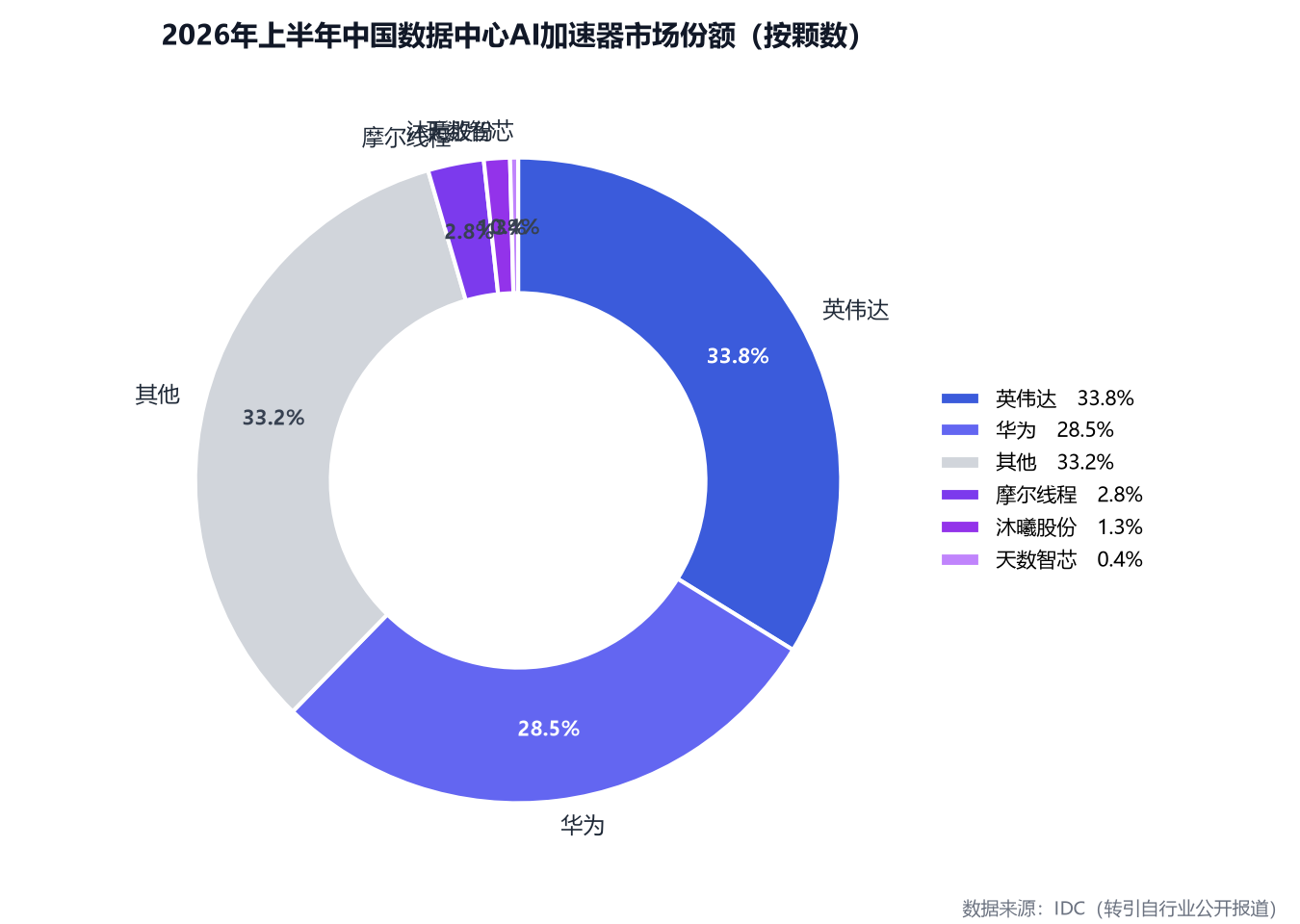
[Chart: Market Share of AI Accelerators in China's Data Centers in the First Half of 2026]
Systems Engineering: The Core Driving Force of Localization Lies Beyond Events
The localization of GPUs has never been driven by a single event; it is a systematic project, and the real core driving force comes from the combined efforts of policies, demand, the industrial chain, and technological routes.
Currently, the pull from the demand side has shifted from being policy-driven to order-driven. According to data from the China Academy of Information and Communications Technology, as of June 2026, the daily Token call volume in China has exceeded 500 trillion, whereas at the end of 2025, this number was 100 trillion. The surge in demand is directly translating into orders: China Mobile has announced that its computing power investment will exceed 100 billion yuan by 2027, and JD Cloud has signed a collaboration with Moore Threads for a full-featured GPU cluster at the scale of 100,000 cards. Bernstein expects that by 2028, ByteDance, Alibaba, and Tencent will account for nearly 50% of AI capital expenditure in China. The growth logic of domestic computing power is shifting from 'policy support' to 'actual cash purchases'.
At the policy and industry chain level, external regulations continue to force the acceleration of localization. Hypernodes are set to become the keyword for domestic computing power in 2026, with hypernode solutions from companies like Huawei and Muxi being implemented, and the market expects commercialization to accelerate in 2027. The penetration rate of supporting domestic switching chips is expected to increase from 10%-20% to 30%-50%, with upstream equipment segments benefiting with certainty. Bottlenecks in the manufacturing stage still need to be overcome, as the production capacity of the Ascend 910C is still constrained by the yield of advanced processes and the supply of HBM.
In terms of technology roadmap, pursuing multiple parallel routes and building an ecosystem is a long-term endeavor. Currently, the domestic camp presents a dual-track pattern of GPGPU and DSA (Domain-Specific Architecture) running in parallel, with GPUs and ASICs each having advantages in inference and training scenarios, complementing each other. The ecosystem is the deepest moat and also the thickest barrier. Muxi's MXMACA is compatible with over 6,000 CUDA applications, and Moore Threads' MUSA ecosystem gathers over 800,000 developers; both follow a transitional route of 'first compatibility, then native.'
However, the key to certainty lies in the market demand space. According to data from Frost & Sullivan, the scale of China's GPU industry has increased from 0.04 trillion yuan in 2020 to 0.16 trillion yuan in 2024, and it is expected to reach 1.36 trillion yuan in 2029, with its share of the global market rising from 30.8% to 37.8%; Zheshang Securities estimates that by 2029, the size of China's general-purpose GPU market will be about 715.3 billion yuan, of which domestic general-purpose GPUs will account for about 222.1 billion yuan.
[Chart: Changes and Forecast of China's AI Chip Self-Sufficiency Rate]