


World's first! Anazhixin AX100 analog computing chip completes tape-out
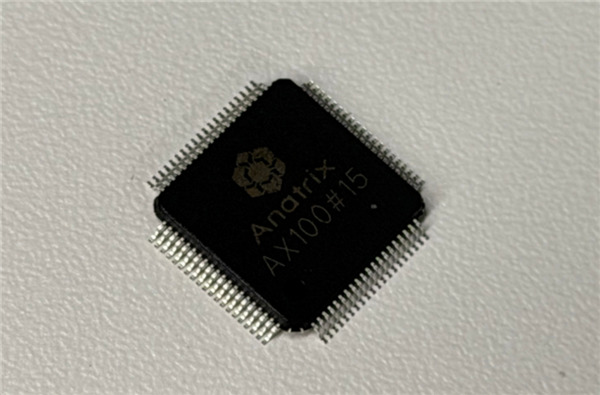
Anazhi Core's self-developed AX100 chip completed tape-out in October. This is the world's first fully integrated analog computing chip capable of solving matrix equations in a single step.
According to tests, the chip's single matrix equation solving time is less than 100 nanoseconds, and the power consumption per calculation is about 80 milliwatts, fully meeting the theoretical simulation and design expectations.
The underlying logic of the AX100 is completely different from GPU-type digital chips. Common tasks such as AI large model training parameter optimization, robot motion control and spatial planning, and communication base station signal processing are essentially all about solving complex matrix equations.
The approach of digital chips is to transform 'solving' into massive multiply-accumulate iterations, with the computational load increasing cubically with the matrix size. For example, solving a 512-order matrix equation requires about 500 million multiply-accumulate operations, taking tens to over a hundred microseconds. Analog computation, on the other hand, directly uses physical laws to achieve parallel computation, with low latency and low power consumption, giving it an inherent advantage in the context of computational bottlenecks.
Currently, the team has tested the chip in three scenarios.
For large model training, the team conducted validation on a 2.93 million parameter Autoencoder model and a 2.72 million parameter Transformer model. In the corresponding experiments, the second-order optimization scheme used reduced the training updates consumption of the two types of models by 92% and 56%, respectively.
In the field of embodied intelligence, this chip can improve the real-time computing ability of robots, accelerate end-to-end algorithms for motion control and planning by 150% to 500%, and speed up the core algorithmic processes of 3D reconstruction and SLAM (Simultaneous Localization and Mapping) by 200% to 500%.
In the field of wireless communications, evaluation results show that for a 128 x 128 channel Gram matrix, compared to existing digital ASIC chips and GPUs, the analog computing chip achieves at least a 20-fold increase and up to a 207-fold increase in equivalent throughput, and at least a 27.6-fold increase and up to a 61.3-fold increase in equivalent energy efficiency.
It is worth noting that the manufacturing of this chip does not rely on advanced processes and the entire chain can be independently controlled using currently mature technology.
