

Although Yangtze Memory Technologies ships more chips, why is its revenue still lower than Micron's? What is the reason?
Recently, an organization released the global NANA flash memory shipment data for Q3 2026, in which Yangtze Memory's share is 17%, ranking third, only behind Samsung and SK Hynix.
By Q2 2026, Yangtze Memory's share was 14%, which means that after one quarter, Yangtze Memory had grown by another 3 percentage points, leading more over Micron, Kioxia, and the others.
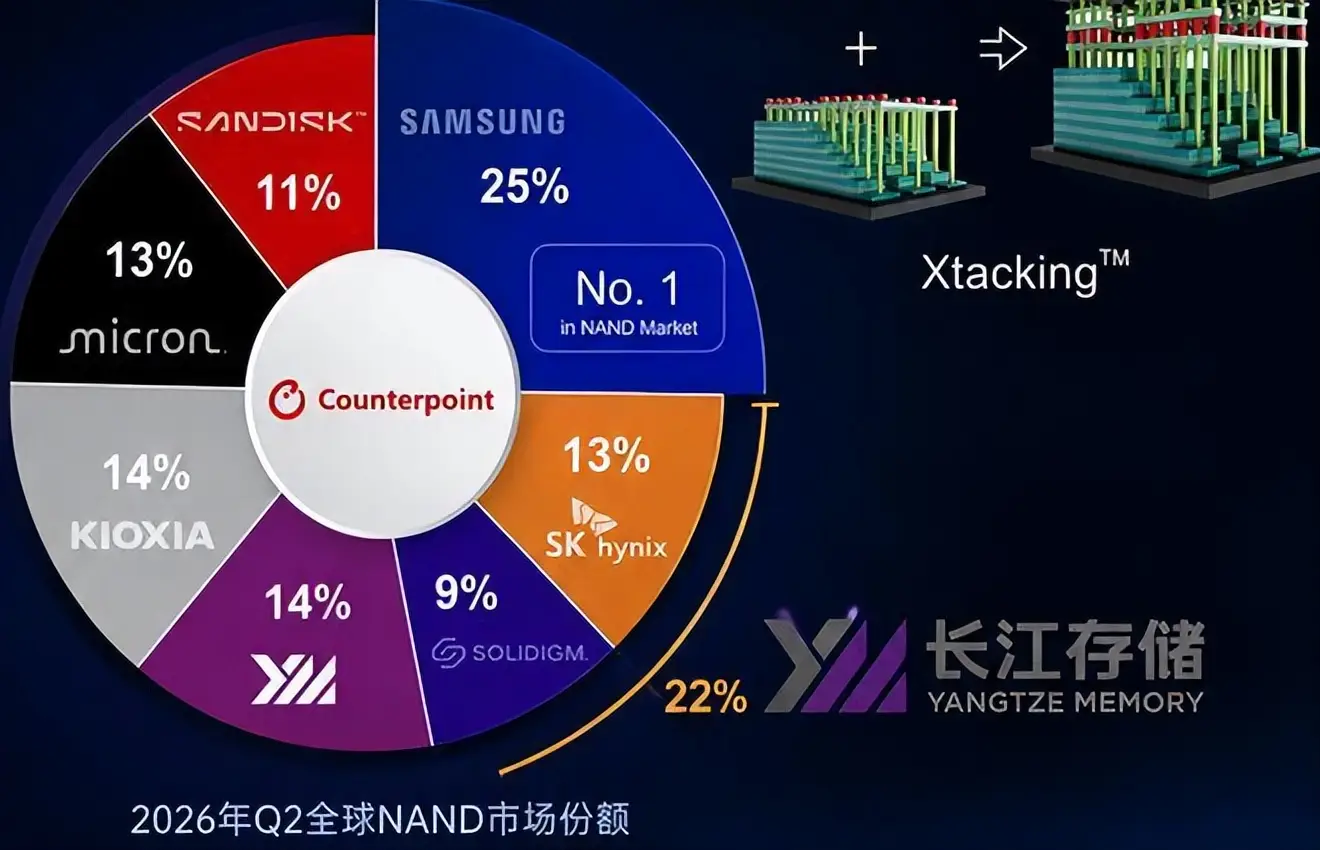
However, people may not know that this share is based on shipment volume, that is, how many bits are shipped, or how many GB of storage chips. If calculated by revenue, Yangtze Memory Technologies would not even be in the top three.
Although the data for the third quarter is unknown, let's think about it: in the second quarter, Yangtze Memory's market share was 14%, ranking third globally. However, its revenue in the second quarter didn't even make it into the top five, falling below Samsung, SK Hynix, Micron, Kioxia, and SanDisk, ranking sixth.
Even if the market share increases to 17% in the third quarter, the revenue will definitely still be less than Micron's.
Why is it like this? Actually, it's not that complicated, because even though both use NAND flash memory, some enterprise-level eSSDs are sold at high prices, while ordinary consumer electronic SSDs are sold cheaply.
Recently, some media outlets calculated, based on the revenue and shipment volumes of Samsung, SK Hynix, Micron, and Yangtze Memory, how much each of these four major manufacturers charges per 1GB of NAND flash memory sold. The data may not be accurate, but it can serve as a reference. I think this is a very meaningful piece of data for reference.
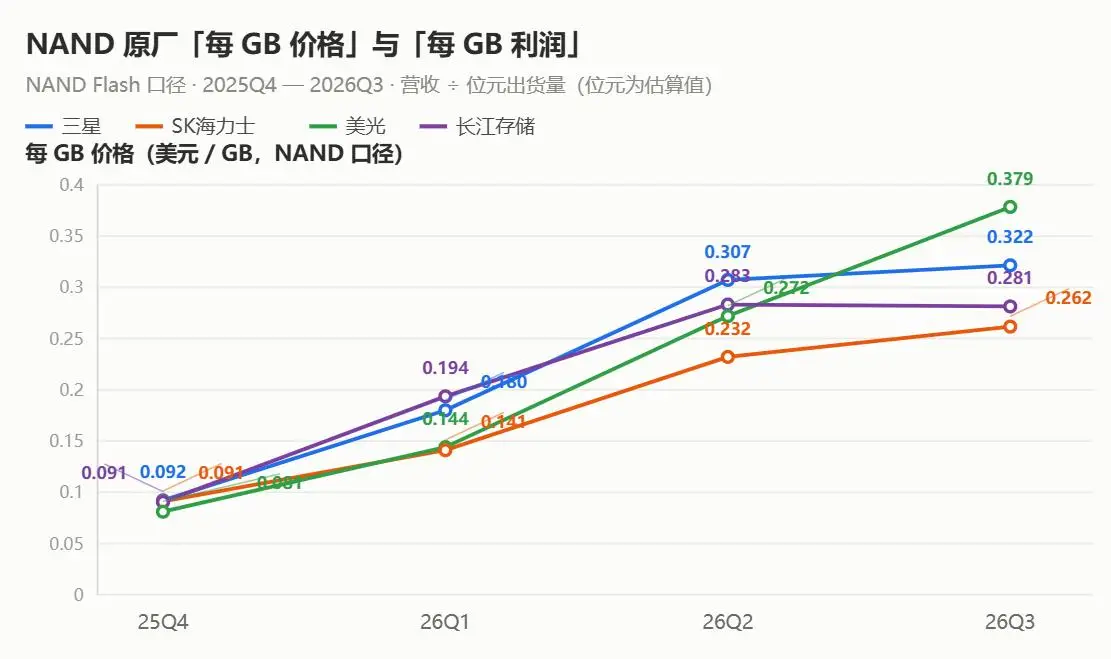
In Q4 of 2025, the four major manufacturers were actually not that far apart, because enterprise-level SSDs were not so popular at that time. But by 2026, with AI continuing to boom, the demand for enterprise-level SSDs exploded, making them increasingly expensive.
Naturally, the more enterprise-level SSDs a company ships, the higher the average price will be. By Q3 2026, everyone will see the difference.
Micron has the highest average price, with each 1GB of NAND flash costing as much as $0.379, which means a 1TB SSD averages $379. Samsung is about $0.322, SK Hynix is $0.281, and Yangtze Memory is $0.262.
Why is Yangtze Memory the lowest? It's because Yangtze Memory relatively has low shipments of enterprise-level products, and more of its products are SSDs used in consumer electronics, which naturally makes the prices much cheaper. So even if the shipment volume is high, the revenue is still not high.
Previous data showed that in 2024, the revenue from enterprise SSDs in long-term storage was almost zero. There was some improvement in 2025, but the proportion was still very low. However, institutions believe that Yangtze Memory is currently focusing on enterprise SSDs, and it is expected that by 2028, the proportion of enterprise SSDs will reach about 38%, an 800% increase.
It can be seen that even if the NAND flash memory is manufactured the same way, the revenue is not the same. To make more money, you need to move toward higher-priced products.
