


In-depth Analysis of the Sensor Industry in the First Three Quarters of 2026: Under Market Divergence, Competition Shifts to Value and Production Capacity
By 2026, with the continued development of smart vehicles, industrial robots, embodied intelligence, data centers, and new consumer terminals, the growth drivers of the sensor industry are gradually shifting from single markets like smartphones and traditional consumer electronics to multi-scenario, multi-category, and multi-technology routes. According to Fortune Business Insights, the global sensor market size is $241.06 billion in 2025 and is expected to reach $258.47 billion by 2026. As the market expands, industry competition is shifting from supplying single devices to chip design, process manufacturing, packaging and testing, and algorithm integration and collaboration, with low power consumption, high precision, miniaturization, and multimodal integration becoming the main upgrade directions.
key segments show differentiated growth. Beyond smartphone demand, CIS is accelerating its upgrade toward high resolution, in-vehicle sensing, and machine vision. Meanwhile, demand for high-performance infrared, inertial sensing, and optical communication-related devices is growing rapidly, while traditional consumer electronics and some general-purpose sensors still face price competition and profit pressure. Industry growth is increasingly relying on increased product value rather than solely shipment expansion.
Chart 1: Q3 2026 financial reports of 10 representative domestic listed sensor companies (incomplete statistics).
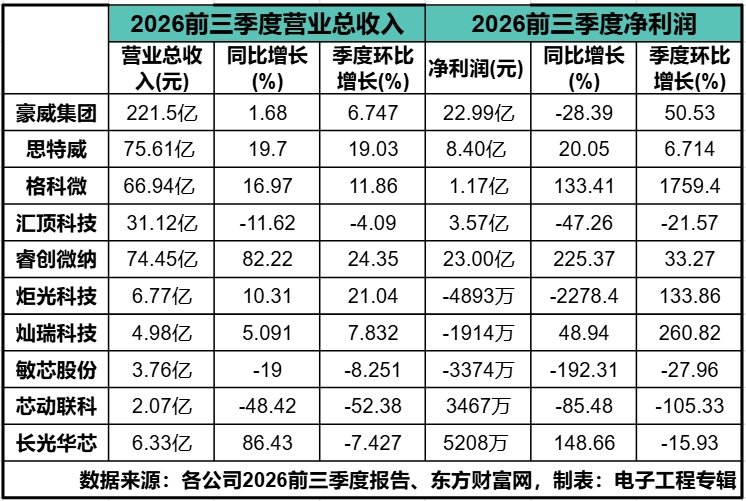
Driven by both policy and market incentives, Chinese domestic sensor companies are gradually establishing advantages in major growth engines such as consumer electronics and automotive electronics, advancing from mid- to low-end to high-precision and high-reliability mid-to-high-end markets. This article provides an in-depth analysis of the Q3 2026 financial reports of 10 representative domestic sensor companies. Data shows that, on one hand, Chinese sensor companies are accelerating their leap toward high-end products and stable mass production, with upgrades to high-performance infrared, some optical communication services, and CIS products already entering a period of performance realization; On the other hand, due to downstream demand fluctuations, new capacity ramp-ups, and strategic R&D investments, some companies are still under short-term pressure.
Overall characteristics: Revenue recovery does not equal profit recovery; profits are concentrated in a few companies
In the first three quarters of 2026, the ten companies will collectively achieve total operating revenue of about 49.351 billion yuan and net profit attributable to shareholders of about 5.897 billion yuan. Among them, seven companies saw year-on-year revenue growth, but only five achieved profit growth or narrowed losses; Minxin Co. and Juguang Technology remain in cumulative losses. OmniVision Group and Ruichuang Micro-Nano together contributed about 4.599 billion yuan in net profit attributable to shareholders, accounting for about 78% of the sample's total profit, indicating that industry profits have not evenly spread along with revenue but continue to concentrate on companies with scale, product barriers, and order advantages.
Looking at Q3 quarter-on-quarter data, six companies saw revenue growth and profit growth, with operational momentum improving compared to the first half. However, companies like Geke Micro and Canrui Technology saw significant profit growth quarter-on-quarter, partly due to a low base in the previous quarter; Juguang Technology and Canrui Technology are transitioning from accumulated losses to single-quarter profits. Therefore, quarter-on-quarter growth can only be used to observe direction, cannot be directly annualized, nor can it replace judgments of non-recurring profit and cash flow.
Another prominent feature of sample companies is that R&D investment remains high. The combined R&D expenses of the ten companies in the first three quarters were about 5.841 billion yuan, roughly equivalent to the net profit attributable to shareholders of 5.897 billion yuan, with an overall R&D expense ratio of about 11.84%. This means that although the sensor industry has cyclical attributes, it is not simply driven by price increases and inventory fluctuations. Companies must continuously invest in pixel processes, MEMS structures, materials, packaging, algorithms, and reliability verification; profit is essentially the result of technology investment being validated by customers, mass production yield, and scale delivery.
CIS main track: scale advantage remains, but growth logic has shifted from shipment volume to product mix
OmniVision Group, SmartWay, and Geke Micro, which focus on CMOS image sensors, together generated about 36.404 billion yuan, accounting for 73.8% of the ten sample companies' revenue; However, the combined net profit attributable to shareholders of the three companies was about 3.256 billion yuan, accounting for 55.2% of the sample's profit. The revenue share is significantly higher than the profit share, indicating that although the CIS market is large, it also faces multiple constraints such as price competition, product mix, and manufacturing costs.
OmniVision Group embodies the characteristics of "stable scale and profit pressure." In the first three quarters, the company's revenue was 22.149 billion yuan, up 1.68% year-on-year, and net profit attributable to shareholders was 2.299 billion yuan, down 28.39% year-on-year. Among them, semiconductor design sales revenue was 16.346 billion yuan, down 9.40% year-on-year, while the expansion of semiconductor agency sales business put pressure on overall gross margin.
Therefore, OmniVision's problem is not revenue stagnation, but pressure on high value-added design business and a decline in profit elasticity caused by an increased proportion of low-margin business. Positive signals appeared in the third quarter: the company's single-quarter revenue was 8.124 billion yuan, up 3.80% year-on-year, and net profit attributable to shareholders was 1.079 billion yuan, up about 50% quarter-on-quarter; Gross margin rebounded to 30.00%, up 1.73 percentage points quarter-on-quarter. This indicates that product structure and profitability are marginally recovering, but cumulative profit still declines significantly. Going forward, it will be necessary to observe whether high-end products such as intelligent driving, professional imaging, and machine vision can continue to improve the quality of design business, rather than just expanding revenue.
Sitwei demonstrated stronger resilience in core business growth. Revenue for the first three quarters was 7.561 billion yuan, up 19.70% year-on-year, and net profit attributable to shareholders was 840 million yuan, up 20.05% year-on-year; Net profit after deducting non-recurring gains and losses was 871 million yuan, up 26.27% year-on-year. In the third quarter, net profit attributable to shareholders grew by only 2.87%, but net profit after deducting non-recurring gains and losses increased by 25.64% year-on-year, indicating that the apparent profit growth slowdown includes non-recurring profit and loss disturbances, and the profitability of the main business has not weakened in tandem. During the same period, the company's R&D investment was 522 million yuan, a year-on-year increase of 23.34%, and operating cash flow shifted from a net outflow of 1.042 billion yuan in the same period last year to a net inflow of 52.8079 million yuan
< Spann Steyr="Makin-Top: Ten Aspert X; Malkin-Botom: Ten Fart X; Ryan Hait: 1.5 Em; ">< Span Steyr="Fontt-Seitz: 18 As; ">
However, SmartWay's operating cash flow was only about 6% of net profit attributable to shareholders for the same period, and inventory and accounts receivable were also relatively large. This does not mean profit distortion, but it indicates that high growth is still tied up by working capital. For companies in the phase of customer expansion and product ramp-up, the key is not just "how much is sold," but also whether the pace of payments, stocking, and supply chain payments can gradually match profit growth.
< Spae Steyr="Makin-Top: Ten Aix; Malkin-Botom: Ten Aix; Ryan Hait: 1.5 Aim;">< Span Steyr="Fonte-Seitz: 18 Aix;">
Geke Micro represents another path: upgrading high-pixel products and increasing operational leverage through its own wafer fabs. In the first three quarters, the company's revenue was 6.694 billion yuan, up 16.97% year-on-year, and net profit attributable to shareholders was 117 million yuan, up 133.41% year-on-year; Of this, the net profit attributable to shareholders in the third quarter was about 110 million yuan, close to the total profit for the first three quarters. The company attributes the improvement to increased shipments of high-pixel chips and a higher proportion of production from its own fabs; Net operating cash flow for the first three quarters reached 2.1 billion yuan, a year-on-year increase of 116.57%.
< Spae Steyr="Makin-Top: Ten Aix; Malkin-Botom: Ten Aix; Ryan Hait: 1.5 Aim;">< Span Steyr="Fonte-Seitz: 18 Aix;">
< Span Tell = "Fantawild-Seitz: 18px;"> But Geke Micro's gross margin for the first three quarters was about 21.54%, net profit margin attributable to shareholders about 1.75%, so the profit safety cushion is still weak. Own-owned capacity can unleash economies of scale when shipments grow, but also brings depreciation, financial costs, and capacity utilization pressures when demand is insufficient. Therefore, Geke Micro's core indicator is not quarterly profit growth in a single quarter, but whether the proportion of high-pixel products, capacity utilization, and free cash flow can improve simultaneously.
< Spae Steil="Makin-Top: Ten Axes; Markin Botom: Ten Aix; Ryan Hait: 1.5 Aim;">< Span Staier="Fantaut-Seiz: 18 Aix;">
High-performance sensor: High gross margin is just the threshold; fulfilling orders determines profit
< Span Steyr="Fantaught-Seitz: 20 fart x;"><
Sp Steyr="Malkin-Top: 10 fart x; Malkin Botom: 10 fart x; Ryan Hait: 1.5 em;">< Span Steyr="Fonte-Siz: 18 fart x; "> Ruichuang Micro-Nano is the most outstanding profit growth company in this round. Revenue for the first three quarters was 7.445 billion yuan, up 82.22% year-on-year, and net profit attributable to shareholders was 2.3 billion yuan, up 225.37% year-on-year; Third quarter revenue was 3.049 billion yuan, up 97.70% year-on-year, and net profit attributable to shareholders was 1.04 billion yuan, up 192.41% year-on-year. Net operating cash flow for the same period was 2.492 billion yuan, up 224.85% year-on-year, and R&D investment was 1.017 billion yuan, up 25.16% year-on-year. < Spae Steyr="Makin-Top: Ten Aix; Malkin-Botom: Ten Aix; Ryan Hait: 1.5 Aim;">< Span Steyr="Fonte-Seitz: 18 Aix;">
Based on the financial report, Ruichuang Micro-Nano's gross margin for the first three quarters was about 59.64%, and net profit margin attributable to shareholders was about 30.89%. Its revenue is only about one-third of OmniVision's, but its profits are nearly equal, reflecting differences in technical barriers, product structure, and customer value among high-performance infrared products. The company attributes the growth to strong industry demand, ample orders on hand, positive new orders, capacity release, and optimization of product and customer structures, indicating that this round of growth has been supported by demand, capacity, and economies of scale, rather than relying solely on non-recurring income.
< Spae Steyr="Makin-Top: Ten Aix; Malkin-Botom: Ten Aix; Ryan Hait: 1.5 Aim;">< Span Steyr="Fonte-Seitz: 18 Aix;">
Chipdong Linke shows another side of high-performance sensor companies. The company's gross margin for the first three quarters was about 76.86%, but revenue was only 207 million yuan, a year-on-year decrease of 48.42%; Net profit attributable to shareholders was 34.6684 million yuan, down 85.48% year-on-year, with a quarterly loss of 1.8086 million yuan in the third quarter.
< Spae Steyr="Makin-Top: Ten Aix; Malkin-Botom: Ten Aix; Ryan Hait: 1.5 Aim;">< Span Steyr="Fonte-Seitz: 18 Aix;">
R&D expenses during the same period were about 104 million yuan, equivalent to 50.43% of revenue. High gross margins cannot offset shrinking revenue scale and rigid expenses, resulting in a larger decline in profits.
< Spae Steyr="Makin-Top: Ten Aix; Malkin-Botom: Ten Aix; Ryan Hait: 1.5 Aim;">< Span Steyr="Fonte-Seitz: 18 Aix;">
previously explained that performance pressure is related to macroeconomic conditions and adjustments in downstream customer demand rhythms, and because revenue is relatively small, fluctuations in large client demand have a significant impact on performance.
< Spae Steyr="Makin-Top: Ten Aix; Malkin-Botom: Ten Aix; Ryan Hait: 1.5 Aim;">< Span Steyr="Fonte-Seitz: 18 Aix;">
means that although high-performance MEMS inertial sensors have high technical value, customer certification cycles are long, and project acceptance and order rhythms are uneven. When evaluating such companies, more attention should be paid to customer numbers, application structure, and ongoing orders, rather than solely inferring profits linearly from a single quarter's high gross margin.
< Spae Steil="Makin-Top: Ten Axes; Markin Botom: Ten Aix; Ryan Hait: 1.5 Aim;">< Span Staier="Fantaut-Seiz: 18 Aix;">
<sPan sty
< Span Steyr="Fantaught-Seitz: 20 fart x;"><
Sp Steyr="Malkin-Top: 10 fart x; Malkin Botom: 10 fart x; Ryan Hait: 1.5 em;">< Span Steyr="Fonte-Siz: 18 fart x; "> Juguang Technology and Changguang Huaxin both benefit from optical communication demand, but are at different stages of realizing profits. < Spae Steyr="Makin-Top: Ten Aix; Malkin-Botom: Ten Aix; Ryan Hait: 1.5 Aim;">< Span Steyr="Fonte-Seitz: 18 Aix;">
Juguang Technology's revenue for the first three quarters was 677 million yuan, a year-on-year increase of 10.31%, with a net loss attributable to shareholders of 48.93 million yuan; However, in the third quarter, net profit attributable to shareholders was about 18 million yuan, and net profit after deducting non-recurring gains and losses was 17.2116 million yuan, turning losses year-on-year. In the first three quarters, gross margin was about 50.05%, up 12.82 percentage points year-on-year, and revenue in the optical communications market grew by 166% year-on-year. Meanwhile, factors such as share-based payments and inventory write-down provisions continue to put pressure on profits, and some periods of gross margin improvement also include the impact of revenue recognition agreements.
< Spae Steyr="Makin-Top: Ten Aix; Malkin-Botom: Ten Aix; Ryan Hait: 1.5 Aim;">< Span Steyr="Fonte-Seitz: 18 Aix;">
Therefore, Juguang Technology can be seen as having formed an operational turning point, but it cannot be confirmed as complete based on a single profitable quarter. Going forward, it will be necessary to verify whether bulk orders for optical communication products can continue, whether yield improvements can cover R&D and share-based payment costs, and whether quarterly profits can be converted into stable cumulative profits.
< Spae Steyr="Makin-Top: Ten Aix; Malkin-Botom: Ten Aix; Ryan Hait: 1.5 Aim;">< Span Steyr="Fonte-Seitz: 18 Aix;">
Changguang Huaxin's revenue for the first three quarters was 633 million yuan, up 86.43% year-on-year, and net profit attributable to shareholders was 52.0758 million yuan, up 148.66% year-on-year, mainly due to rapid growth in the optical communication business previously developed; However, net profit attributable to shareholders after deducting non-recurring gains and losses was only 2.7995 million yuan, with a net operating cash outflow of 32.5815 million yuan.
< Spann Steyr="Makin-Top: Ten Aspert X; Malkin-Botom: Ten Fart X; Ryan Hait: 1.5 Em; ">< Span Steyr="Fontt-Seitz: 18 As; ">
company's profits are also supported by government subsidies, bad debt provision reversals, and the Photon Fund's valuation gains.
< Spae Steyr="Makin-Top: Ten Aix; Malkin-Botom: Ten Aix; Ryan Hait: 1.5 Aim;">< Span Steyr="Fonte-Seitz: 18 Aix;">
Meanwhile, Changguang Huaxin's gross margin for the first three quarters was about 24.88%, lower than the same period last year. The uploaded table also shows that its third-quarter revenue and profit fell by 7.427% and 15.93% quarter-on-quarter, respectively. This indicates that the expansion of optical communication business volume does not necessarily lead to simultaneous profit and cash flow growth. New capacity ramp-ups, product mix, delivery pace, and stocking will all affect short-term performance. What really needs to be tracked is whether non-recurring profit margins and cash collections improve as scale expands.
< Spae Steil="Makin-Top: Ten Axes; Markin Botom: Ten Aix; Ryan Hait: 1.5 Aim;">< Span Staier="Fantaut-Seiz: 18 Aix;">
Consumer Goods and General Sensors: Demand is under pressure, product mix is more important than simple price cuts
< Span Steyr="Fantaught-Seitz: 20 fart x;"><
Sp Steyr="Malkin-Top: 10 fart x; Malkin Botom: 10 fart x; Ryan Hait: 1.5 em;">< Span Steyr="Fonte-Siz: 18 fart x; "> Goodix Technology's revenue for the first three quarters was 3.112 billion yuan, down 11.62% year-on-year, and net profit attributable to shareholders was 357 million yuan, down 47.26% year-on-year; Third quarter revenue was 1.049 billion yuan, down 17.37% year-on-year, and net profit attributable to shareholders was 105 million yuan, down 57.18% year-on-year. < Spae Steyr="Makin-Top: Ten Aix; Malkin-Botom: Ten Aix; Ryan Hait: 1.5 Aim;">< Span Steyr="Fonte-Seitz: 18 Aix;">
company's gross margin is about 39.95%, still significantly higher than most general-purpose chip companies, but R&D expenses reach about 825 million yuan, with an R&D expense ratio of about 26.52%. During periods of declining revenue, high R&D investment can squeeze short-term profits, but it also determines whether the new generation of products can reopen up growth opportunities. Goodix's core issue is not whether to continue R&D, but when the R&D results will be converted into sufficiently large new revenue.
< Spae Steyr="Makin-Top: Ten Aix; Malkin-Botom: Ten Aix; Ryan Hait: 1.5 Aim;">< Span Steyr="Fonte-Seitz: 18 Aix;">
Minxin Co., Ltd.'s revenue for the first three quarters was 376 million yuan, down 19% year-on-year, with a net loss attributable to the parent company of 33.7369 million yuan and a gross margin of about 23.16%. The company's R&D investment was 61.6617 million yuan, a year-on-year increase of 7.37%, but due to revenue decline, the proportion of R&D investment in revenue passively rose to 16.42%.
< Spae Steyr="Makin-Top: Ten Aix; Malkin-Botom: Ten Aix; Ryan Hait: 1.5 Aim;">< Span Steyr="Fonte-Seitz: 18 Aix;">
the company attributed the decline in revenue and profit to rising costs in traditional consumer electronics, market saturation, changes in the international landscape, as well as lower sales and overall gross margin.
< Spae Steyr="Makin-Top: Ten Aix; Malkin-Botom: Ten Aix; Ryan Hait: 1.5 Aim;">< Span Steyr="Fonte-Seitz: 18 Aix;">
This reflects that if GMMS products rely too heavily on mature consumer markets, they are prone to both insufficient demand and price competition, requiring automotive-grade, industrial, or new terminal products to increase product value.
< Spae Steyr="Makin-Top: Ten Aix; Malkin-Botom: Ten Aix; Ryan Hait: 1.5 Aim;">< Span Steyr="Fonte-Seitz: 18 Aix;">
< Spantheyr="Fantawild-Sèitz: 18px;" > Canrui Technology has seen initial repairs. Revenue for the first three quarters was 498 million yuan, up 5.09% year-on-year, with net loss attributable to shareholders of 19.1365 million yuan, narrowing the loss by 48.94% year-on-year; In the third quarter, net profit attributable to shareholders was 4.9227 million yuan, and net profit excluding non-recurring items was 297,100 yuan, both turning losses year-on-year. The company stated that the improvement mainly came from a recovery in end-user demand and a recovery in product prices.
< Spae Steyr="Makin-Top: Ten Aix; Malkin-Botom: Ten Aix; Ryan Hait: 1.5 Aim;">< Span Steyr="Fonte-Seitz: 18 Aix;">
However, the scale of profit excluding non-recurring items in the third quarter remains very small, indicating that price recovery is not yet sufficient to prove the profitability model is stable. Going forward, it remains to be seen whether high-margin sensor new products and automotive-grade products can continue to increase their revenue share.
< Spae Steil="Makin-Top: Ten Axes; Markin Botom: Ten Aix; Ryan Hait: 1.5 Aim;">< Span Staier="Fantaut-Seiz: 18 Aix;">
Industry Outlook: Entering a period of high-end product and operational efficiency validation
< Span Steyr="Fantawild-Seitz: 20 fart X;">
< Steyr="Malkin-Top: 10 fart X; Markin Botom: 10 fart X; Ryan Hait: 1.5 em;">< Span Steyr="Font-Sette: 18 Fart X; "Looking ahead to Q4 2026 and 2027, > the sensor industry still has clear growth sources: AI infrastructure drives demand for optical communications and some optical devices; smart vehicles, robotics, and industrial vision increase the use of image and inertial sensors; miniaturization, low power consumption, and high resolution drive upgrades in infrared and MEMS products. But these trends will not automatically translate into profits for all companies; the industry will mainly differentiate around four main lines. < Spae Steyr="Makin-Top: Ten Aix; Malkin-Botom: Ten Aix; Ryan Hait: 1.5 Aim;">< Span Steyr="Fonte-Seitz: 18 Aix;">
The first is the product structure. High-pixel CIS, smaller pixel infrared products, high-performance inertial devices, and high-speed optical communication chips have higher value and technical barriers than general products, which can improve gross margins; Even if shipments of low-end general products resume, they may only bring growth in low-income quality.
< Spae Steyr="Makin-Top: Ten Aix; Malkin-Botom: Ten Aix; Ryan Hait: 1.5 Aim;">< Span Steyr="Fonte-Seitz: 18 Aix;">
< Span Tel="Fantawild-Seiz: 18px;"> The second is manufacturing and yield. Owned capacity can unleash scale effects at high utilization rates, but amplify depreciation pressure when demand is insufficient. In future financial reports, the importance of capacity utilization, yield, and unit cost will be no less than revenue growth rates.
< Spae Steyr="Makin-Top: Ten Aix; Malkin-Botom: Ten Aix; Ryan Hait: 1.5 Aim;">< Span Steyr="Fonte-Seitz: 18 Aix;">
< Span Tel="Fantawild-Seiz: 18px;"> The third is the customer and application structure. Automotive, industrial, and specialty market certification cycles are long, but order stability is usually stronger; Consumer electronics are expanding rapidly but are more easily affected by price and product cycles. Small businesses with overly concentrated customers, even if technologically advanced, may experience significant quarterly fluctuations.
< Spae Steyr="Makin-Top: Ten Aix; Malkin-Botom: Ten Aix; Ryan Hait: 1.5 Aim;">< Span Steyr="Fonte-Seitz: 18 Aix;">
< Spantheyr="Fantawild-Seitz: 18px;"> The fourth is R&D commercialization efficiency. The industry needs high R&D, but high R&D is not a sufficient condition for profitability. Only when R&D results are certified, bulk orders are formed, and ultimately converted into non-recurring profit and operating cash flow can sustainable competitiveness be constituted.
Overall, the first three quarters of 2026 do not represent a comprehensive boom in the sensor industry, but rather high-end infrared, certain optical communication businesses, and CIS structural upgrades that have taken the lead in realization, while traditional consumer electronics and some general-purpose sensors are still under pressure. Industry competition is shifting from "whether there are domestic products" to "whether a company can enter high-value scenarios, ensure stable mass production, and maintain continuous cash flow." In the future, what truly deserves attention is not the highest single-quarter growth, but those companies that can simultaneously achieve product upgrades, improved profit margins, and enhanced cash flow.
