

Huge gap! The market share of domestic memory chips is still only one-fifth of South Korea's!
With the rise of domestic memory chips like Changxin Technology and Yangtze Memory, everyone is in a frenzy, with all kinds of claims that Samsung and SK Hynix in South Korea are about to be surpassed and their positions are in jeopardy.
Of course, all Chinese people hope that domestic memory chips can surpass Samsung and SK Hynix, since China consumes one-third of the world's memory annually. Once domestic products rise, imports can be greatly reduced, saving a lot of money.
Moreover, with the rise of domestic brands and achieving independent control, they no longer fear the other party's chokehold, outrageous demands, or payment defaults. This means more than spending less.
But here's the question: Are Samsung and SK Hynix in Korea really that easy to overtake? Currently, how far are we from behind Korea's two major manufacturers?
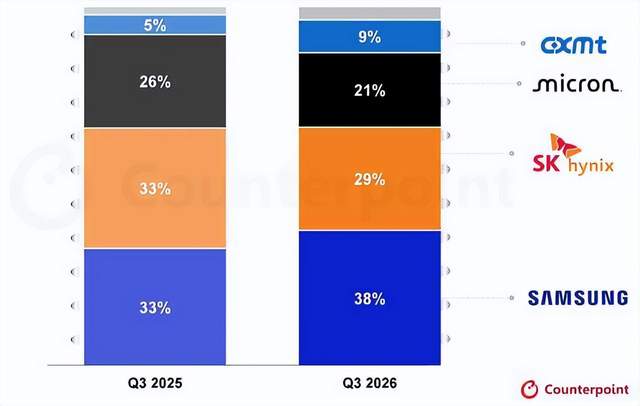
Let's first look at DRAM memory. The chart below shows Counterpoint's Q3 2026 data: Samsung ranks first with a 38% share, SK Hynix is second with a 29% share, totaling 67%.
China Changxin ranks fourth with a 9% share. Calculating this, Samsung + SK Hynix have a market share of 7.44 times that of Changxin. Everyone knows how big the gap is.
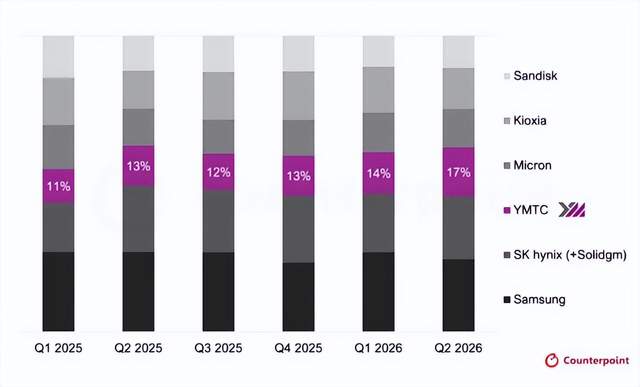
Looking at NAND flash, Counterpoint also released data showing that as of Q3, Yangtze Memory's market share was 17%, but Samsung and SK Hynix did not show that share.
Actually, Samsung holds a 24% share, while SK Hynix has about 20%. Together, these two Korean companies account for 44%, which is about 2.59 times the 17% share of Yangtze Memory.
Currently, global memory chips are mainly DRAM + NAND flash; we will temporarily set aside other marginalized memory chips.
DRAM market size is even larger. In Q2 2026, DRAM will be about $145 billion, while NAND will be about $81 billion, with a roughly 1.79:1 ratio between the two.
Let's use this data as a basis to convert, the total share of Korean memory chips compared to China's total share is approximately 1.79*67% + 1*44%: 1.79*9% + 1*17% = 1.6393 : 0.3311 ≈ 4.95 : 1.
calculating it this way, everyone basically understands that currently, China's total market share for memory chips is about one-fifth of South Korea's, roughly 20%.
So, even if Samsung and SK Hynix in Korea remain put, China still needs to grow fourfold on its current foundation to reach the same scale and size as others. Everyone should understand how big the market gap is, right?
Moreover, South Korea is stronger in advanced HBM, enterprise DRAM, and enterprise NAND fields, while domestic storage is mostly in consumer electronics, so there is a certain technical gap.
So, being a bit optimistic is good, but we shouldn't be blindly optimistic either. At the very least, we need to know how big the gap is before we can work hard to catch up
