

Taiwan, China's revised draft of the Trade Law intends to expand the export control of semiconductors to the mainland
On November 2, 2026, the Economic Committee, the legislature of Taiwan, China, held a public hearing on the draft amendments to some articles of the Trade Law. The topic was directed at expanding export controls on specific integrated circuits, semiconductor wafer key materials, parts and manufacturing equipment in Chinese Mainland.
The current Article 13 of the Trade Law only prohibits the export of 12 types of semiconductor wafer manufacturing equipment, including chemical mechanical polishing machines, to the mainland. This pattern has been in use since 2008. The revised draft proposes to add Article 13-2, which includes specific integrated circuits, semiconductor wafer key materials, components, and manufacturing equipment as a whole in the controlled goods list; At the same time, a new Article 27-3 will be added, raising the maximum penalty for violations from the previous maximum of five years' imprisonment and a fine of up to 3 million New Taiwan Dollars to a maximum of ten years' imprisonment and a fine of 5 million to 10 million New Taiwan Dollars. The act of transporting or reselling related products through a third place to the mainland will face the same punishment and confiscation of criminal proceeds.
In terms of institutional origins, Taiwan signed the Memorandum of Understanding on the Protection of Strategic Goods and Technology Trade with the United States in 1990, and the Trade Act was enacted in 1993; The mainland was included in the controlled territory in 2002. The direct driving force behind this amendment is the Taiwan US Mutual Trade Agreement (ART) signed on February 12, 2026, which promises to strengthen cooperation between Taiwan and the United States in export control regulations and enforcement, take additional regulatory measures to prevent advanced semiconductors, related equipment, and advanced computing products from flowing to mainland China, Russia, Iran, and North Korea, and promote consistency between relevant export control rules and those of the United States.
Gap in export system
At the public hearing, Liu Weilian, Director General of the International Trade Agency of Taiwan's economic affairs department, listed the evasion methods of exporters, including using multi-layer transportation networks in third countries, setting up shell companies in Southeast Asia, Central Asia, and the Middle East to cover up the final destination, falsely reporting AI chips as ordinary consumer grade chips, or dismantling the entire semiconductor equipment into mechanical components and exporting them in batches before restructuring overseas. He also acknowledged that even if high-end chips are subject to physical export restrictions, companies in controlled areas may still obtain computing power through remote leasing of overseas cloud computing services, and controlled technology and data may also flow across borders through digital file transmission and international talent exchange. The current customs inspection system has loopholes.
This loophole has been exposed in a recent series of smuggling cases. On March 19, 2026, the US Department of Justice sued three individuals including Yih Shyan "Wally" Liaw, co-founder of Supermicro, accusing them of reselling approximately $2.5 billion worth of servers equipped with Nvidia GPUs to mainland China through Southeast Asian shell companies between 2024 and 2025. Supermicro itself was not listed as a defendant, and the contractor involved pleaded guilty in Manhattan Federal Court on October 8.
A parallel case in Taiwan landed in August this year: the Keelung District Prosecutors Office prosecuted individuals suspected of exporting Nvidia GPU servers to mainland China, including Nvidia and Supermicro employees.
The key background is that, until the amendment of the law, unauthorized export of AI hardware to mainland China did not directly constitute a crime in Taiwan, and prosecutors could only prosecute for other charges such as breach of trust and forgery of documents - this is precisely the institutional gap that Taiwan's economic affairs authority head Gong Mingxin said.
Gong Mingxin clearly stated in a Bloomberg interview on October 12th that he intends to include AI servers and advanced semiconductors in the export control list, and "the measures we will take on some controlled items in the future will correspond to those of the United States, as we have made considerable commitments in the 'Peer to Peer Trade Agreement'," but refused to specify the implementation schedule.
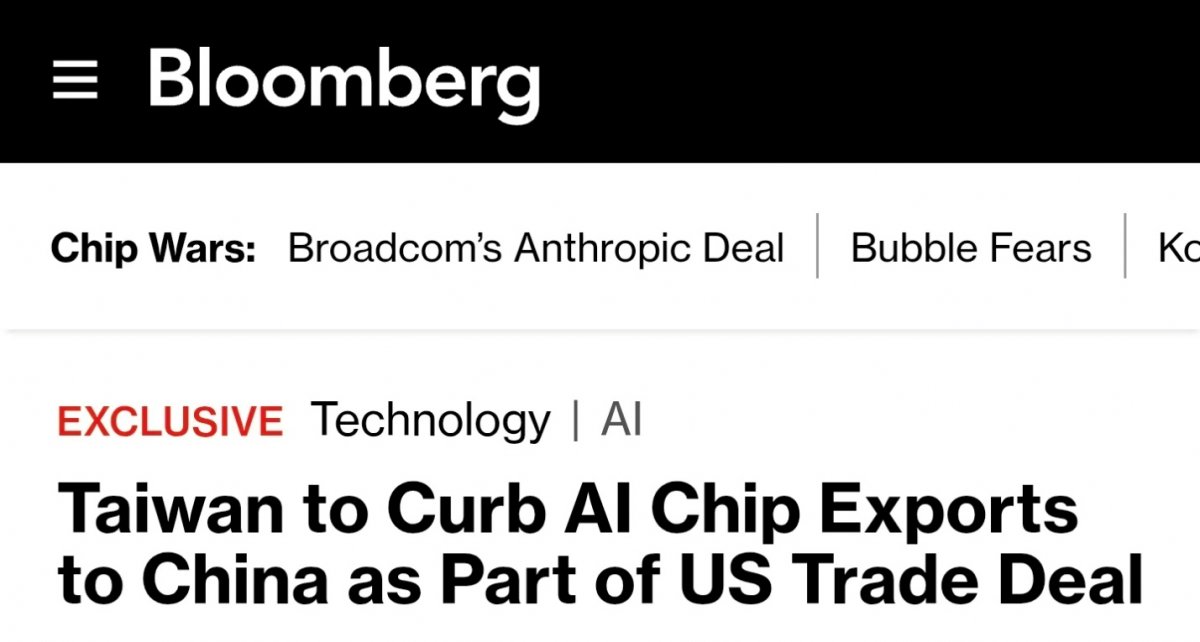
(Bloomberg report title)
The impact on mainland semiconductors
The amendment targets the two hidden lines that the mainland relies most on to obtain advanced computing power: the physical transportation of chips and servers, and Taiwan's node position in wafer foundry, advanced packaging, and server manufacturing. After the implementation of the draft, Taiwanese businessmen who ship any listed chips, materials, components, and equipment to the mainland, and even transit through third countries, will face a risk exposure of ten years of criminal liability and confiscation of income. Taiwanese companies such as TSMC and Sunlight, which have a large inventory of business in mainland China, are bound to face an increase in compliance review and customs declaration costs.
Associate Professor Lu Hsin chang of the Department of International Business at National Taiwan University warned at a public hearing that the supply chain involves multiple resells, and manufacturers may not be able to control the final flow. If the law does not clarify responsibilities at every stage, normal operating enterprises will face unforeseeable legal risks.
The US rules are also simultaneously plugging the leak: the "50% rule" covering overseas subsidiaries of Chinese companies will come back into effect on November 10, 2026, and the path for purchasing Blackwell chips through subsidiaries in Malaysia and Singapore will be blocked. In the short term, the cost of computing power for top model manufacturers in mainland China has increased, and the delivery cycle has been extended. The compliance risk of obtaining advanced computing power through third countries has sharply risen.
The reverse effect of sanctions is the restructuring of supply structure: Morgan Stanley data shows that China's self-sufficiency rate in AI chips has increased from about 20% in 2023 to over 40% in 2026, and may reach about 85% in 2030. Bernstein predicts that Nvidia's AI chip market share in China will shrink to about 8% by 2026, with Huawei Ascend taking on the main replacement demand. Bloomberg reported that the Ascend 910C is scheduled for mass production in May 2025 and is expected to increase production to approximately 600000 units by 2026.
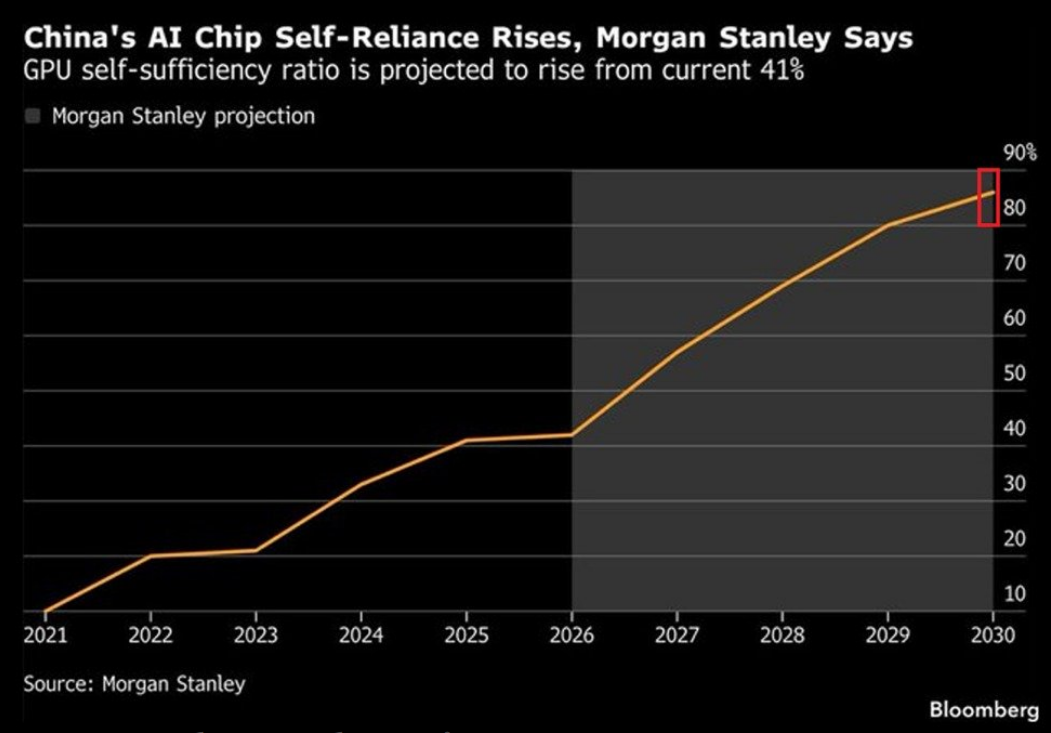
(Prediction of self-sufficiency rate of AI chips in China)
The policy direction in Beijing is also undergoing rapid calibration. In September 2025, the Cyberspace Administration of China requested large technology companies to stop purchasing Nvidia chips. However, after the US approved the export of H200 to China in December 2025, the plot reversed: in January 2026, Beijing instead requested some technology companies to suspend the purchase of H200 in order to prevent stockpiling before policy adjustments were made. Subsequently, Chinese customs informed Nvidia that H200 was prohibited from entering the country, forcing Nvidia suppliers to suspend the production of key components.
Lu Hsin chang warns that Taiwanese companies have taken on regulatory requirements from multiple jurisdictions, and stricter controls will increase operating costs and impact Taiwan's financial, logistics, and overall industrial competitiveness. For the mainland, the short-term advanced computing power channel is indeed narrowing, but each round of increased regulation since 2022 corresponds to a leap in the share of domestic computing power. The cycle of regulation and countermeasures is cutting the global semiconductor supply chain into two systems.
