


After the wave of price increases, which local MCU companies benefited in the third quarter?
In the second half of 2026, the "AI super cycle" of the global semiconductor industry is still accelerating. According to data released by the Semiconductor Industry Association (SIA) in the United States, global semiconductor sales reached $159.7 billion in August 2026, a month on month increase of 8% and a significant year-on-year increase of 144.3%; The cumulative sales in the first eight months of this year have exceeded $1 trillion, marking the first time in history that this milestone has been achieved within the first three quarters. So far, the global semiconductor market has been growing year-on-year for 18 consecutive months, and SIA expects its annual sales to exceed $1.6 trillion in 2026.
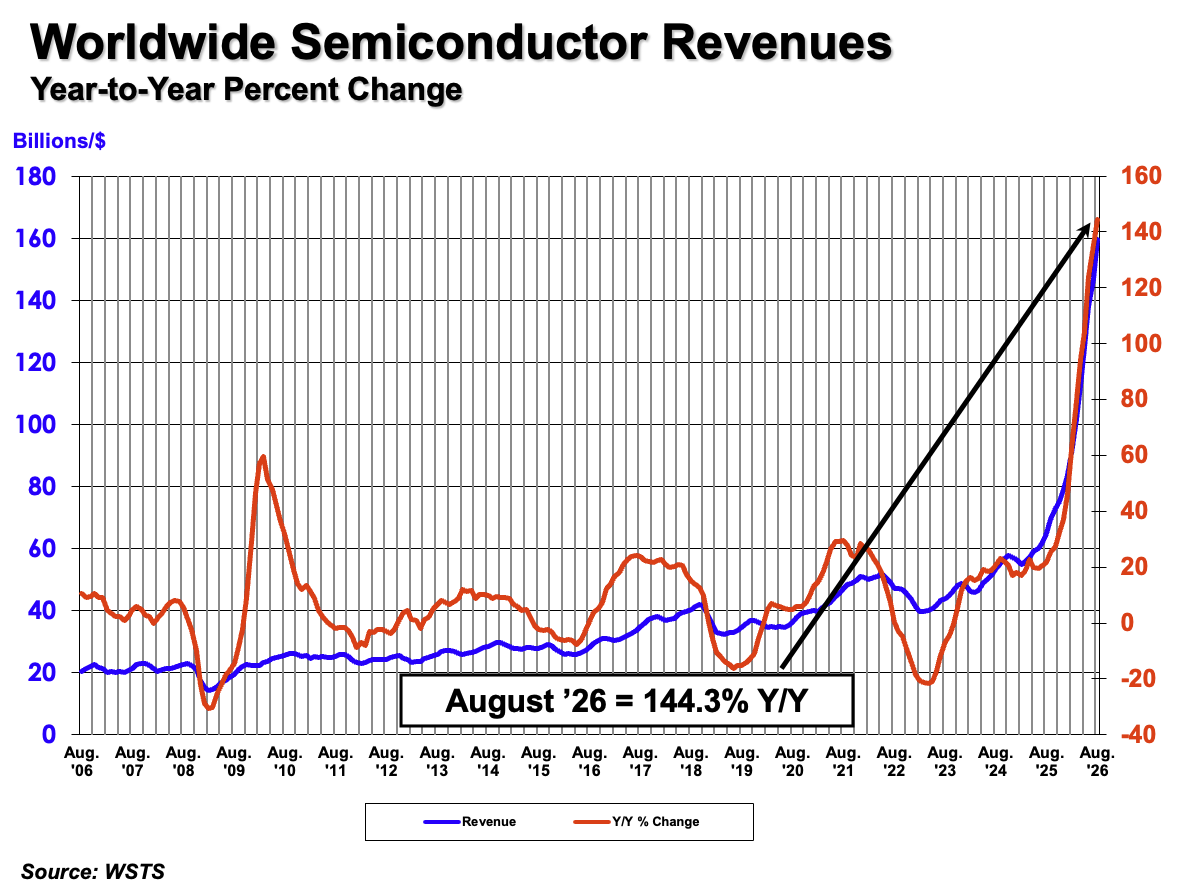
The growth structure is still highly concentrated in AI related categories: prices of various types of memory have generally increased by 5-10 times, HBM and enterprise grade DRAM are devouring production capacity, and the supply of consumer and industrial grade chips continues to tighten. In this feast, the MCU, sandwiched between high-performance computing chips and mature processes, faces a much more delicate situation.
After the wave of price increases: the "L-shaped recovery" and structural opportunities of MCU
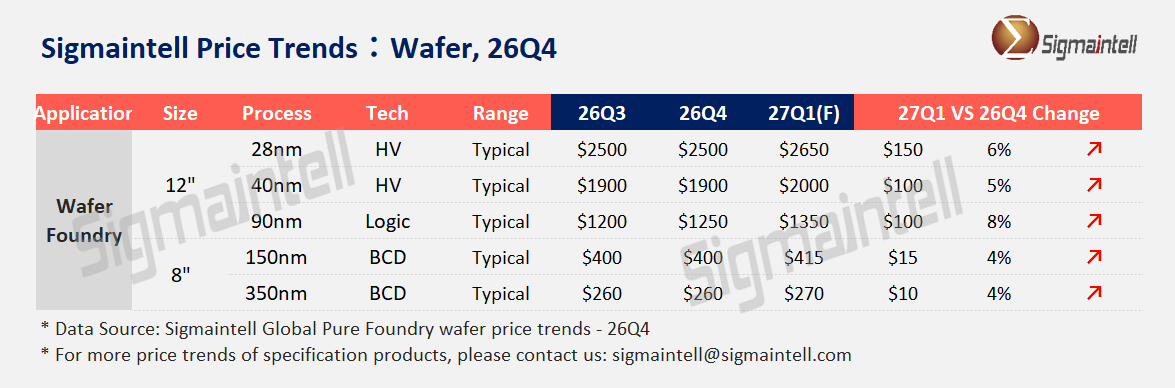
The MCU price increase wave initiated by domestic manufacturers such as Zhongwei Semiconductor, Fengqiao Technology, Puran Co., Ltd., and National Technology in the first half of this year did not subside in the second half of the year, but evolved into a relay for international giants - STMicroelectronics issued another price increase notice in August, which is its third price adjustment in 2026. The root cause of the price increase lies in the supply side: TrendForce Consulting pointed out that TSMC and Samsung will continue to reduce their 8-inch production capacity from 2025, and it is expected that the total global 8-inch wafer production capacity will decrease by 2.4% year-on-year in 2026. 8-inch wafers are the main production lines for PMIC, power devices, and automotive MCU; In the second half of the year, foundries such as UMC, TSMC, SMIC, and Huahong have successively raised their prices for mature processes.
But the transmission of cost to MCU is not smooth. According to Sigmientell's analysis, the main process of MCU, 28/40nm, is expected to remain stable in overall pricing in 2026. Contract manufacturers are generally adopting a strategy of "taking care of price sensitive customers", and the pressure of cost increases is expected to gradually release until 2027; 55/90nm will continue to increase in price from the fourth quarter onwards. Morgan Stanley's May report straightforwardly stated that MCU is still in the process of "L-shaped recovery" - downstream consumption is weak coupled with upstream crystal round price increases, and the industry has not yet seen a clear turning point. However, companies that have completed the transformation to car standardization, high-end, and AI still maintain growth in performance, while those that mainly focus on low gross profit consumer products are struggling to increase revenue without increasing profits or even sustained losses.
This judgment was validated in the first three quarters financial reports of domestic MCUs. From the perspective of shipment volume and business view, the MCU business of top manufacturers is generally increasing in volume: Zhaoyi Innovation claims that multiple product lines such as MCU have achieved good growth in shipment scale; Under the "Storage+" strategy of PuRan Corporation, new products such as MCU and Driver have rapidly increased in volume in the fields of industrial control and AIoT, and have entered the supply chains of multiple top brands; LeXin Technology's revenue in the first three quarters increased by 23.94% year-on-year, and the penetration rate of various industries in the Internet of Things is still increasing. The real incremental variables come from AI data centers - the explosive demand for MCU in AI server power management, 800G/1.6T optical module control, and cooling systems, which directly benefits card holders such as Zhaoyi Innovation, National Technology, and Fengqiao Technology. Industry institutions estimate that the shipment volume of 1.6T optical modules will jump from one million to over 20 million by 2026, and the usage of supporting MCUs will increase dramatically.
In other words, the local MCU industry landscape in 2026 is characterized by a moderate recovery in total volume and severe structural differentiation - manufacturers with product portfolios tilted towards automotive, industrial, and AI data center support have benefited, while manufacturers trapped in the consumer general market are still digesting the pressure of rising costs.
In this context, "Electronic Engineering Album" analyzed the financial reports of 21 A-share listed semiconductor companies with MCU business for the first three quarters of 2026, combined with the third quarter reports of each company and official updates, presenting the real picture of the local MCU industry. Due to the fact that most companies do not have a single MCU product, this list does not rank and does not include non listed companies.
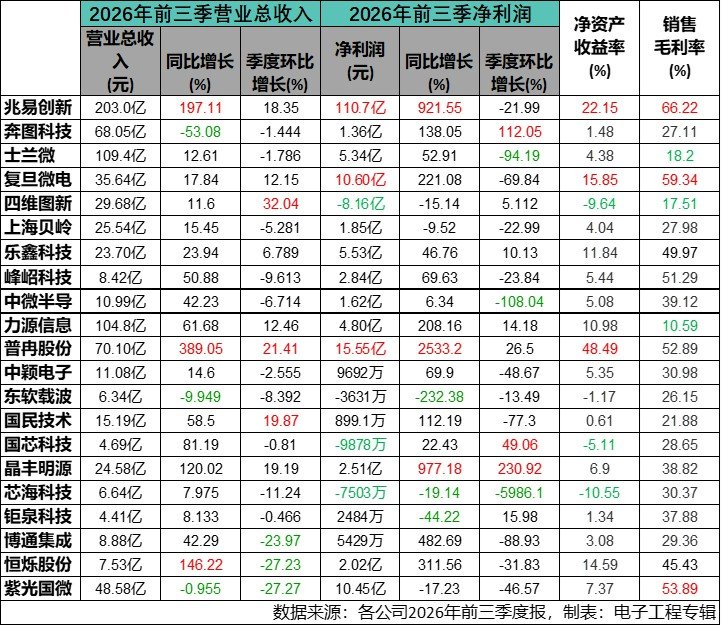
Data source: Q3 2026 reports of various companies, Table: Electronic Engineering Album
In the data, the return on equity (ROE) reflects the return on investment of a company's owner's equity and has strong comprehensiveness; The gross profit margin reflects the company's cost control and product pricing ability, and can be compared with companies in the same industry to evaluate the relative strength of profitability.
Profit and loss ranking
The return on equity of semiconductor companies is usually between 2% and 10%, and reaching 15% is already an excellent company. Based on the data from the first three quarters, MCU related companies' ROE continued to improve significantly, with only 4 out of 21 companies showing negative values. The top three companies with the highest returns are PuRan Shares (48.49%), Zhaoyi Innovation (22.15%), and Fudan Microelectronics (15.85%) - PuRan's ROE of nearly 50% is rare in the entire semiconductor sector, as evidenced by the dual dividends of storage price increases and SHM consolidation; The three lowest ranked companies are Xinhai Technology (-10.55%), NavInfo (-9.64%), and Guoxin Technology (-5.11%).
The three companies with the highest gross profit margins in sales are Zhaoyi Innovation (66.22%), Fudan Microelectronics (59.34%), and Ziguang Guowei (53.89%). Zhaoyi Innovation's gross profit margin has further increased from 63.13% in the first half of the year, and the upward trend in storage chip prices is still being realized. The three companies with the lowest gross profit margin are Liyuan Information (10.59%, due to their distribution business attributes), NavInfo (17.51%, with a significant year-on-year decline in gross profit margin), and Silanwei (18.2%).
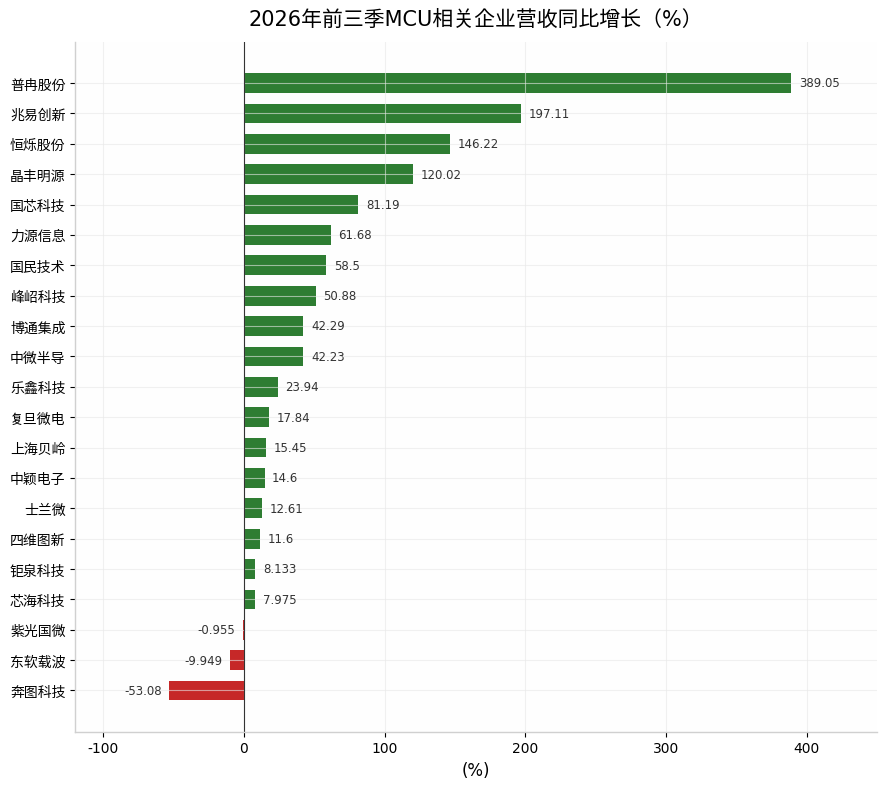
From the perspective of year-on-year revenue growth, 3 out of 21 companies experienced negative growth: Bentu Technology (-53.08%, mainly due to the change in the caliber of Lexmark no longer being consolidated), Neusoft Carrier (-9.949%), and Ziguang Guowei (-0.955%) - Ziguang Guowei was the newly added negative growth company in this quarter. The three companies with the highest year-on-year growth are Puran Shares (389.05%), Zhaoyi Innovation (197.11%), and Hengshuo Shares (146.22%), and "including reserves" remains the absolute main line of growth.
On a quarter on quarter basis (Q3 2026Q2 compared to Q2 2026Q2), the industry's momentum has significantly cooled down: 13 out of 21 companies experienced negative quarter on quarter growth, while only 8 maintained growth. Four dimensional TuXin (32.04%), PuRan Shares (21.41%), and National Technology (19.87%) have the highest month on month growth rates; In the first half of the year, Hengshuo Shares (-27.23%), Ziguang Guowei (-27.27%), and Broadcom Integrated (-23.97%), which led the rise, experienced the largest decline. The base that was boosted by price increases and centralized replenishment in the second quarter began to rebound in the third quarter.
Looking at net profit again: 4 out of 21 companies suffered losses, which remained the same as the first half of the year. The top three companies in terms of profit are Zhaoyi Innovation (11.07 billion yuan), Puran Shares (1.555 billion yuan), and Fudan Microelectronics (1.06 billion yuan), with Ziguang Guowei (1.045 billion yuan) ranking fourth by a tiny margin; The top three companies with losses are NavInfo (-816 million yuan), Guoxin Technology (-98.78 million yuan), and Xinhai Technology (-75.03 million yuan).
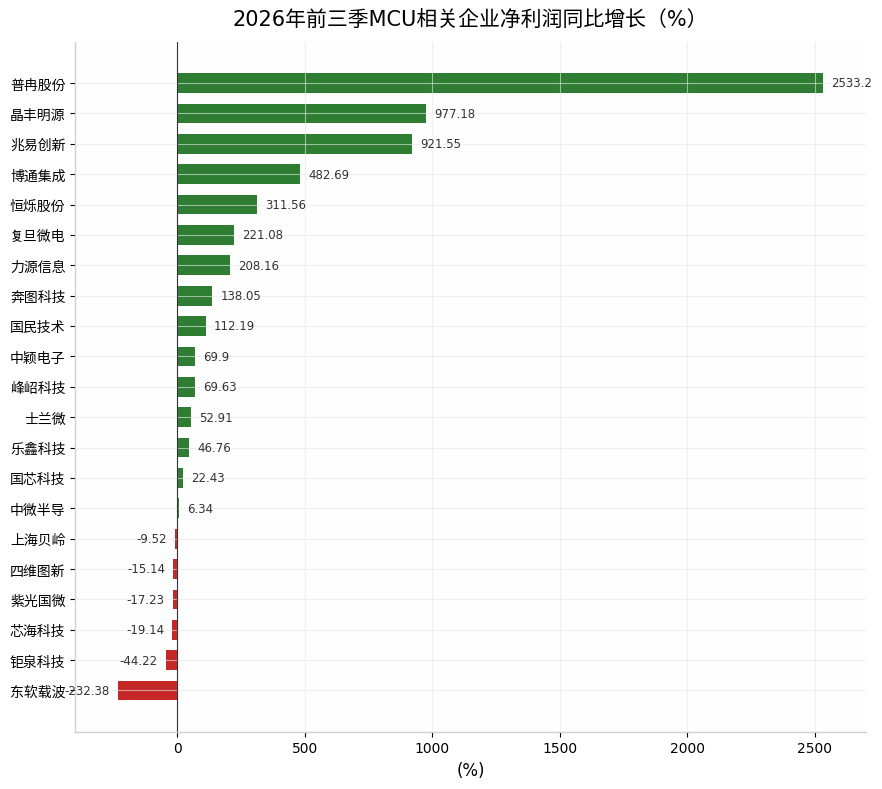
In terms of year-on-year net profit growth, 6 companies experienced negative growth, an increase from 4 companies in the first half of the year. The top three companies in terms of growth are Puran Shares (2533.2%), Jingfeng Mingyuan (977.18%), and Zhaoyi Innovation (921.55%); The top three declining companies are Neusoft Carrier (-23.38%), Juquan Technology (-44.22%), and Xinhai Technology (-19.14%).
On a quarter on quarter basis, 13 companies also experienced a decline in net profit, confirming the marginal decline in industry profitability in the third quarter. The top three growth drivers are Jingfeng Mingyuan (230.92%), Bentu Technology (112.05%), and Guoxin Technology (49.06%); The top three companies experiencing a decline are Xinhai Technology (-5986.1%, with a slight profit turning positive in Q2 and a further loss of 36.67 million yuan in Q3), Zhongwei Semiconductor (-108.04%, with a quarterly loss of 9.6752 million yuan in Q3), and Silanwei (-94.19%, with a net profit decline in Q3 mainly due to a decrease in the fair value of its holdings of Anlu Technology and Yuneng Technology stocks, and a year-on-year increase in Q3 net profit after deducting non profits of 303.62%).
Reasons for decline/loss
Ziguang Guowei: Special IC high base+intelligent security chip supply chain disruption, Q3 net profit halved
Ziguang Guowei was the company with the largest changes in the first three quarters list: its revenue and net profit maintained double-digit growth in the first half of the year, but it turned into revenue of 4.858 billion yuan (-0.955%) and net profit of 1.045 billion yuan (-17.23%) in the first three quarters, with a single quarter revenue of 1.414 billion yuan in the third quarter, a year-on-year decline of 23.85%, and a net profit attributable to the parent company of 248 million yuan, a year-on-year cut of 56.63%. The stock price hit the limit down the day after the financial report was disclosed.
The company explained in its third quarter report that the decline in performance was due to a decrease in sales volume of integrated circuit business compared to the same period last year, resulting in a decrease in operating revenue, and a change in product structure leading to a decrease in gross profit margin. On the investor relations platform, the company further dismantled the two major factors of Q3: first, the base effect of the special integrated circuit business - in the third quarter of 2025, revenue was centrally recognized due to the delay in previous deliveries, and this year's Q3 only returned to a normalized level; The second issue is that some of the intelligent security chip business has been disrupted by occasional supply chain problems, which have temporarily dragged down shipments. The company claims that shipments are recovering and delayed orders are expected to gradually make up for them. In addition, the company's provision for credit impairment in the first three quarters was approximately 99 million yuan (due to concentrated year-end payments from special business customers), and the slight decline in gross profit margin was due to the structural adjustment of intelligent security chip products and the lagging transmission of upstream manufacturing costs. It is worth noting that the company is advancing the acquisition of 100% equity of power semiconductor enterprise Rui Neng Semiconductor, and is laying out in commercial aerospace (with revenue exceeding 100 million in the first three quarters), automotive grade chips, and end side AI chips (with first generation products already sampled), with clear transformation intentions.
Xinhai Technology: Losses Expand, Scissor Gap between Cost and Selling Price Remains
In the first three quarters, Xinhai Technology's revenue was 664 million yuan (+7.975%), with a net profit attributable to the parent company of -75.03 million yuan, and the loss increased by 19.14% year-on-year; In the third quarter, the revenue was 229 million yuan, a year-on-year decrease of 5.13%, and the single quarter loss was 36.6661 million yuan, which worsened again compared to the situation of turning losses in Q2 of the first half of the year, with a month on quarter decrease of up to 5986.1%.
The company is still facing the structural difficulties disclosed in the semi annual report: upstream supply chain manufacturing costs have risen, downstream market competition has led to delayed product price adjustments, and new product ramp ups have not yet formed economies of scale. Under the scissors gap between the price increase of wafer foundry and the weak price increase of consumer MCU, these manufacturers, which mainly focus on analog+MCU and downstream consumption, have become the most pressure bearing link in the cost transmission chain. The company's R&D investment remained at a high level in the first three quarters (R&D accounted for 29.22% of revenue in Q3), and the high-end transformation of end side AI and automotive regulations is still in the investment period.
Neusoft Carrier: Extended transition period for grid standard switching, continuous losses
Neusoft Carrier's revenue for the first three quarters was 634 million yuan (-9.949%), with a net profit attributable to the parent company of -36.31 million yuan (-23.38%), making it the company with the largest year-on-year decline in net profit. The company's third quarter report stated that the distribution network field is still in a transitional period of bidding structure adjustment and product standard switching in the short term, and the supply rhythm of terminal and communication unit products has not yet recovered, resulting in a year-on-year decline in revenue and gross profit - this suppression factor has continued for more than a year since the implementation of the "State Grid Intelligent Integration Terminal New Standard" in the third quarter report of 2025. The good news is that the company has disclosed that it has won multiple bids for intelligent fusion terminals, specialized transformer terminals, and energy meters in the 2026 State Grid metering equipment bidding, and there is a time gap between order reserve and revenue recognition; The integrated circuit sector has seen a year-on-year rebound in gross profit margin by tilting resources towards areas such as white goods and lithium battery management. Part of the buildings in the first phase of the company's Greater Bay Area Intelligent Power Equipment Innovation Valley have topped out in the third quarter, continuing to bet on the Southern Power Grid market.
Juquan Technology: Decreased financial income+provision for inventory depreciation, Q3 single quarter has rebounded
Juquan Technology had a revenue of 441 million yuan (+8.133%) and a net profit of 24.84 million yuan (-44.22%) in the first three quarters. According to the third quarter report, the decline in profits was mainly due to a decrease in financial income and an increase in asset impairment losses caused by the provision for inventory depreciation, offsetting the increase in gross profit brought about by sales growth - consistent with the fundamental trend of "increase in meter chip quantity and decrease in price" in the first half of the year. The positive signal is that the company's third quarter revenue was 163 million yuan, a year-on-year increase of 19.71%, and net profit was 11.2452 million yuan, a year-on-year increase of 59.48%. The demand for electricity meter standard iteration and stock replacement has begun to be realized on the reporting end.
Four dimensional chart update: joint venture losses+pre stocking, but Q3 losses narrowed
In the first three quarters, NavInfo's revenue was 2.968 billion yuan (+11.6%), with a net loss attributable to the parent company of 816 million yuan. The loss expanded by 15.14% year-on-year and remains the largest loss among the 21 companies. The third quarter report revealed two major drag factors: first, the expansion of investment losses in joint ventures, with a loss of 245 million yuan in the first three quarters, a significant increase from 143 million yuan in the same period last year; Secondly, supply chain costs and pre stocking - in order to cope with the tight supply chain, Zhixin Business (Jiefa Technology Automotive MCU) locked in wafer and packaging production capacity in advance, and pre stocking multiple projects for mass production in the intelligent driving business. The inventory increased by 262 million yuan compared to the beginning of the year, and the net operating cash flow was -358 million yuan. It is worth noting that the company's revenue in the third quarter was 1.201 billion yuan, a year-on-year increase of 33.62%, and the quarterly loss narrowed by 17.86% year-on-year. The improvement trend in revenue is still continuing.
In addition, Shilanwei's net profit for the first three quarters was 534 million yuan (+52.91%), but it dropped sharply by 94.19% month on month in Q3, mainly due to fluctuations in the fair value of its holdings of Anlu Technology and Yuneng Technology stocks. After deducting non essential assets, its net profit for Q3 increased by 303.62% year-on-year, and its main business did not deteriorate. However, the company also admitted that the lower than expected demand in the downstream white goods market led to a slowdown in IPM module revenue growth, and the rise in commodity prices posed continuous challenges to cost management.
Reasons for increase/profit
Zhaoyi Innovation: Storage dividend continues, but Q3 month on month decline has occurred
Zhaoyi Innovation's revenue for the first three quarters was 20.297 billion yuan (+197.11%), with a net profit attributable to the parent company of 11.066 billion yuan (+921.55%) and a net cash flow from operating activities of 10.124 billion yuan (+463.81%). The company announced that the significant growth in performance is mainly due to the tight supply in the storage chip industry, the simultaneous increase in product quantity and price, and the good growth in the shipment scale of multiple product lines such as MCU.
But hidden concerns have emerged: the third quarter revenue was 8.732 billion yuan (+225.65%), and the net profit attributable to the parent company was 4.209 billion yuan (+728.93%), a decrease of about 22% compared to the second quarter. This is consistent with the industry rhythm of slowing down the rise in spot storage prices and entering the platform period of downstream centralized replenishment. Zhaoyi's report is still the ceiling for local "MCU+storage" platform companies, but the shift in momentum compared to the previous period is worth tracking.
Puran Corporation: SHM contributes 60% of revenue, while "Storage+" MCU continues to grow in volume
In the first three quarters, PuRan Group's revenue was 7.01 billion yuan (+389.05%), net profit was 1.555 billion yuan (+2533.23%), and ROE was as high as 48.49%. According to the third quarter report, the consolidated subsidiary SHM contributed approximately 4.385 billion yuan in revenue in the first three quarters, accounting for 62.55%; In the third quarter, the revenue was 3.05 billion yuan (+479.25%) and the net profit was 728 million yuan (+3875.57%), indicating an increase in the shipment volume and selling price of major storage chip products and 'storage+' chip products (mainly MCU products and new products such as drivers) compared to the same period last year.
What deserves more attention from the MCU industry is its structural upgrade: high-capacity NOR Flash accelerates the penetration of intelligent audio, servers, and new energy intelligent driving scenarios; Batch shipment and import of DDR5 memory modules and SPD/TS chips matched with EEPROM to key major customers, entering the server core hardware supply chain; High performance MCUs are deeply integrated into high reliability scenarios such as home appliance control, variable frequency motors, and industrial servo control. The company is upgrading from a storage chip design supplier to an "integrated storage solution and software hardware collaboration platform", with a year-on-year increase of 60.92% in research and development investment in the first three quarters.
Jingfeng Mingyuan: Main business high growth+easy to offset consolidation, with the second highest net profit elasticity in the industry
Jingfeng Mingyuan had a revenue of 2.458 billion yuan (+120.02%) and a net profit of 251 million yuan (+977.18%) in the first three quarters, with a month on month increase of 230.92% in Q3 net profit, making it the company with the most significant improvement in ring ratio on the list. According to the third quarter report, after excluding the impact of the acquisition of Sichuan Yichong, the company's original business revenue was 1.743 billion yuan, a year-on-year increase of 55.99%, and net profit was 237 million yuan, a year-on-year increase of 916.81% - high growth in the main business is the main factor in profit elasticity; Starting from March, Yichong consolidated its financial statements and contributed revenue of 715 million yuan. The company's path of upgrading from LED lighting driver chips to high-performance computing power chips (entering the AMD platform supply chain), motor control, and other directions is highly in line with the current wave of demand for AI computing power and server power.
Hengshuo Shares: Storage volume and price both rise, turning losses into profits in the first three quarters
Hengshuo Group's revenue for the first three quarters was 753 million yuan (+146.22%), with a net profit of 202 million yuan, turning losses into profits year-on-year. The company's third quarter report stated that the storage chip industry is in a new phase of rising prosperity, with both the quantity and price of the company's storage chip products increasing, revenue expanding, and gross profit margin significantly improving. However, Q3 single quarter revenue fell by 27.23% month on month and net profit fell by 31.83% month on month, synchronized with the overall slowing pace of inventory replenishment in the industry; The mass production conversion of its high-capacity NAND, eMMC, DDR4 product lines, as well as the layout of MCUs in motor control and ultra-low power IoT tracks, will be the focus of further observation.
Broadcom Integration: Wi Fi Wireless Connection Upgrade+End Side AI Scene Implementation, Deducting Non Profit and Turning Losses
Broadcom Integrated's revenue for the first three quarters was 888 million yuan (+42.29%), with a net profit of 54.29 million yuan (+482.69%) and a non recurring net profit of 17.028 million yuan, achieving a turnaround from losses to profits. The company stated in its third quarter report that during the reporting period, it focused on promoting product upgrades, customer introductions, and market expansion around the main channel of wireless connectivity, with a particular emphasis on upgrading wireless connectivity chip products represented by Wi Fi and expanding the ecosystem. It also promoted the implementation of solutions around scenarios such as end-to-end AI, smart homes, smart hardware, and industrial applications, resulting in significant improvements in business performance. In the trend of increasingly blurred boundaries between MCU and wireless SoC, the revival of Broadcom integration is another footnote to the "connectivity+end-to-end intelligence" route.
Conclusion
In the first three quarters of 2026, the global semiconductor market historically surpassed $1 trillion in the first eight months, and the frenzy of AI and storage has not stopped. But for the MCU category, the third quarter financial report revealed an important turning point: the peak of price increases and inventory replenishment in the second quarter has passed, and the industry has entered a high-level differentiation stage -13 out of 21 companies have seen a month on month decline in revenue and 13 have seen a month on month decline in net profit. Even the biggest beneficiaries, such as Zhaoyi Innovation, saw a month on month decline in net profit of about 22% in Q3.
From the performance of enterprises, we can extract the triple impact of the current industry situation on MCU enterprises:
Firstly, the combination of storage and AI remains the biggest source of profit, but there is a marginal shift in momentum. The profit elasticity of Zhaoyi, Puran, and Hengshuo still comes from storage. Puran's "Storage+" (MCU, Driver), Zhaoyi's optical module MCU, and National Technology's AI server power MCU represent the MCU manufacturers' initiative to provide card slots to AI data centers. This route will be validated as effective in 2026, but its ceiling depends on the sustainability of storage and computing cycles.
Secondly, the migration of products towards high-end standards such as automotive and industrial specifications has become a survival proposition. Morgan Stanley's "L-shaped recovery" is fully reflected in the financial report: companies such as Xinhai Technology and Neusoft Carrier, which are struggling in the consumer general market, are still losing money, while those that have completed the transformation to automotive standardization and high-end have maintained growth resilience. Ziguang Guowei's entry into military vehicle grade chips and end side AI, as well as the early locking of wafer production capacity in the new intelligent chip business of NavInfo, and Lexin's shift from "connection driven" to "function driven" and achieving a gross profit margin of 49.97%, are all different aspects of the same logic.
Thirdly, the transmission of supply chain costs is the biggest deterministic risk in 2027. Qunzhi Consulting has clearly indicated that the price stability of MCU main processes such as 28/40nm in 2026 is only a temporary measure for foundries to "take care of price sensitive customers", and the pressure of cost increases will gradually be released in 2027; 55/90nm has continued to rise since the fourth quarter of this year. For mid to low end MCU manufacturers, whose gross profit margins are already under pressure, next year will be a dual test of their ability to raise prices and control costs.
Looking ahead to the full year of 2026, SIA expects global semiconductor sales to exceed $1.6 trillion, and high revenue growth for local MCU companies is a foregone conclusion. The annual reports of top companies are likely to set a historical record. But under the frenzy, what really determines the quality of the local MCU industry is not the profit from the storage cycle, but the depth of domestic substitution of automotive grade MCUs, the speed of end-to-end AI MCUs from "bud" to "volume", and the product structure upgrade completed before the implementation of OEM price increases. The wave of price increases will eventually recede, and those who stay on the beach will be the companies that truly embed MCUs into AI era system level solutions.
