


The United States lifts a stone and hits its own feet: China's proportion of imported American chip equipment has dropped to 9.1%
As is well known, the United States is still very skilled in the field of chip equipment. Three American companies, Applied Materials, Kelei, and Panlin, are all among the top five chip equipment manufacturers in the world, with a considerable market share.
And all along, Chinese chip companies have also imported a large amount of chip equipment from the United States, especially some advanced chip equipment. After all, domestic ones are inferior in terms of technology, and more are still imported to meet the needs of mature chip processes and advanced processes.
Because of this, the United States is afraid of the rise of China's chip industry and has begun to restrict the sale of chip equipment to China. It has imposed regulations on manufacturers such as Applied Materials, Kelei, and Panlin, and some advanced equipment cannot be sold to China.
In this situation, China can only switch to American devices. One is to replace it with domestically produced equipment, and the other is to import equipment from other countries and regions to reduce imports of American equipment.
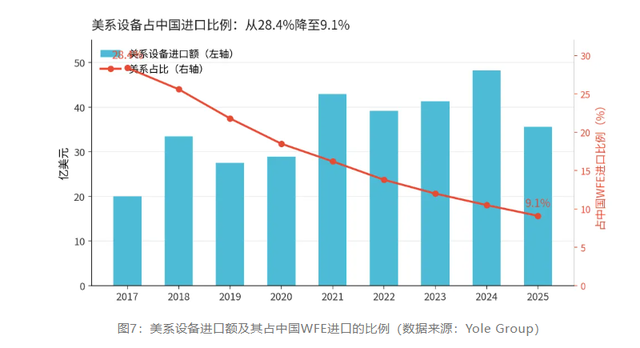
As shown above, this is Yole's tracking data on imported Chinese chip equipment.
Data shows that in 2017, American made equipment accounted for around 28.4% of China's imported equipment, exceeding a quarter, and was imported from the United States.
But by 2025, it has already fallen below 10%, only 9.1%.
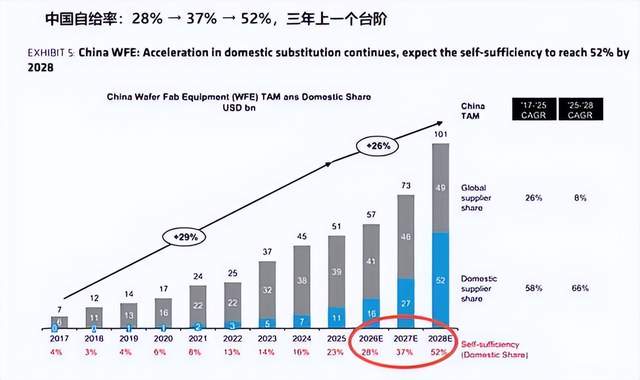
At the same time, China's self-sufficiency rate in chip equipment is gradually increasing. In 2017, the domestic production rate was only 4%, but by 2025, it has reached around 23%. Although not very high, it has increased by 500% compared to the previous 4%.
And chip devices, in fact, also have an ecosystem. At the beginning, it is the most difficult to replace them because they need to work together with other devices. However, once the replacement begins, as the ecosystem becomes more and more perfect, the subsequent replacement becomes easier.
So it is expected that the domestic production rate will reach 38% by 2027 and 52% by 2028, with over half of the chip equipment being domestically produced.
It seems that the United States has really hit itself in the foot by lifting a stone. Originally, it wanted to restrict the supply of chip equipment to block the development of China's chip industry, but it did not expect that it would instead promote the increase of China's domestic production rate of chip equipment and reduce its dependence on American own equipment.
As Huang Renxun said, it is the increasing restrictions imposed by the United States that have accelerated the progress of China's semiconductor industry. He said that these constantly upgrading regulatory measures have prompted China to accelerate the development of its own chip technology and manufacturing, and strive to improve localization.
Huang Renxun's words may seem a bit murderous, but the fact is indeed the same.
