


Samsung Exynos 2700 internal test exposed: CPU multi-core leads Snapdragon 8 Elite Extreme Gen 6 by about 20%
In mid to late October, multiple South Korean media reported that Samsung's next-generation self-developed flagship processor Exynos 2700 performed well in internal benchmark tests, with CPU and GPU performance leading Qualcomm's latest Snapdragon 8 Elite Extreme Gen 6. However, these test results have not yet been independently verified by a third party, and the actual performance of the final mass-produced machine remains to be observed.
According to Yonhap News Agency and ChosunBiz, Samsung conducted an internal benchmark test on the Exynos 2700 using the Xiaomi 18 Pro Max.
In the Geekbench 6.5 CPU multi-core test, the Exynos 2700 scored about 13000 points, while the Xiaomi 18 Pro Max equipped with Snapdragon 8 Elite Extreme Gen 6 scored about 11000 points, with the former leading by about 20%. In the Geekbench 7.0 multi-core test, the Exynos 2700 also maintained a lead of about 15%.
If compared to the slightly lower positioned regular version Snapdragon 8 Elite Gen 6 (equipped on Xiaomi 18 Pro), the gap is further widened: the lead of Exynos 2700 in Geekbench 6.5 and Geekbench 7 has expanded to 44% and 36% respectively.
GPU peak performance leads by 20%, basic graphics leads by 5%
In terms of graphics performance, the Exynos 2700 also has an advantage. In tests targeting the peak performance of graphics in large games, Samsung chips scored about 20% higher than Qualcomm flagship models; In the basic graphics computing ability test of common large-scale 3D games, the lead margin is about 5%.
However, the report did not specify the specific GPU testing project name, nor did it disclose detailed testing conditions, power consumption data, or sustained performance measurement results. Therefore, the claimed performance improvement cannot be directly equated with the actual gaming experience.
10 core dual ultra large core design, second-generation 2nm process
According to chip die photos released by SemiAnalysis and multiple media reports, the Exynos 2700 adopts an adjusted 10 core CPU configuration, changing the single ultra large core design of the previous generation Exynos 2600 to a dual ultra large core layout, specifically a 1+4+1+4 architecture:
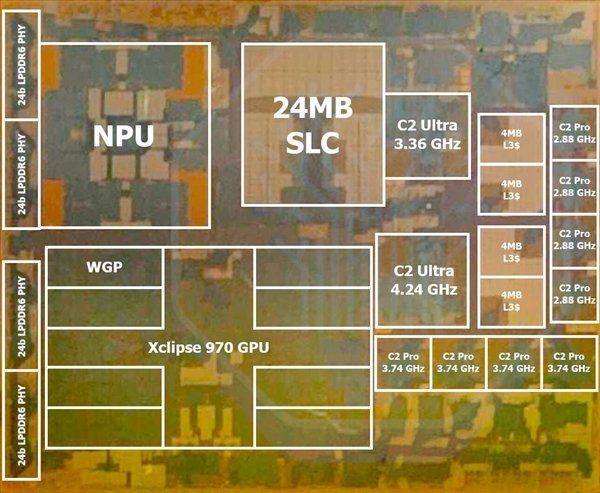
1 Arm C2 Ultra core, with a maximum frequency of 4.24GHz;
1 C1 Ultra core, with a main frequency of 3.36GHz;
4 C1 Pro/C2 Pro cores, with a main frequency of 3.74GHz;
4 C1 Pro/C2 Pro cores, with a main frequency of 2.88GHz.
The chip integrates Xclipse 970 GPU, equipped with 8 Work Group processors, has 24MB system level cache, and supports LPDDR6 memory.
In terms of process, the Exynos 2700 adopts the second-generation 2nm process (SF2P) from Samsung's wafer foundry division. According to Fast Technology, compared to the previous generation SF2 process, SF2P has improved performance by 12% and reduced power consumption by 25%. Samsung reportedly has started mass production of the chip, with an initial output about 10% higher than the previous generation.
In terms of heat dissipation, the Exynos 2700 is expected to adopt an improved Heat Path Block packaging solution to better manage chip heat generation.
The Game Behind Rumors: Snapdragon's "Overpopularity" vs. Samsung's Plan B
The timing of the exposure of Exynos 2700 internal test results is quite subtle. Just a few days ago, the Seoul Economic Daily reported that Samsung found during the final performance verification of the Galaxy S27 Ultra that the Qualcomm Snapdragon 8 Elite Extreme Gen 6 had repeatedly exceeded the temperature threshold under sustained high load, triggering protective frequency reduction. Samsung has issued an ultimatum to Qualcomm to improve by mid October.
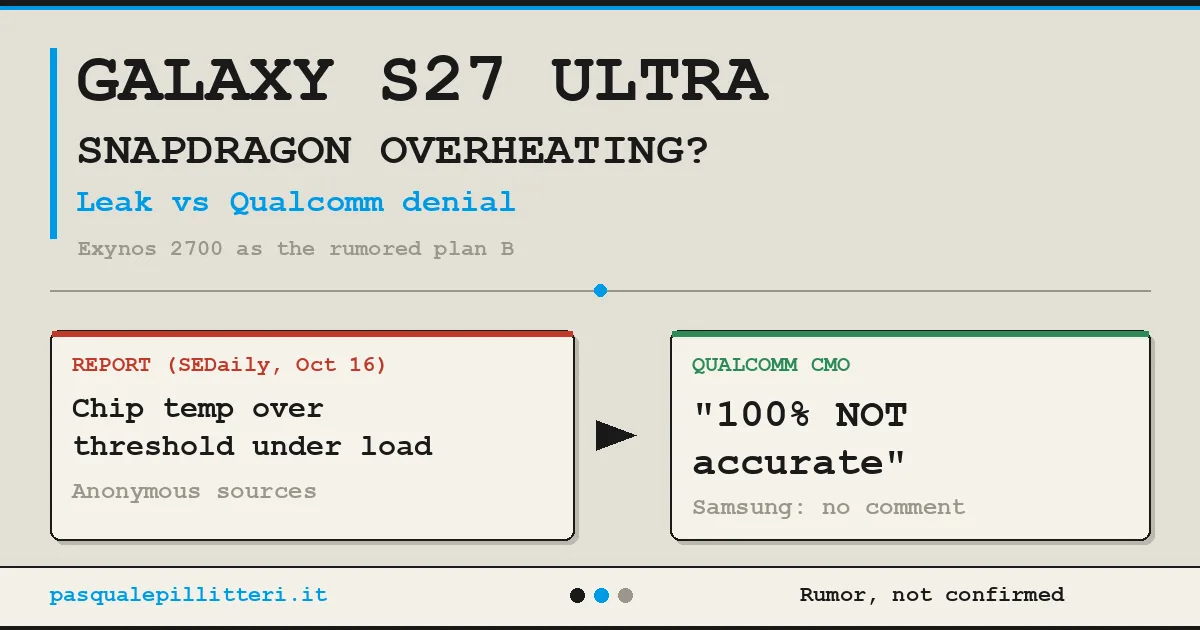
If Qualcomm cannot solve the problem on schedule, Samsung's alternative solution is to let the Exynos 2700 enter the Ultra model. This will be the first time since the 2022 Galaxy S22 Ultra (European version equipped with Exynos 2200) that Samsung has abandoned the Snapdragon platform in its highest end flagship.
Regarding this, Don McGuire, the Chief Marketing Officer of Qualcomm, quickly denied on social media, stating that the relevant reports were "100% not accurate" and emphasizing that there were no systemic heat dissipation issues with the chip. Qualcomm stated that mobile phone manufacturers will continuously calibrate their chip platforms before release to balance performance and power consumption in different usage scenarios.
It is worth noting that Xiaomi 18 Pro Max, iQOO 16, OnePlus 16 and other models equipped with Snapdragon 8 Elite Extreme Gen 6 have already been launched in the Chinese market, and there have been no large-scale overheating complaints so far.
Can I return to Ultra? Historical reputation is the biggest obstacle
Even though the paper parameters of the Exynos 2700 are impressive, Samsung still faces multiple considerations regarding whether to "abandon Qualcomm and use self-developed" on Ultra models.
On the one hand, the historical reputation of the Exynos 2100 and 2200 on European Ultra models is not ideal, and there is a natural resistance among consumers to the acceptance of the "Exynos Ultra". Especially in key markets such as North America, Samsung has long used Snapdragon as a performance selling point for Ultra, and a hasty switch may trigger resistance from channels and users.
On the other hand, the Ultra model is the best-selling model in the S series and requires a large supply of chips. If we fully switch to Exynos, whether Samsung's wafer foundry capacity can be met and whether the yield is stable are both practical issues.
At present, the industry generally expects the Galaxy S27 and S27+to be equipped with the Exynos 2700 in most markets, while the chip selection for the S27 Ultra is still undecided. Samsung needs to make a final decision before its release in early 2027.
Internal testing ≠ Mass production performance
It should be emphasized that all the performance data currently exposed are from Samsung's internal testing and have not been independently verified by a third party. The actual user experience will also be affected by multiple factors such as heat dissipation design, system scheduling, and overall power consumption control.
The reputation of Samsung's self-developed chips has gone through a rollercoaster ride, from the "lackluster" performance of the Exynos 2200 to the "decent" performance of the Exynos 2600. Whether the Exynos 2700 can truly achieve a "comeback" with its second-generation 2nm process and dual ultra large core design ultimately depends on the actual experience of the production machine and consumers. Before the official release and independent evaluation are released, all claims of "crushing Qualcomm" should be kept cautious.
