

The US is in an awkward position; suppressing Yangtze Memory has no effect and has turned the tables to climb to third place globally
In 2020, Chinese memory chip manufacturer Yangtze Memory launched the world's first 232-layer stacked 3D NAND flash memory, surpassing Samsung, SK Hynix, and Micron.
In the field of NAND flash memory, whether the technology is advanced or not depends on the number of stacked layers. The more layers there are, the higher the storage density, so for the same capacity, the wafer area is smaller and the cost lower.
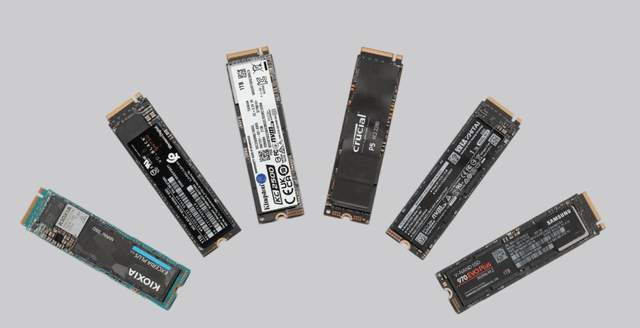
So at the time, everyone believed that Yangtze Memory, with its most advanced 232-layer 3D NAND flash chips, could quickly capture market share from manufacturers like Samsung and Micron, securing the best time window for development.
But unexpectedly, the U.S. crackdown followed immediately. Because the U.S. also knows that if Yangtze Memory gains this leading time window, its share will rise dramatically, which is something the U.S. neither wants nor dares to see.
Due to the crackdown, cooperation between Kelai and Lam Research and Changcun was suspended, and some advanced equipment was no longer sold to Changcun......
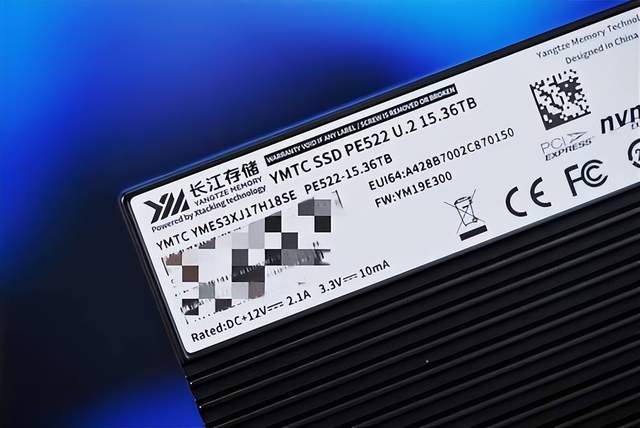
Honestly, the situation at the time had a significant impact on Changcu, because without support from advanced equipment, even if the technology was ahead, its advanced memory chip production capacity couldn't be expanded, and it couldn't quickly capture the market.
In this situation, Changcun can only work with domestic equipment manufacturers to work hard to replace domestic equipment and reduce dependence on overseas equipment, so as to avoid being choked.
So later, we found that the domestic production rate of Changcun's equipment continued to rise. Media shows that in the newly built production lines for Changcun, domestic equipment accounted for over 50%, one of the highest among domestic chip production lines.
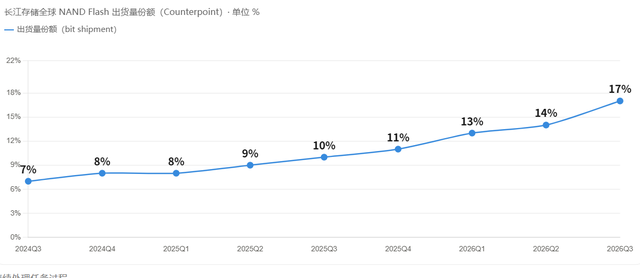
Moreover, relying on domestic equipment, Yangtze Memory continues to advance, with its global market share steadily increasing.
As shown in the chart above, in 2024, it was still below 10% but kept growing. Then, by Q2 2026, Yangtze Memory's global market share reached 14%, ranking third globally. By Q3, it rose to 17%, firmly holding third place globally and leaving Micron, Kioxia and SanDisk all behind.
Technically, Changchun is currently almost on par with Samsung's. Their mass-produced 3D NAND is around 300 layers—some slightly higher, some lower—but all are on the same level.

Additionally, hybrid Jianhe technology based on the Xtacking architecture has become the core weapon in 3D NAND flash memory technology. Samsung and SK Hynix have both licensed patents from Changcun, showing just how valuable Changcun's technology is now.
So, it's clear that the U.S. crackdown at the time did affect Changcun in the short term, but after a few years, the impact gradually diminished. Now, it seems to have no effect, and instead prompted Changcun to replace it with domestic products.
