


To be honest, how far has domestic semiconductor substitution come?
In recent years, the domestic semiconductor industry chain has raised the most about domestic substitution.
Everyone knows that with the continued tightening of U.S. regulations, if we continue to rely too heavily on foreign countries, the situation is indeed severe. Therefore, domestic substitution is a path that must be taken, no matter how difficult it is, we must grit our teeth to go.
So here's the question: after all these years of talking, how far has domestic substitution really come?
The entire domestic supply chain can mainly be divided into several major segments: EDA, semiconductor materials, semiconductor equipment, chip design, manufacturing, and chip packaging and testing.
First, let's look at EDA. As a foundational tool for chip design, the barriers are extremely high. Currently, the domestic substitution rate is not as high as people think; the overall domestic rate is about 15-20%, while for advanced chips, the localization rate may be only around 5%.
Looking at semiconductor materials, overall, it might be around 25%, though some types have higher yields and others lower.
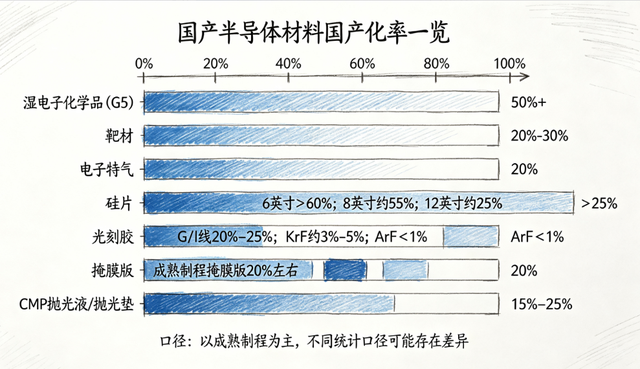
As shown in the figure above, advanced photoresists have very low substitution rates, while wet electronic chemicals have higher substitution rates, indicating significant room for overall improvement.
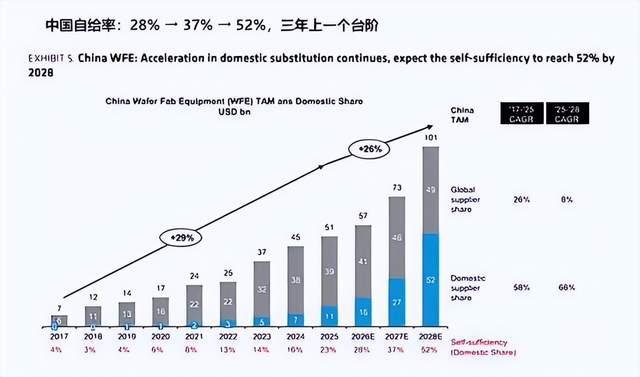
Looking at semiconductor equipment, overall, it is less than 30%. Previously, there was a data showing that it will reach 28% in 2026, 37% in 2027, and 52% in 2028.
Since the rest are all predictions, they cannot be counted; only the 28% figure for 2026 is basically credible, indicating the outlook is not very optimistic.
Next, let's look at chip design. It's actually hard to judge because it's hard to talk about domestic substitution rates, since many chips can be designed but cannot be manufactured.
For exampleHuaweiThey definitely have the design capability for 2nm and 3nm chips, but who will manufacture them? So there are no specific numbers for this area.
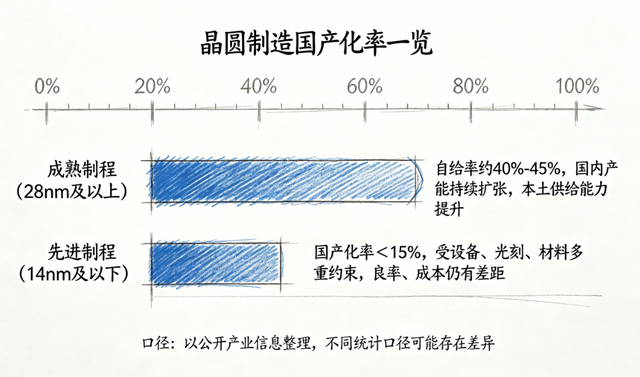
Next, let's look at chip manufacturing. Currently, the highest domestic process is still 7nm, and most of our production capacity is still in mature chips. Overall, the domestic substitution rate for mature chips has reached about 45%, but the self-sufficiency rate for advanced chips may only be around 15%.
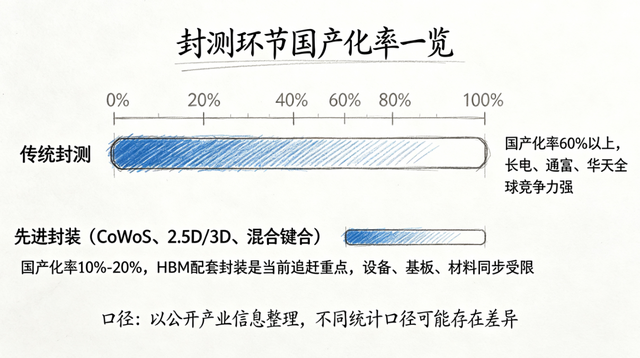
In chip packaging and testing, we have performed quite well, especially in traditional packaging and testing, which can almost meet domestic substitution. Of course, due to capacity constraints, the current capacity is not 100%, but it is still above 60%.
However, in some advanced packaging and testing areas like CoWos, there is still a gap, with a localization rate of only 15-20%. This is also the direction we need to improve in the packaging and testing area going forward.
So overall, in the mature chip field, domestic substitution has moved very quickly, with many achieving breakthroughs from zero to one, or even from 1 to 50, but to reach 100, effort is still needed.
But in advanced fields, they still fall short. Some haven't even achieved breakthroughs from zero to one, let alone from 1 to 50 to 100. The second half will be about tackling tough challenges in these advanced fields, such as EUV, advanced packaging and testing, and high-end materials.
The dividend of domestic substitution shifts to a more choking track, facing greater challenges but also greater opportunities.
