


3D force, slip detection, I²C direct connection: MLX90901 How to adapt grippers to dexterous hands
According to comprehensive reports, large AI models continue to enhance robots' abilities in understanding, reasoning, and motion planning, but for intelligent algorithms to be implemented for stable physical operations, tactile perception remains an unavoidable shortcoming. However, many commercial grippers still lack tactile feedback, and high-end multimodal haptic hands often face high costs, high levels of customization, and complex integration, making it difficult to form stable, large-scale supply. The latest MLX90901 haptic fingertip module from Mylaixin is precisely aimed at this pain point.
Currently, the robot tactile track has split into several mature routes. Mainstream tactile solutions on the market are roughly divided into piezoresistive, capacitive, piezoelectric, magnetic sensing, visual haptics, etc. Each approach has its own trade-offs in spatial resolution, force detection dimensions, environmental robustness, integration difficulty, and cost. The Mailaixin MLX90901 belongs to the three-dimensional force module of magnetic sensing.
Mailaixin introduced that MLX90901 is the company's first fully mechatronic tactile fingertip module, built on the self-developed Tactaxis® magnetic sensing technology. It integrates the sensor chip, permanent magnet, elastic contact layer, mechanical structure, and supporting circuitry, eliminating the need for manufacturers to start material selection, structural debugging, and sensor calibration from scratch, significantly lowering the threshold for developing tactile solutions.
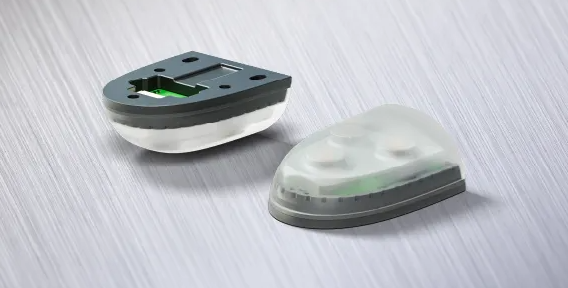
MLX90901 (Image source: MailaiXin)
MLX90901's core capability is to synchronously acquire normal forces and tangential forces in both directions, enabling the robot not only to know "what it has touched" but also to judge "how steady the contact is." When external force is applied to the fingertip, the elastomer embedded in the magnet deforms. The multi-axis magnetic sensor below captures the magnetic field change and then calculates the three-dimensional contact force through signal processing. Compared to solutions that can only output a single contact signal, it more directly supports clamping stability judgment, load state estimation, and sliding trend recognition.
In terms of performance, the module supports measurements of up to 15N normal force and 4N tangential force, with full-scale accuracy up to 10% and a typical force resolution of 200mN; The communication interface uses universal I²C, allowing easy integration with robotic controller and various embedded main controllers.
To facilitate vendor validation and development, Mailaixin simultaneously provides a DVK90901 evaluation kit to form a standardized development foundation. Developers can use the suite to complete three-axis force calibration and dynamic response testing, quickly collecting high-quality tactile data to support closed-loop control algorithms and physical AI model training.
In industrial gripper scenarios, MLX90901 modules can serve as standardized components for the clamping end. Developers focus on mounting interfaces, contact interface dimensions, and whether the existing control system can easily access I²C signals. Its three-dimensional force output can be used to dynamically adjust clamping force, such as changing the clamping degree based on the object's weight and surface friction conditions, or responding promptly when abnormal sliding is detected. However, the actual effect still depends on the mechanical rigidity of the gripper, contact material, and control algorithms; the module's capabilities cannot be equated with the entire machine already having adaptive gripping capabilities.
Overall, the dexterity hand tactile sensor track will not see a single path dominate: piezoresistive and capacitors will continue to occupy the low-cost, basic tactile market; The magnetic sensing three-dimensional force module will also become a standard option for dexterous hands equipped with haptics; Visual haptics continue to occupy high-resolution, high-complexity, and fine-grained scenarios, with companies choosing different solutions based on the application scenarios of dexterous hands.
