

Has the sky fallen on the Samsungs? DRAM can’t rise anymore, while NAND has declined.
In the first three quarters before 2026, all storage chip companies were making crazy profits.
Whether it is Samsung, SK Hynix, or Micron, the three giants, or relatively smaller companies like Changxin, Changcun, SanDisk, Kioxia, and even Taiwanese companies like Nanya and Winbond in the memory chip sector, their profits are all increasing fivefold, eightfold, or tenfold.
Samsung further revealed that the profits from memory chips in 2026 may equal the total profits from memory chips over the past 40 years.
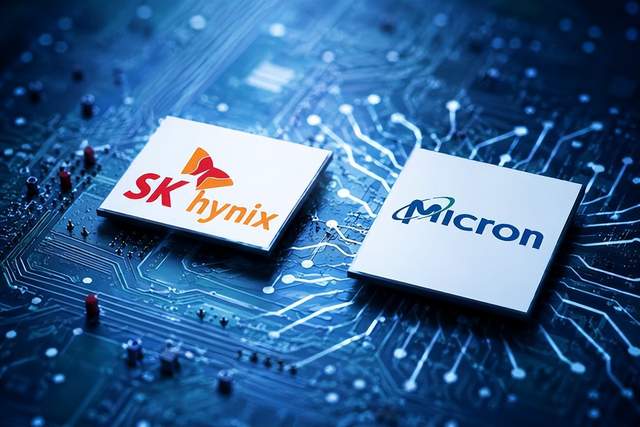
The reason for such a large increase is that over the past year, whether it’s DRAM memory or NAND flash, the average price has risen four to five times. Additionally, with everyone increasing their production capacity, after these two factors combine, naturally both revenue and profit have soared.
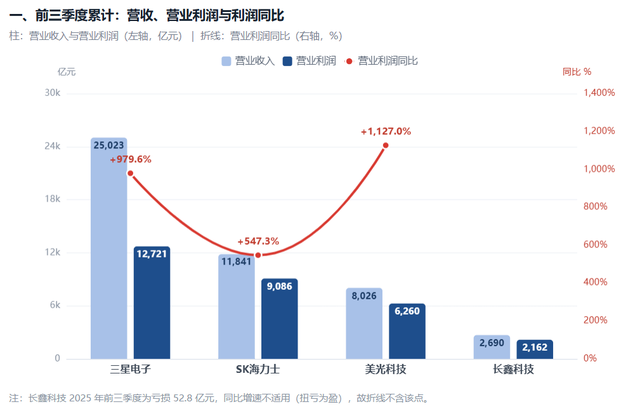
As shown in the figure below, this is the revenue, profit, and year-on-year profit of the four major manufacturers Samsung, SK, Micron, and Changxin in the first three quarters of this year. You can see for yourself how huge their earnings are.
What makes everyone even more frustrated is that Samsung and others often release news saying that currently, memory chips are completely in short supply, and prices will rise at least until 2028, or even until 2030.
Of course, some big shots scoff at the news released by Samsung and others, believing it is nothing more than a smokescreen, more like a tactic of the three companies working together to control prices and shout at each other. In reality, prices can no longer be pushed up.
As investment in AI is increasingly being questioned, and with sales of downstream products like mobile phones and computers collapsing, memory chips no longer have much room to rise. The loud calls from companies like Samsung are nothing more than an attempt to jointly control prices, and also a sign of their insecurity.
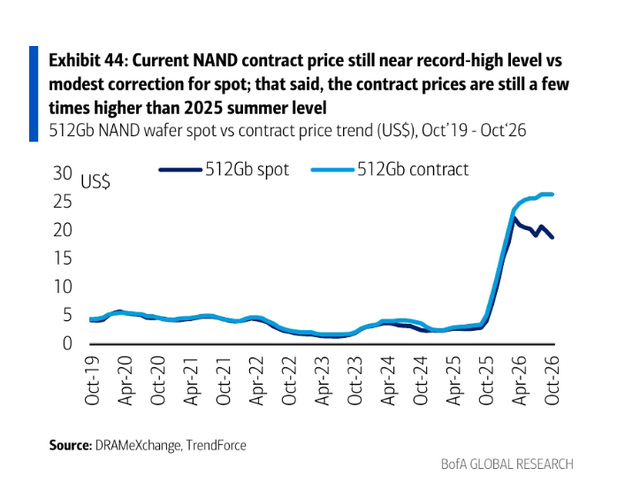
Recently, some institutions have been tracking the contract prices and spot prices of DRAM memory and NAND flash. People have also noticed that although DRAM is still at a high level, it is actually not rising much anymore, with no significant increases for several consecutive weeks, remaining at the same level.
The above image shows price data for 512GB NAND flash memory. It can be seen that contract prices are still high, but spot prices have been falling for several weeks and have not yet recovered, and they seem likely to continue declining.
On top of the current Nvidia incident and Comrade Trump's midterm election failure, industry insiders judge that AI investment will become more conservative, demand for memory chips will decline, and naturally, it is no longer possible for prices to surge.
This is truly like the sky falling for manufacturers such as Samsung, SK Hynix, and Micron, because once memory chip prices stop rising, they are the ones directly affected, with both revenue and profits experiencing significant impact.
As for the downstream mobile phone manufacturers and PC manufacturers, they are probably quite happy because once storage prices drop, the cost of phones decreases, which may lead to a rebound in sales, less memory tax for everyone, and life becomes a bit easier.
