


This is impressive! China's mature chip production capacity will account for 82% of the world?
The industry generally uses the 28nm process as the dividing line between mature chips and advanced processes.
Processes below 28nm are advanced processes, while 28nm and above are mature processes. Over the years, although some people think this dividing line should be set at 7nm, to this day it has not changed and is still 28nm.
In the past years, due to limitations of advanced equipment such as lithography machines, the increase in China's chip production capacity has indeed been mainly in mature processes, with relatively little improvement below 28nm.
However, don't think that mature processes of 28nm and above no longer have a market.
Previous data shows that even by 2025, among all the chips worldwide, those of 28nm and 28nm processes still account for more than 75% of the total, that is, three-quarters, while chips truly using processes below 28nm make up only about one-quarter.
So, when China starts with mature chips and strives to increase the production capacity of mature chips, it actually has a huge impact on the global chip landscape.
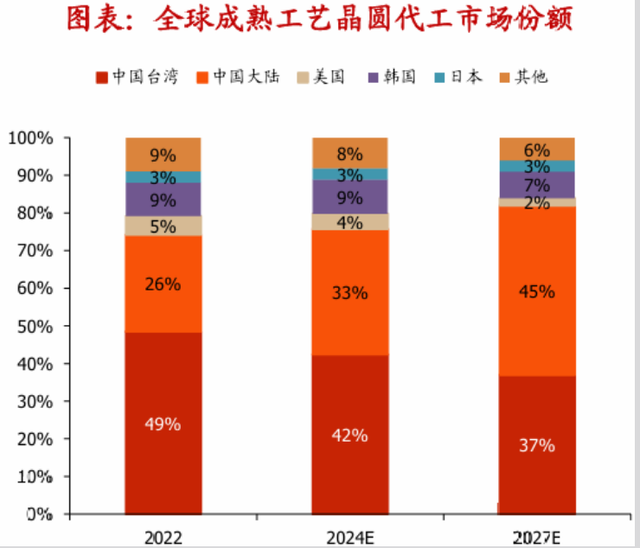
The above figure was released by an organization and shows data on the global share of mature chip production capacity. It can be seen that in 2022, Taiwan accounted for 49% of mature chip production capacity, mainland China accounted for 26%, totaling about 75%.
By 2024, Taiwan's share in China will drop to 42%, Mainland China's share will rise to 33%, with a total share of about 75%, only that part of Taiwan Province has been transferred to the mainland.
But by 2027, Taiwan's share in China will drop to 37%, while Mainland China's share will rise to 45%, bringing China's total share to 82%, reaching a new high.
At the same time, the shares of mature chips held by the United States, South Korea, and other countries and regions are getting lower and lower, because they are all being taken over by China.
What impact will the significant increase in China's mature chip production capacity have?
First, China's chips will be exported in large quantities, spreading to global markets. Relying on the advantages of 'Made in China,' chips from other countries, at least in terms of mature processes, will not be China's competitors. Therefore, the influence of Chinese chips globally will gradually increase.
Secondly, with the substantial increase in China's mature chip production capacity and higher incomes for everyone, more money can be invested in the industry, driving overall technological progress and moving towards advanced processes. This will be a trend.
Third, currently domestic wafer fabs, when cooperating with domestically produced semiconductor equipment and carrying out domestic substitution, will also drive the growth of the domestic equipment market, help everyone move towards advanced equipment, and ultimately reduce dependence on imports.
Then China's chip industry will form a truly positive cycle flywheel, with the development of mature chips driving the semiconductor equipment market, further promoting the development of advanced equipment, and ultimately leading to the rise of domestic chips on a global scale.
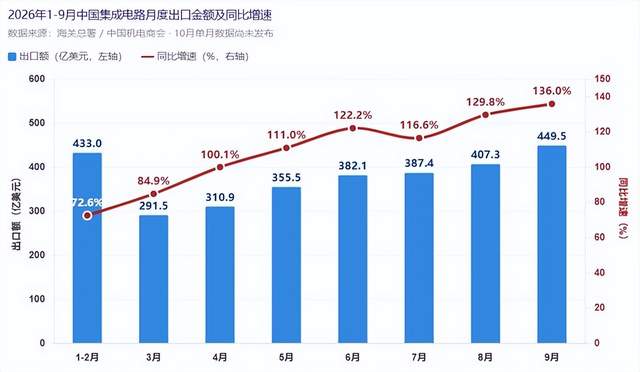
So we see that in 2026, China's chip exports also saw significant growth, exporting chips worth $301.56 billion in the first nine months (over 2 trillion RMB), a year-on-year increase of 108.1%. The self-sufficiency rate of domestic equipment has also greatly improved, and it is expected to reach 52% by 2028. All of these are closely interconnected, and it is estimated that the United States has long been anxious.
