

Are the US, Japan, and the Netherlands panicking? China is gradually stopping purchases of their chip equipment, causing all exports to China to decline
In the global semiconductor equipment (chip equipment) market, the United States, Japan, and the Netherlands hold an absolute monopoly.
According to the 2025 data, among the world's top 10 semiconductor equipment companies, nine are from the United States, Japan, and the Netherlands, and only one from mainland China made the list, which is North Huachuang.
It is only because of the strong growth of North Huachuang in recent years that it has been able to enter the top 10. Three years ago, the world's top 10 semiconductor equipment companies were all monopolized by companies from the United States, Japan, and the Netherlands, with none from China on the list.
As for semiconductor equipment, it is essential for all wafer companies, such as lithography machines, etching machines, ion implantation machines, and so on. Without these machines, no matter how advanced the technology or how talented the people are, chips cannot be manually produced.
So over the past years, China has been purchasing large amounts of equipment from companies in the United States, Japan, and the Netherlands.
These companies have also been continuously making money from China. Among the equipment they export, China accounts for over 40%, and in some cases nearly 50%. In other words, for every two pieces of equipment sold, one might be sold to China.
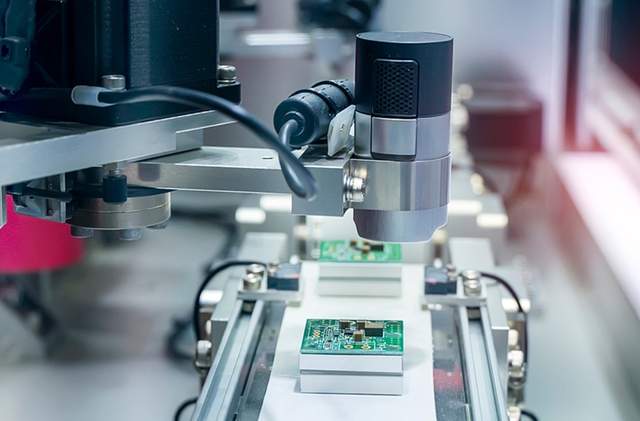
However, as the United States continues to increase regulations on chip equipment, these companies on one hand can no longer freely export these chip devices to China; the advanced ones can no longer be sold, and only some mature chips can be sold.
On the other hand, China has started domestic substitution. Chinese wafer fabs, together with China's chip equipment companies, test domestic equipment on production lines. Once the testing is completed, large-scale substitution is carried out to reduce foreign imports.
These semiconductor equipment companies from the United States, Japan, and the Netherlands are continuously reducing their export share to China.
According to third-quarter data, the proportion of exports to China by the world's four major semiconductor equipment companies—ASML (Netherlands), Lam Research (USA), KLA (USA), and Tokyo Electron (Japan)—has dropped too much compared to a year ago.
ASML's exports to China accounted for 42% in the third quarter last year, dropping to 23% in the third quarter this year, a decrease of 19 percentage points. Lam Research dropped from 43% in the same period last year to 35% this year, KLA fell from 39.5% last year to 34.5%, and Tokyo Electron decreased from 40.3% to 36.4%.
Moreover, all four major companies expect that China's share will continue to decline in the future, because the domestic production rate of semiconductor equipment in China will gradually increase, replacing their equipment.
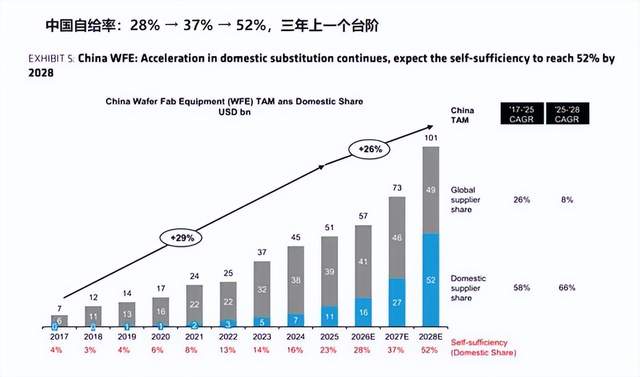
As shown in the figure above, this is the change in the localization rate of Chinese semiconductor equipment as compiled by institutions.
It was only 4% in 2017, reached 23% by 2025, is expected to reach 28% in 2026, 37% in 2027, and will reach 52% in 2028. Such a growth rate is truly unprecedented.
Once the localization rate of semiconductor equipment in China increases, the companies most affected will be these semiconductor equipment companies from the United States, Japan, and the Netherlands. If China reduces its purchases, who will they sell their equipment to?
