


After the original factory stopped supplying: old chips from Huaqiangbei were installed into new phones
In the market where DRAM contract prices have risen for several consecutive quarters, the most striking piece of news comes from the smartphone supply chain: In 2026, recycled chips—removed from old devices, cleaned and tested, re-soldered with solder balls, and then soldered into the finished device—are expected to account for 3% to 4% of global mobile RAM usage, rising to 7% to 9% by 2027. Most of these chips are 4GB LPDDR4X taken from retired phones and ultimately soldered into entry-level 4G phones priced under $200. TrendForce's survey also estimates that if DRAM prices continue to rise in the first quarter of 2027, recycled chips will spread from entry-level models to mid-range mainstream phones.
following upstream along this supply chain, you'll find that the real starting point for recycling scrap material isn't at the counter in Shenzhen Huaqiangbei, but at the capacity allocation meetings of Samsung, SK Hynix, and Micron.
core point:
1. AI reallocates storage capacity. HBM and server DRAM have taken away newly added and freed up capacity, consumer-grade LPDDR is being systematically compressed, and the shortage of phone memory is the result of allocation, not an absolute shortage of DRAM capacity.
2. Entry-level phone manufacturers are not facing price issues, but whether there is stock. The supply gap in mobile phone LPDDR4X reaches 15% to 20%, with small-capacity chips under 6GB being especially scarce. The purchasing logic has shifted from "calculating costs" to "sourcing sources."
3. The rise of recycled chips is essentially a reconstruction of downstream products after manufacturers voluntarily abandon the low-end market. Behind the 60% price difference compared to new products lies the cost of aging, crashes, and crashes.
4. This is not an ordinary cyclical market, but an asymmetric capacity war. If price increases continue, recycled chips will spread from entry-level phones to the mid-range mainstream, and the affordable phone category will face repricing.
capacity go?"
global DRAM is not short of capacity; what is lacking is the market share allocated to mobile phones.
Today's DRAM industry is highly oligopolitan. Every downturn in history has been a matter of life and death: Intel was the leader in the memory industry in the 1970s, but exited in the 1980s to focus on processors; Germany's Qimonda went bankrupt in 2009, and Japan's Elpida, once the world's third-largest DRAM manufacturer, went bankrupt in 2012. After several rounds of sifting through the sand, SK Hynix, Samsung, and Micron have tightly controlled over 90% of DRAM production.
These three companies maintain textbook restraint in their capacity expansion. Elpida and Qimida, which fell during the previous DRAM reshuffle, left a deep warning: idle wafer fabs can cost companies their lives, but unmet market demand will not. Therefore, when HBM orders surged in 2024 and early 2025, all three chose not to blindly expand production—new HBM fabs could only produce chips by 2027 or 2028 at the earliest. In December 2025, Samsung executives were still emphasizing "prioritizing long-term profitability over rapid capacity expansion."
total capacity is limited, while demand for AI servers is exploding. The only solution is to snatch wafers away from traditional products. By the end of 2025, tech media Tom's Hardware put it bluntly: with total wafer operating rates flat and packaging lines locked down, every wafer invested in HBM production will remove the corresponding capacity from the bulk commodity DRAM. By the end of 2025, SK Hynix had allocated 30% of its wafer capacity to HBM, with almost all of this capacity drawn from DDR and LPDDR; Micron went even further, directly shutting down consumer brand Crucial in December 2025, halting all consumer-facing shipments and shifting all capacity to AI and enterprise markets.
In terms of share, HBM's share of total DRAM capacity has risen from 2% in 2023 to 5% in 2024, and is expected to surpass 10% in 2025. Industry research institutions' estimates of per-wafer revenue also show that in the first quarter of 2026, both the single-wafer capacity and profit margins of HBM will be surpassed by DDR5 64GB RDIMM. Meanwhile, negotiations between buyers and suppliers have shifted toward the 2027 HBM4 supply agreement, and HBM contract prices are expected to rise several times in 2027—manufacturers continue to prioritize allocating advanced process capacity to high-end server DRAM and HBM, and the direction will only become more resolute
p Steyr="Malkin-Top: Ten fart Aix; Malkin-Botom: Ten fart Aix; Lane Hait: 1.5 Aim;">< Span Steyr="Fantaut-Seiz: 18 fart Aix;" "> the tilt of production capacity has split the storage market into two logics: server customers are locking inventory, while consumer customers are calculating costs; HBM, high-capacity RDIMM, and enterprise-grade SSDs are prioritized, while smartphones and PCs are beginning to bear cost pressures. It is worth emphasizing that this is not a complete shortage caused by absolute capacity shortages, but rather a change in distribution rules. < Spae Steyr="Malkin-Top: Ten Aspert X; Malkin-Botom: One Ten Fart X; Ryan Hait: 1.5 Em;">< Span Steyr="Fontt-Seiz: One Fart X;">
crack between
369% and 4%
< Span Steyr="Fantaut-Seiz: One Eight-Aix;" "> Counterpoint data shows that in the third quarter of 2026, DRAM industry revenue surged 369% year-on-year, while bit shipments only grew by 4%, with the average selling price soaring to $1.90/GB. The huge gap between revenue growth and bit growth shows that DRAM industry revenue growth is no longer driven by "selling more" but by "selling at higher prices"; The confidence behind "selling at a high price" comes from AI demand locked in by long-term contracts. Statistics on the CFM flash market can be seen in terms of scale, supporting the steepness of the market: in the first quarter of 2026, the global DRAM market size will reach $94.325 billion, a quarter-on-quarter increase of 81.5%.
< Spae Steyr="Makin-Top: Ten Aix; Malkin-Botom: Ten Aix; Ryan Hait: 1.5 Aim;">< Span Steyr="Fonte-Seitz: 18 Aix;">
< Spansthey=" Fantawild Seiz: 18px;"> AI bought not only the GPU but also the adjacent storage. JPMorgan estimates that the share of storage in cloud service providers' hardware capital expenditures will rise from about 15% in previous years to 52% in 2026 and 73% in 2027. In cloud AI systems, the GPU-to-CPU ratio is narrowing from 4:1 to 2:1. Agent AI consumes a huge amount of CPU computing power, and in the future, the ratio may approach 1:1, with the number of DRAM installed on a single server multiplying. DRAM demand driven solely by AI server CPUs will reach 11 billion GB and 17 billion GB in fiscal years 2027 and 2028, accounting for 19% and 24% of global DRAM demand.
< Span Steyr="Fantaut-Seiz: One eight-fart x;">
< Aimamuji Esirsi="/Uplodfiler/Imag/20261111/1794368069115945.png" Steyr="Bordel: Zero Ax Solidide Algibi (229, 231, 235); Box Seisin: Boulder Box --Tvi Bould Speying Aix: Zero; --Twi Bould Spesing - Outer: Zero; --Tebb Translet Aix: Zero; --Tebu-Translet-E: Zero; --Tvi Rotat: Zero; --Tub-Schu-Aix: Zero; --Tebu-Skeu-Yi: Zero; --Tu-Skyer-Aix: One; --Tu-Skeir-Yi: One; --Tedou-Pan-Aix: ; --tw-pan-y: ; --Tu-Pinchi-Zum:; --Tvi Skroll-Snap Stricktness: Proximiti; --Teb-Gradient-From-Posichen: ; --Tvi-Gradient Via-Posishin: ; --Tvi-Gradient To-Posichen: ; --Tvi Ordinal: ; --Tu-Srashd-Zero:; --tw-numeric-figur: ; --Tvi Numeric Spesing: ; --Tvi Numeric Vlakshen: ; --Tevi-Lin-Inset: ; --Tvi-Lin-Offset Vides: Zero; --Twi-Lin Offset Kolor: #fff; --Tu-Lin Kolor: Aljiba (59, 130, 246, .5); --Tvi-Lin-Offset-Shado: Zero Zero #零零零零; --Tevi-Lin-Shado: Zero Zero #零零零零; --Tvi-Shado: Zero Zero #零零零零; --Tevi-Shado-Kolored: Zero Zero #零零零零; --Tu-Bühler: ; --Twey Brightness: ; --Illustration - Contraste: ; --Tu-Grescal: ; --Tvi-Hugh-Rotat: ; --Illustration - Invert: ; --Tvi Satouret: ; --Illustration - Sepie: ; --Tvi-Drop Shado: ; --Tvi Bakdrop Bühler: ; --Tvi Bakdrop Breitnes: ; --Tvi Bacdrop-Kontrast: ; --Tvi Bakdrop Greskár: ; --Tvi-Bakdrop-Hugh-Rotat: ; --Tvi-Bachdrop-Invert: ; --Tvi Bakdrop Opasiti: ; --Tvi Bakdrop Satouret: ; --Tvi-Bakdrop-Sepie: ; --Tvi-Kantain-Seiz: ; --Tvi-Kantain-Leot: ; --Tvi-Kantain-Paint: ; --Twi Kantein Steyr: ; Malkin: Zero Axe Otto -1.25 Therm; Padding: Zero Ax; Dispry: Block; Verticar-Allen: Middle; Vides: Six-seven-six-fart X; Haite: 326 Axes; " Tetelr="1794368069115945.png" Alt="1794368069115945.png" Wiedert="676" Haidt="326"><
p Steyr="Markin-Top: Ten Ex; Malkin-Botom: Ten Ex; Ryan-Haidt: 1.5 Aim;">< Span Steyr="Fontaine-Seiz: 18 X; "> price stickiness is locked in by long-term contracts. Hyperscale cloud providers in North America and China have locked up their inventory through multi-year long-term agreements, making server memory pricing particularly sticky—even if spot prices fluctuate in 2027, the locked contract prices will remain relatively stable. Supply-side inventory is also thin: server DRAM inventory can only cover 2 to 3 weeks of shipments, with manufacturers firmly holding pricing power. < Spae Steil="Makin-Top: Ten Axes; Markin Botom: Ten Aix; Ryan Hait: 1.5 Aim;">< Span Staier="Fantaut-Seiz: 18 Aix;">
This round of market trends is not limited to DRAM alone. TrendForce data shows that in Q2 2026, the top five NAND brands will see a combined revenue increase of 77%, with enterprise-grade SSDs being the main growth driver. On the DRAM side, contract prices in Q3 2026 rose 13% to 18% quarter-on-quarter, and institutions have warned that PC DRAM capacity allocated to 2027 may decline further, and server DRAM supply shortages will continue.
sacrificing the market under
$200
The cost of capacity redeployment is transmitted step by step along the supply chain, ultimately ending in the price range with the least bargaining power.
flash memory market forecast: after the factory production line switch, there will be a 15% to 20% supply gap in the smartphone LPDDR4X, and supply of low-capacity chips below 6GB will be extremely tight, driving Q3 LPDDR4X contract prices to rise by more than 20% quarter-on-quarter. A more intuitive long-term outlook: from Q1 2025 to Q1 2026, the standard price for LPDDR4 used in phones rose by 250%, and LPDDR5 by 220%; In Germany, the price of DDR5 for PCs surged by 414% within a year.
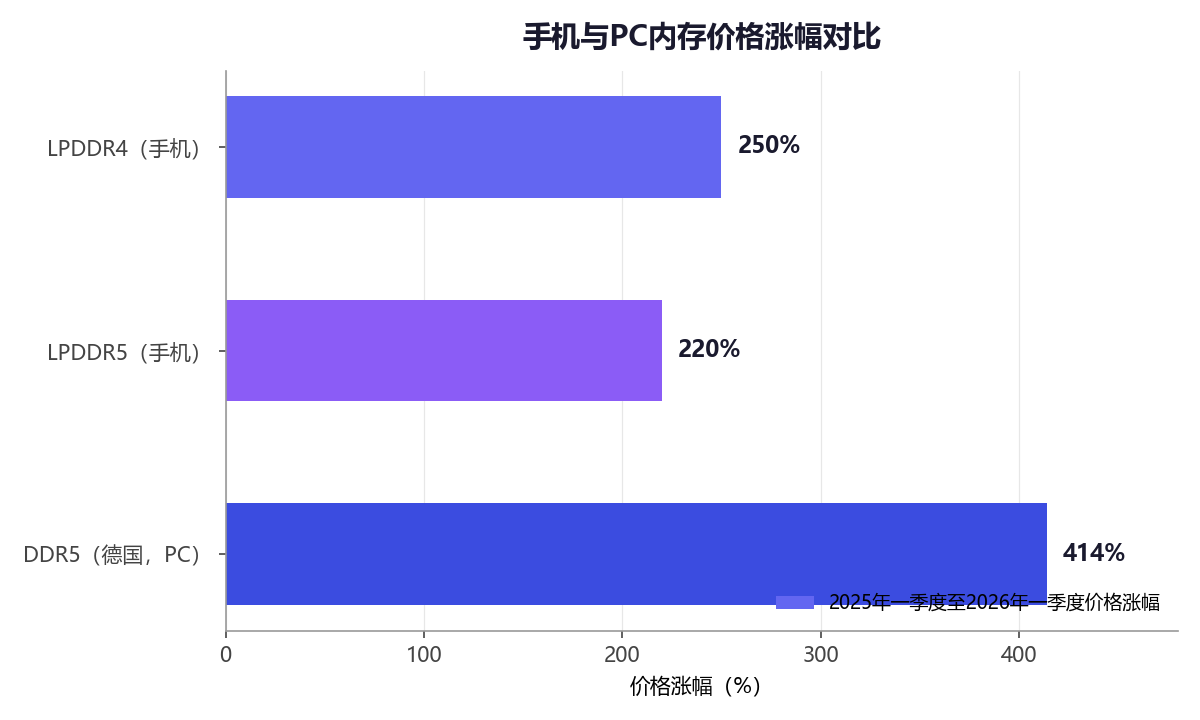
The squeeze of the end market is manifesting simultaneously. Counterpoint data shows that global smartphone shipments in Q1 and Q2 2026 will decline by 6% and 11% year-on-year, respectively, with Q2 hitting the lowest level for the same period since 2013. Its latest outlook forecasts a 14.3% decline in full-year shipments for 2026. But the high-end market shows a completely different resilience: sales of high-end models with wholesale prices above $600 grew 5% year-on-year, accounting for 29% of total sales, and Apple and Samsung, which secured memory supply early, achieved growth against the trend.
The differentiation is clear: high-end models have profit buffers and long-term contract guarantees, while entry-level models face the wall of "price but no stock." Some manufacturers point out that prices will continue to climb for months, and in the future, buyers may face the extreme situation of not being able to buy storage chips no matter how much they pay. Entry-level phone makers are no longer just facing material price hikes, but also the problem that new components cannot be added to the BOM.
recycling chips, reconstruction
on the ruins
the low-end market given up by the original manufacturer, leaving no buffer period for capacity expansion, so downstream can only source locally.
Thus, a solution has emerged that this industry has never used on a large scale: clean, test, re-insert solder balls from used storage chips removed from old equipment, and then solder them into brand-new phones. These parts, known as recycled (dechipped) storage chips, are gradually becoming a rescue solution for low-end phone supply chains—reprocessed chips in Shenzhen's Huaqiangbei second-hand market are up to 60% cheaper than new products. According to TrendForce surveys, recycled memory chip modules will account for 3% to 4% of global mobile RAM usage by 2026, rising to 7% to 9% by 2027; Counterpoint Research also confirmed that some entry-level smartphone manufacturers have begun adopting recycled memory chips to control material costs
p Steyr="Malkin-Top: Ten Aspert X; Malkin-Botom: Ten Fart X; Lane Heit: 1.5 Em; ">< Span Steyr="Fantaut-Seiz: 18 Fart X; "> the other side of being 60% cheaper is the reliability discount. Old chips are prone to aging after long-term use and reheating, which may cause phone app crashes, crashes, or sudden shutdowns. For a phone priced under $200, this may be an acceptable quality control range, but it means the bottom line for the quality of affordable phones is being redefined by the market—the money saved on material costs is partly passed on to consumers as failure rates. TrendForce estimates that if DRAM prices continue to rise in the first quarter of 2027, recycled chips will spread from entry-level models to mid-range mainstream phones, becoming the new normal for the industry to combat high costs. < Spae Steyr="Malkin-Top: Ten Aspert X; Malkin-Botom: One Ten Fart X; Ryan Hait: 1.5 Em;">< Span Steyr="Fontt-Seiz: One Fart X;">
< Span Thier="Forent-Seiz: 20px;"> supply abandonment or cycle, the industry is waiting for an answer
There is real disagreement within the industry regarding the quality of this round of the market.
< Spae Steyr="Makin-Top: Ten Aix; Malkin-Botom: Ten Aix; Ryan Hait: 1.5 Aim;">< Span Steyr="Fonte-Seitz: 18 Aix;">
bulls believe that long-term agreements are eliminating cyclicality in the storage industry: multi-year contract prices locked in by cloud providers will continue to support vendor revenue in 2027, significantly improving the profitability stability of storage providers. The opposing side is equally sharp: memory chips essentially sell capacity, and the unit value of capacity is fixed. Prices can only fluctuate around costs, and AI has only given the storage industry a shot of confidence, not changing its underlying genes as a tech commodity. For manufacturers, the most dangerous thought is "this time is different"—when everyone thinks storage has broken free from the cycle and will rise in prices for a long time, that is often the moment when the next cycle peaks.
< Spae Steyr="Makin-Top: Ten Aix; Malkin-Botom: Ten Aix; Ryan Hait: 1.5 Aim;">< Span Steyr="Fonte-Seitz: 18 Aix;">
But for entry-level phone manufacturers, this debate is irrelevant before 2028. Regardless of who is right or wrong in terms of cycles, the new capacity of the three major manufacturers will not be launched until 2027 or 2028, and the reality of capacity tilting toward AI will persist throughout 2027. Cyclical shortages may ease with capacity expansion, but structural supply abandonment will not resolve itself: OEMs have transferred advanced capacity to high-margin servers and HBM markets, and supply contraction in the low-end consumer market is the result of rational business decisions, not accidents. The rise of chip recycling is therefore more of a signal—when the "capacity-selling" business gives way to the "bandwidth sales" business, the low-end market will either accept second-hand chips or reprice complete devices.
< Spae Steyr="Makin-Top: Ten Aix; Malkin-Botom: Ten Aix; Ryan Hait: 1.5 Aim;">< Span Steyr="Fonte-Seitz: 18 Aix;">
What is truly worth tracking is whether this round of capacity reallocation will give rise to a new supply structure. Domestic chip manufacturers are eyeing the gap left by overseas OEMs cutting DDR4 production, with domestic companies like Changxin Technology holding DRAM shares rising to 7.7%. If the original manufacturer continues to abandon low-end supply, the low-end market will not disappear; it will only replace a new batch of suppliers. In this asymmetric capacity war, winners are listed on the AI server's bill of materials, and losers are listed on the BOM sheet of a $200 phone; Meanwhile, the supply chain that once provided cheap smart devices to hundreds of millions of people worldwide is now reviving an ancient craft from the ruins—removing old chips and installing them into new phones.
