


In the history of human computers, there are two major pieces of hardware that both 'went backward' for the first time in 2026.
Human technology is constantly advancing, reflected in various fields: higher configurations, stronger performance, and lower prices.
Take computers and smartphones as an example: as technology keeps advancing, the performance of CPUs and SoCs keeps improving, and RAM for RAM is certainly increasing, while storage and SSDs are also
increasing.
This is an industry pattern. Data shows recently that in the past 10 years, SoC performance has improved 40 times.
But by 2026, the situation has shifted. In fact, for the first time in computer history, two major hardware components have regressed and their configurations have shrunk.
The first major configuration is memory.
According to 2025 data, 32GB memory configurations are the most popular and the most popular type, while 64GB configurations are gradually becoming more common. Logically, 32GB and 64GB configurations will keep rising, while smaller memory configurations like 8GB and 16GB will have a lower proportion.
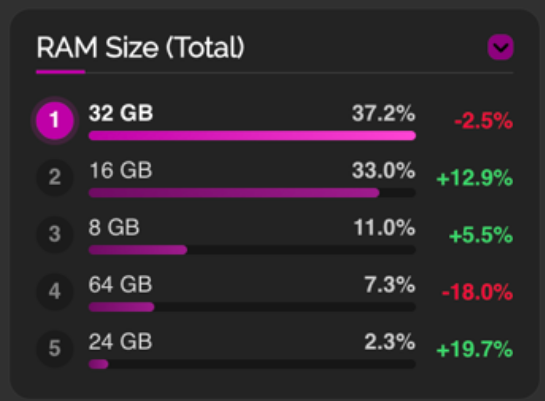
But by 2026, not only has memory not increased, the proportion of large memory has decreased, while the proportion of small memory has increased. This marks the first shrinkage in human computer history.
As shown in the chart above, over the past year, the proportion of 32GB memory dropped by 2.5% to 37.2%. Although it remains the highest proportion, the proportion has decreased, with 64GB memory down by 18%.
The
16GB model saw a 12.9% increase, the 8GB model a 5.5% increase, and the 24GB version a 19.7% increase. Clearly, many configurations that can't afford large memory are replaced with smaller memory.
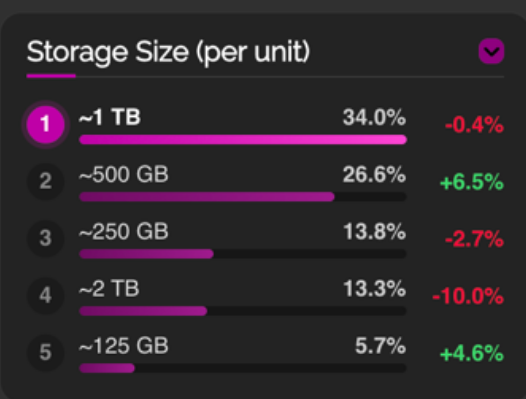
The second biggest downgrade is the hard drive.
As shown in the chart above, the share of 1TB hard drives dropped by 0.4%. 250GB dropped by 2.7%, and 2TB dropped by 10%.
500GB grew by 6.5%, and 125GB by 4.6%. From these figures, it's clear that many users who can't afford 1TB or 2TB have opted for smaller drives like 500GB or 125GB.
Why will memory and hard drives regress in 2026? The reason is that they're too expensive.
Over the past year, memory chips and NAND flash chips have increased four to five times. 32GB DDR5 memory may have increased by 2,000 yuan compared to last year, and 1TB SSD drives have also increased by over 1,000 yuan.
So both computer manufacturers and consumers have had to lower specs to save costs. But even with lower specs, the actual cost and final price are still higher than last year's—truly something rarely seen in life
