


A trillion-dollar windfall in one season! The boom in storage seems to have reached the ceiling
Recently, the global memory industry delivered the most astonishing quarterly earnings report portfolio in semiconductor history.
In Q3 2026, Samsung Electronics' quarterly operating profit reached 107.4 trillion KRW, making it the world's first technology company to surpass 100 trillion KRW in quarterly operating profit; SK Hynix's quarterly revenue surpassed 100 trillion KRW for the first time, with an operating margin as high as 80%; Micron's quarterly revenue was $54.2 billion, with a gross margin of 87%; Kioxia posted quarterly revenue of 2.48 trillion yen, surpassing the entire fiscal year in just one quarter; SanDisk's quarterly revenue grew 378% year-on-year, with a gross margin of 85%.
This is a report card with almost no weaknesses, but at times like this, it's worth asking: how exactly are these profits made, and how long can they last?
Same boom, different value
unified to a single quarter, listing each company's report cards side by side. At first glance, you see astonishing growth, but the second time you see a certain discord.
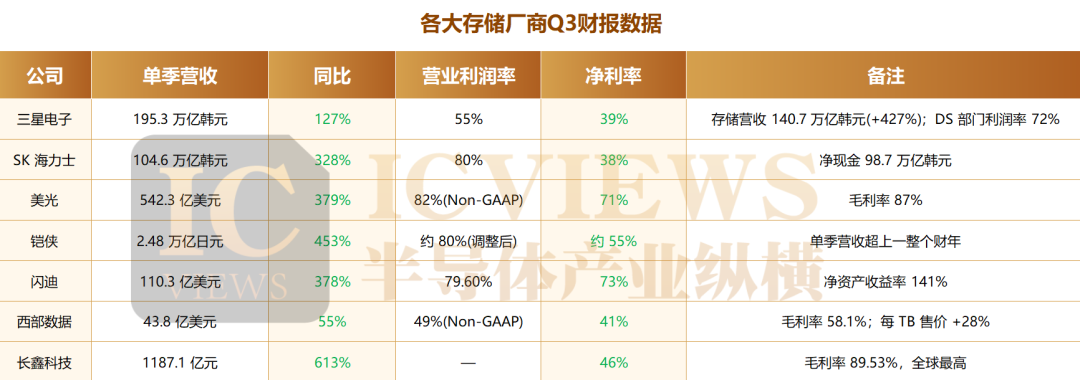
Samsung's single-quarter revenue was 195.3 trillion KRW, up 127% year-on-year. Among them, the DS division had revenue of 147.1 trillion KRW and operating profit of 106.5 trillion KRW, contributing almost all of the group's profits; SK Hynix had revenue of 104.6 trillion KRW, up 328% year-on-year, with operating profit of 83.3 trillion KRW and an operating margin of 80%. Micron's revenue for the fourth quarter of fiscal year 2026 was $54.23 billion, up 379% year-on-year, with a gross margin of 87%. Kioxia's revenue for the second quarter of fiscal year 2026 was 2.48 trillion yen, up 453% year-on-year, with a profit margin of about 80%. SanDisk's revenue for the first quarter of fiscal year 2027 was $11.03 billion, up 378% year-on-year, with a gross margin of 85% and an operating margin of 79.6%. Western Digital reported revenue of $4.38 billion, up 55% year-on-year, with a gross margin of 58.1%. Including A-share company Changxin Technology, Q3 revenue was 118.71 billion yuan, up 613% year-on-year, with net profit attributable to shareholders of 54.435 billion yuan and a gross margin of 89.53%.
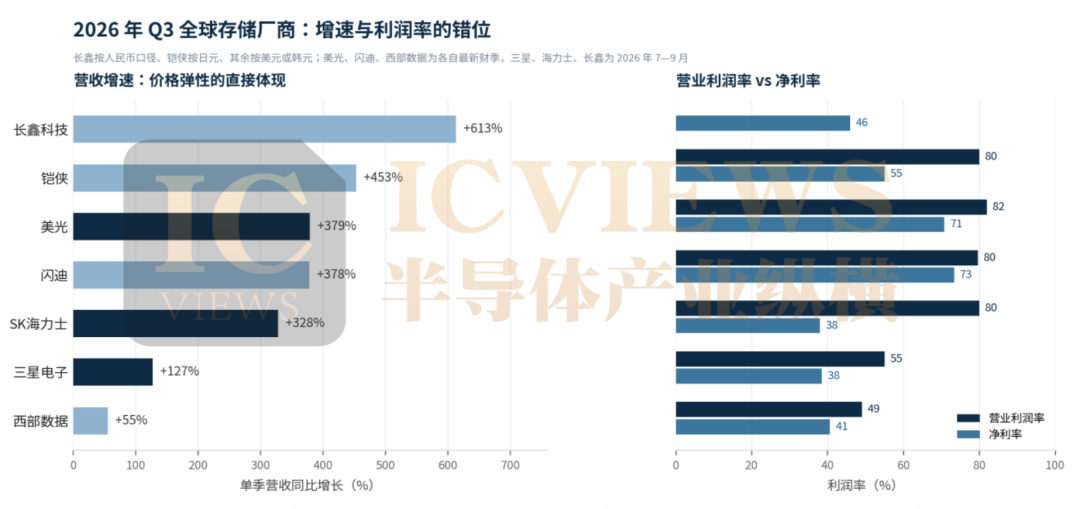
The most informative part of these numbers isn't who runs fastest, but the obvious mismatch between revenue growth and profit margin. SK Hynix's revenue rose 328%, with a profit margin of 80%, because it sells not more bits, but more expensive bits. HBM4 is fully shipped, server DDR5 prices have surged, and 321-layer enterprise-grade SSDs are ramping up, with all three product lines standing at the steepest price curves.
Kioxia's revenue growth reached 453%, but almost all of its growth was driven by price: bit's shipments were only 10% to 15% quarter-over-quarter, average selling price rose to the mid-20% range, compared to 70% last quarter. High growth depends on price, not volume, which directly explains why its guidance for next quarter is almost stagnant—once shipments move or prices stabilize, growth immediately slows down.
Western Digital only grew 55% in revenue, the slowest among the six, but its adjusted gross margin is 58.1%, next quarter guidance is 60% to 61%, relying on a 28% price per TB increase and nearly dual-oligopoly supply discipline. It grows the slowest but has the highest predictability.
The most interesting is Changxin Technology, with a gross margin of 89.53%, higher than Samsung and SK Hynix's storage businesses. This is not because of its technological leadership, but because in the domestic market's pricing system, it is the irreplaceable supplier.
So in this cycle, profit margins no longer reflect technological gaps; they reflect which product line you stand on and which customer group you are dealing with. HBM companies earn 80%, general-purpose DRAM earn 50-60%, NAND earns 40-50%, hard drives earn 50% but only earn certainty within three years; In the Chinese domestic market, Changxin Technology has achieved a gross margin more valuable than technology due to scarcity.
Why has it risen so fiercely this round, and why has it suddenly stopped
understand this cycle, the hardest logic is HBM's multiplier squeeze over capacity.
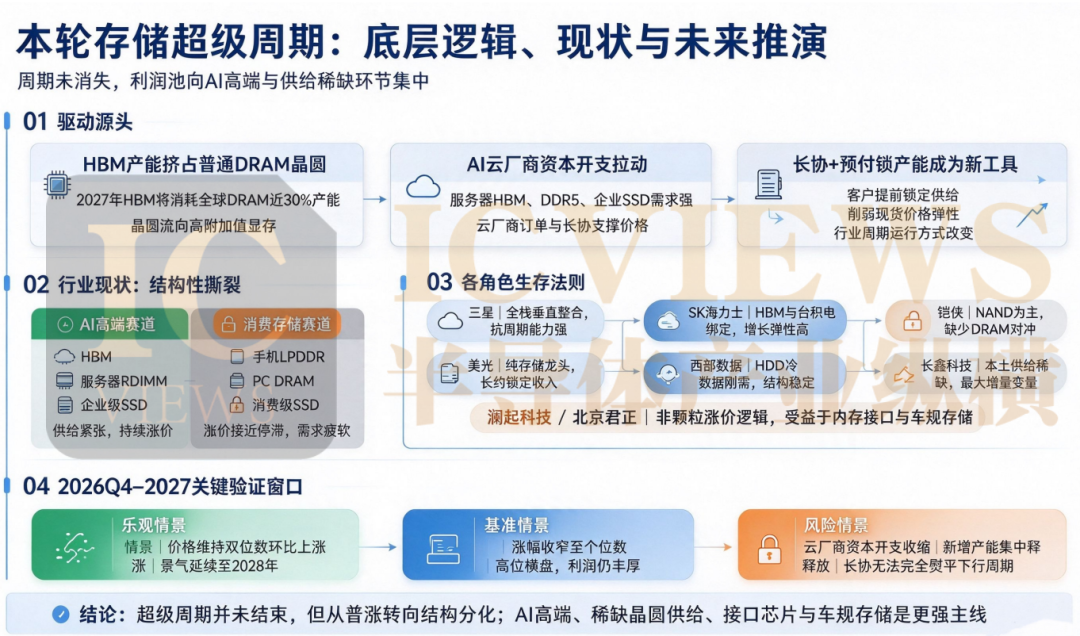
HBM is not "more expensive DRAM"; it is a capacity-hungry machine. An HBM consists of eight to twelve layers of DRAM stacked vertically, plus a logic base die, and the wafer area consumed per unit capacity is about three times that of ordinary DRAM. Samsung executives stated at the earnings call that by 2027, HBM will consume nearly 30% of global DRAM capacity. This means that even if global DRAM bit supply grows by 15% to 20%, after excluding HBM's squeeze-out, the incremental amount left for PCs, mobile phones, and general-purpose servers may be close to zero.
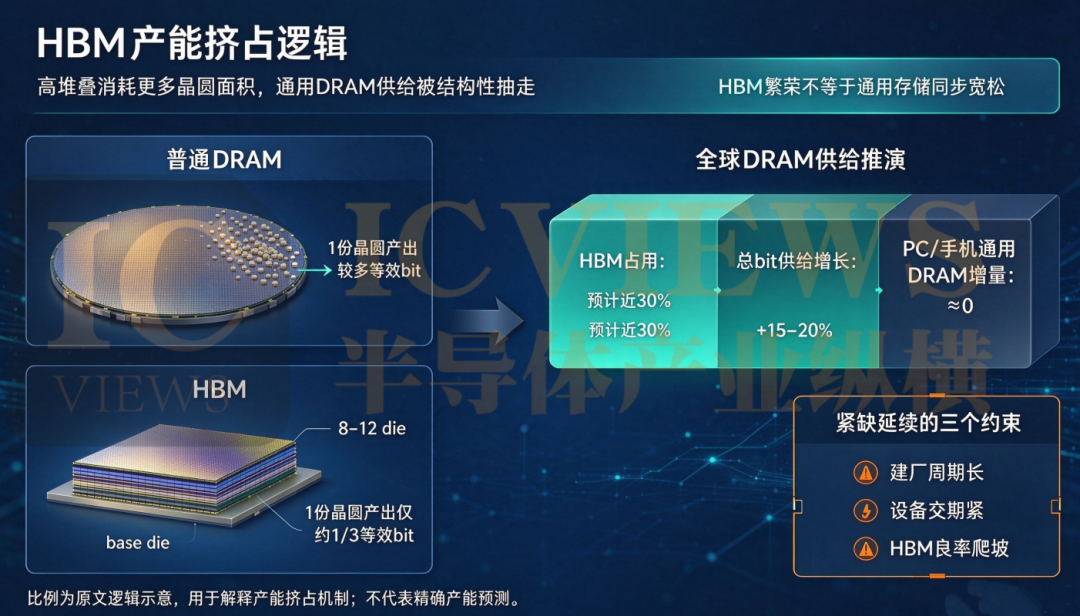
three seemingly contradictory things can be explained: the price of general-purpose DRAM contracts rising 90% to 95% quarter-on-quarter in Q1 2026 is not due to a sudden surge in demand, but rather because supply has been drained; Phone manufacturers have raised prices five times and are still out of stock, because LPDDR is the last priority in factory production scheduling; Samsung says the shortage will last until 2028, while SK Hynix says it will last until 2030, because the triple constraints of factory construction cycles, equipment delivery times, and HBM process yield are combined—money can be printed, but cleanrooms cannot.
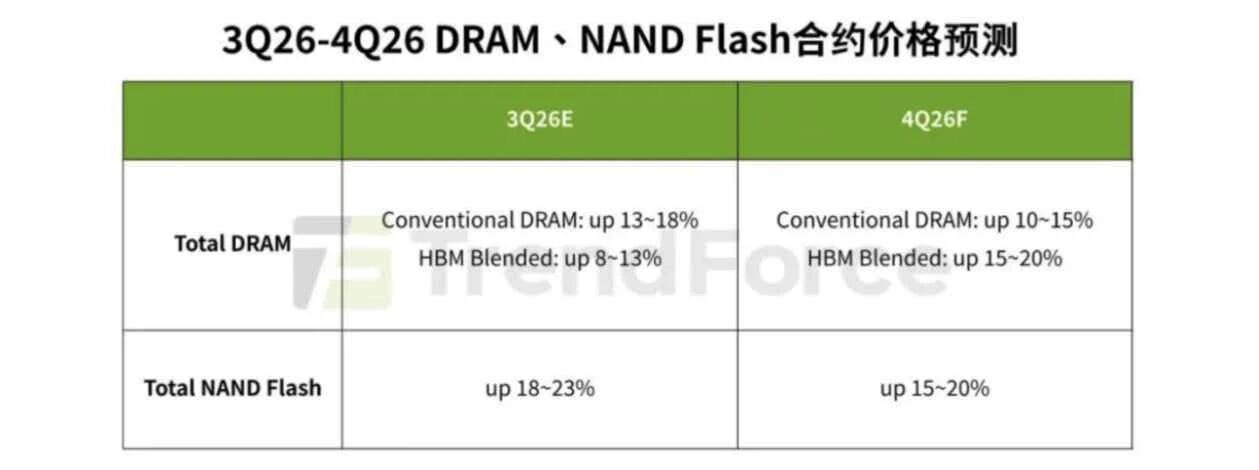
But what really started to loosen this round of prosperity was the clear turning point in the price increase slope in Q3. According to TrendForce, the quarter-on-quarter increase in general DRAM contract prices was 93% to 98% in Q1, 58% to 63% in Q2, narrowed to 13% to 18% in Q3, and projected at 10% to 15% in Q4; NAND rose from 55% to 60% in Q1, 70% to 75% in Q2, dropped to 18% to 23% in Q3, and is projected at 15% to 20% in Q4. Even more noteworthy is the structural divergence: in Q4, server RDIMM is expected to rise 18% to 23%, enterprise QLC SSDs are up 23% to 28%, while mobile LPDDR and UFS are only 0 to 5%, and personal computer DRAM and consumer SSDs are only 3% to 8%. In other words, high-end AI-related categories are still rising, while consumer sectors have hit the ceiling. The price increase across the entire industry chain has dropped from 90% to 10%, but this is not the same story. What is truly happening is structural differentiation, not demand collapse.
Behind this differentiation lies a more fundamental change: the nature of demand has changed. In recent cycles of storage upcycles, driven by personal computers and smartphones, demand is dispersed, highly elastic, and comes and goes quickly; This round is driven by AI servers simultaneously driving DRAM, HBM, and enterprise-grade SSDs, with highly concentrated and predictable demand, but also heavily dependent on the capital spending rhythm of a few cloud providers. The quarterly capital expenditures of four cloud companies often reach tens of billions of dollars, while Amazon alone reached $77.26 billion, doubling year-on-year. Such large-scale procurement allows upstream users to earn more than five years of profit in a year, but can also immediately disrupt upstream capacity planning when the pace shifts. Intel gave a negative example: its CFO bluntly stated that the PC market slowdown will last at least until the first half of next year and memory prices in 2027 are "very severe." In the same industry, servers are scrambling for supplies while consumers are shrinking. This tearing apart is the most authentic reflection of this cycle.
Another easily overlooked change is the restructuring of the industry order in this round of long-term contracts. Samsung has signed long-term supply agreements with 10 major customers, locking in 60% to 70% of its medium- and long-term capacity; Hynix has signed contracts with 14 customers, partly negotiating further five-year terms, with the locked volume equivalent to more than 50% of total capacity from 2027 to 2028; Micron increased strategic client agreements from 16 last quarter to 26, raised customer financial commitments from $22 billion to $32 billion, mostly cash prepayments, covering over 35% of revenue by 2030, with three-quarters set price caps and some contracts extended to 2031; Kioxia has already sold out production capacity by 2027, more than half locked in for 2028, and negotiations for 2029 and 2030 have already begun. This is the most fundamental difference between this cycle and the 2017-2018 and 2021-2022 cycles: the industry's first collective cycle of long-term contracts, prepayments, and price range competition. The trade-off is that during the price increase cycle, long-term contracts lock in excess profits, which is why Micron's next quarter gross margin guidance of 86.3% has become the "lowest point of the year," with contract prices always lagging behind spot prices.
different methods of different original manufacturers
Samsung's quarterly accounts are a typical example of "using vertical integration to gain cyclical discourse power." Its core profitability lies in its DS division: average DRAM prices rose 20% quarter-on-quarter, NAND rose about 10%, and HBM4 sales grew more than threefold, accounting for 60% of total HBM sales. But net profit was only 75.21 trillion KRW, dragging down financial expenses from 9.5 trillion KRW, with net profit margin falling from 41.8% in Q2 to 38.5%; Meanwhile, the DX consumer electronics division recorded an operating loss of 0.8 trillion KRW, and storage price hikes are backing off on its own terminal business—this is Samsung's unique two-handed struggle
In terms of technology, Samsung is the only player in the world to hold storage, foundry, and packaging. HBM4 uses its own 1C-class 10nm DRAM paired with its own 4nm logic base die, with mass production starting in February 2026, the earliest among the three manufacturers, and plans to mass-produce HBM4E in the first half of 2027; Capital expenditure for 2026 will be 84.4 trillion KRW, up about 60% year-on-year, with the DS division investing 76.8 trillion won, mainly invested in Pyeongtaek P5 and the US Taylor fab.
it is betting on the strongest capital expenditure and the most comprehensive technology stack to raise HBM's share from 32% to 40%, at the cost of end-user losses, foundry ramp-up investments, and pressure to trade price for volume in HBM4 negotiations—it reports $4 to $5 per Gb, significantly higher than the industry's just over $3 per GB.
SK Hynix demonstrated how far "focus plus customer binding" can go. Quarterly revenue broke 100 billion KRW for the first time, operating profit reached 83.3 trillion KRW, profit margin 80%, net cash position expanded to 98.7 trillion KRW, borrowings decreased to 15.8 trillion KRW. From Q4, HBM4 will surpass HBM3E in both shipments and revenue to become the main force.
The biggest difference between it and Samsung is in the HBM4 base die. It entrusts the logic part to TSMC for foundry, which has the advantage of more reliable yield and capacity, but the downside is that cost sharing and capacity are controlled by others. On the NAND side, 321-layer TLC accounts for more than half of South Korea's domestic capacity. In the medium to long term, it is betting on HBF (High Bandwidth Flash), aiming to turn NAND into key-value cache layered storage for AI inference. This is its differentiated path to counter "pure NAND commercialization." In terms of capital expenditure, BOCOM International estimates it will be 46.7 trillion KRW in 2026, 79.6 trillion in 2027, and 95.6 trillion in 2028. DRAM capacity is expected to increase from 575,000 units per month at the end of 2026 to 740,000 units by the end of 2028.
Its resilience is reflected in two ways: first, 14 long agreements lock in revenue floors for 2027-2028; second, it suspended Solidigm's public offering review when cash flow was at its highest, citing the current market environment making it difficult to achieve expected results—a clear signal that management believes there are still downside risks in the cycle and needs to maintain balance sheet flexibility, meaning it would rather bear the financial pressure of expansion itself than dilute value during an unfavorable window.
Micron's four major business lines all set records in Q4 of fiscal year 2026: core data center $18 billion, up 56% quarter-over-quarter, gross margin 90%; cloud memory $16.3 billion, gross margin 83%; mobile and client $13.1 billion, gross margin 90%, with next-generation 1γDRAM accounting for nearly half of this segment's revenue; automotive and embedded $6.8 billion, up 47% quarter-on-quarter. Data center solid-state drives generated nearly $10 billion in quarterly revenue, up more than tenfold year-over-year and accounting for more than two-thirds of NAND revenue—this is the most genuine structural source of NAND price increases.
The reason its profit didn't keep up with revenue this quarter is because expenses are expanding: adjusted operating expenses were $2.6 billion, 52.8% above consensus expectations, R&D $1.8 billion, up 35%, plus inventory days rose to 129 days, making next quarter's gross margin guidance the year's low. It doesn't do contract manufacturing, doesn't do terminals, only storage, so its capital efficiency is the highest, with a return on equity of 88.3% and return on invested capital of 93.8%, but it has the least buffer during a downturn. Twenty-six long-term contracts totaling $32 billion in customer commitments essentially trade profit elasticity for certainty. If prices continue to rise in 2028, it won't get that portion of excess returns.
Kioxia is the most elastic but least certain asset in this cycle. Quarterly revenue exceeded the entire previous fiscal year, with SSD and storage business reaching 1.616 trillion yen, accounting for 65% of revenue, with data centers and enterprise segments making up about 65%, and it also paid an interim dividend for the first time. But its guidance was almost unchanged: third-quarter revenue was about 2.5 trillion yen, up only 0.8% quarter-on-quarter, and operating profit was about 2 trillion yen, up 0.6% quarter-on-quarter.
management explained that this was a shipping timing issue: some orders were requested to be confirmed early in September, some enterprise-level orders were delayed until January to March next year due to long production cycles, and combined with the negative impact of yen appreciation on operating profit of about 55 billion yen; However, its CFO also admitted that, considering the significant price increase, it is still uncertain whether NAND prices will continue to rise in fiscal year 2027. Currently. Its capacity scheduling is not weak, with sales to be sold out in 2027 and more than half locked in in 2028. Its joint venture with SanDisk is expanding, and the eighth-generation BiCS already accounts for more than half of wafer output.
SanDisk and Western Digital are a textbook spin-off comparison. SanDisk is left with only NAND and consumer brands, with quarterly revenue of $11.03 billion, data center up 61% quarter-on-quarter to $4.8 billion, edge business $5.83 billion, while consumer business fell 29% to just $397 million; it has fastest revenue growth, highest gross margin, and a return on equity of 141%, $5 billion in repurchases and $5.7 billion in free cash flow. However, the contraction in consumer business has exposed the limits of end-user capacity. When a segment shrinks nearly 30% in a quarter, how long enterprise-level high growth can last becomes a must-answer question.
Western Digital is left with only hard drives, shipping 248EB, up 21.6% year-on-year, with a price per TB up 28%. Its order visibility for the top seven customers is already scheduled into 2030 or 2031; Its growth rate is the lowest, but it may be the one underestimated among the six, because hard drives are a duopoly structure, supply discipline far exceeds the four-way battle for NAND, and capacity is a must-have. AI training data, cold data archiving, and checkpoint storage all ultimately fall to hard drives.
Changxin Technology is the most variable among the six. In the first three quarters, revenue was 269.024 billion yuan, up 738.5% year-on-year, net profit attributable to shareholders was 132.04 billion yuan, and R&D investment was 11.071 billion yuan, up 73% year-on-year. However, its quarter-on-quarter growth rate sharply dropped from about 96% in Q2 to 19.3%, and net profit attributable to shareholders only increased by 3%. The reasons are: first, a base effect—Q2 saw the steepest price increase; second, equity structure. Q3 growth mainly came from two controlling subsidiaries, Changxin Xinqiao and Changxin Heat Pump, both with revenue and profit growth rates exceeding 50%. The group's shareholding ratio in these companies is relatively low, diluting the statutory value attributable to shareholders. In August, the company increased its equity ratio in Changxin Heat Pump through a capital increase.
In terms of technology, the fifth-generation DRAM platform G5 went into mass production in September, with active band half-pitch reduced to 11.95 nanometers, and single wafer die output increased by at least 50% compared to the previous generation; In October, progress on the 4F cell architecture was announced, with plans to launch a new generation DDR5 RDIMM integrating hybrid bonding by year-end; Self-developed LPDDR6 began mass production and commercial use in August, debuting Xiaomi 18 Fold, marking the first time LPDDR6 has been implemented globally in flagship smartphones.
< Spann Steyr="Makin-Top: Ten Aspert X; Malkin-Botom: Ten Fart X; Ryan Hait: 1.5 Em; ">< Span Steyr="Fontt-Seitz: 18 As; ">
It faces a dual-track market: ranking fourth internationally, with a market share of about 7% to 8%, yet the only DRAM manufacturer in China capable of large-scale supply. This not only gives it an abnormally high gross margin but also means its expansion is not bound by global supply discipline, making it the biggest supply-side variable in this cycle.
< Spae Steil="Makin-Top: Ten Axes; Markin Botom: Ten Aix; Ryan Hait: 1.5 Aim;">< Span Staier="Fantaut-Seiz: 18 Aix;">
<Span Steyr="Forent-Seiz: 20px;"> survival slice at different positions in the industry chain
< Staier="Malkin-Top: Ten Ass Axes; Markin Potom: Ten Ass Axes; Ryan Heit: 1.5 Aimes;">< Span Steyr="Fontt-Seiz: Twenty Crit Axes;"><
p Steyr="Malkin Thomp: Ten Ass X; Markin Botom: Ten Butt X; Ryan Heit: 1.5 IM; ">If the six major original factories are water sellers, then the following nine are sellers of water bottles, pipes, and water quality testers. Their financial reports hide the most genuine differentiation of this cycle, and it must be viewed separately from the original manufacturers mentioned earlier, because their business models are completely different. < Spae Steyr="Makin-Top: Ten Aix; Malkin-Botom: Ten Aix; Ryan Hait: 1.5 Aim;">< Span Steyr="Fonte-Seitz: 18 Aix;">
< Spanstell="Fantawild-Seiz: 18px;"> is most typical of the Modding Trio. Jiangbolong's revenue for the first three quarters was 38.718 billion yuan, up 131.4% year-on-year, with net profit attributable to shareholders of 14.322 billion yuan, up 1909.7% year-on-year; Baiwei Storage's revenue was 21.717 billion yuan, up 230.3% year-on-year, and net profit attributable to shareholders was 8.768 billion yuan, a 287-fold increase year-on-year; Demingli's revenue was 28.555 billion yuan, up 328.8% year-on-year, and net profit attributable to shareholders was 8.746 billion yuan, a 324-fold increase year-on-year. But if you zoom in to a single quarter, the story changes completely: Jiangbolong's Q3 net profit attributable to shareholders was 3.745 billion yuan, down 44.2% quarter-on-quarter; Baiwei's Q3 revenue was 6.142 billion yuan, down 30% quarter-on-quarter, and net profit attributable to shareholders was 1.602 billion yuan, down 62% quarter-on-quarter; Only Demingli saw a 2% quarter-on-quarter growth. Its lowest gross margin at 32.89% is the most stable because its model is closer to "self-developed main controller plus modules plus enterprise-level supply," earning money from processing and solutions rather than pure stock price differences.
< Spae Steyr="Makin-Top: Ten Aix; Malkin-Botom: Ten Aix; Ryan Hait: 1.5 Aim;">< Span Steyr="Fonte-Seitz: 18 Aix;">
This set of data shows that module factories are essentially not storage companies, but inventory management companies. Profit equals selling price minus inventory cost multiplied by shipment volume. The first half of inventory is assets, and the second half is liabilities.
< Spae Steyr="Makin-Top: Ten Aix; Malkin-Botom: Ten Aix; Ryan Hait: 1.5 Aim;">< Span Steyr="Fonte-Seitz: 18 Aix;">
Baiwei's highlight lies in its structure: in the first three quarters, AI emerging edge storage revenue reached 4.823 billion yuan, a year-on-year increase of 389.6%, making it the only analog organization manufacturer with non-price-driven growth logic.
< Spae Steyr="Makin-Top: Ten Aix; Malkin-Botom: Ten Aix; Ryan Hait: 1.5 Aim;">< Span Steyr="Fonte-Seitz: 18 Aix;">
GigaDevice is the company closest to the original manufacturer, with Q3 revenue of 8.732 billion yuan, up 225.7% year-on-year and 18.35% quarter-on-quarter. Net profit attributable to shareholders was 4.209 billion yuan, up 728.9% year-on-year but down 22% quarter-on-quarter, while net profit after deducting non-recurring items was 4.551 billion yuan, up 31.04% quarter-on-quarter. It sells its own brand of NOR flash, SLC NAND, DRAM, and MCU, with all risks not in operations but in profit sustainability.
< Spae Steyr="Makin-Top: Ten Aix; Malkin-Botom: Ten Aix; Ryan Hait: 1.5 Aim;">< Span Steyr="Fonte-Seitz: 18 Aix;">
Montage Technology is one of the few companies in this chain that does not rely on price hikes to make money. Q3 revenue was 2.079 billion yuan, up 46% year-on-year and 10.9% quarter-on-quarter; net profit attributable to shareholders was 1.24 billion yuan, up 162% year-on-year; gross margin was 67.56%. Its growth logic is not storage price hikes, but "each server requires more memory modules, and each module requires more interface chips." AI inference and agent applications are driving the growth in server CPU demand, which in turn drives the total volume of memory modules; The CPU-to-GPU ratio will shift from 1:8 to 1:4, and may reach 1:1 in the future, increasing the number of CPUs per machine; Currently, mainstream server CPUs support 8 or 12 memory channels; the new generation mass-produced next year will support 16 channels, and the maximum module per CPU can be paired with will be increased accordingly; With the advancement of DDR6 standards, each RDIMM will need to be equipped with more interface chips. In Q3, the shipment share of DDR5 third, fourth, and fifth generation RCD chips increased, and the shift in product mix led to a 5.73 percentage point quarter-on-quarter increase in gross margin, giving it the attribute of weathering cycles.
< Spae Steyr="Makin-Top: Ten Aix; Malkin-Botom: Ten Aix; Ryan Hait: 1.5 Aim;">< Span Steyr="Fonte-Seitz: 18 Aix;">
Beijing Junzheng's financial report illustrates a counterintuitive phenomenon. Q3 revenue was 3.145 billion yuan, up 31.2% quarter-on-quarter, and net profit attributable to shareholders was 1.419 billion yuan, up 61.5% quarter-on-quarter. Its three product lines are DRAM, NOR flash, and SRAM, focusing on automotive and industrial control, making it the most "non-AI" company in this chain. Yet, because it's not AI, its demand is more stable: smart cockpits and advanced driver assistance drive up automotive-grade storage usage, industrial control replacement cycles are long, price elasticity is low but stickiness is strong. When GM DRAM is squeezed out of capacity by HBM, the downstream automotive-grade and industrial control small-capacity storage is the first to run out of stock and rise in price. Its 56.53% storage gross margin is higher than many module manufacturers, because it sells certification barriers, not chips.
< Spae Steyr="Makin-Top: Ten Aix; Malkin-Botom: Ten Aix; Ryan Hait: 1.5 Aim;">< Span Steyr="Fonte-Seitz: 18 Aix;">
Dapuwei was the biggest dark horse this round, with Q3 revenue of 5.113 billion yuan, up 891.31% year-on-year, net profit attributable to shareholders of 1.209 billion yuan, up 25.4% quarter-on-quarter, and gross margin of 25.64%, a clear decline from Q2's 33.89%. Its enterprise-grade products account for 99.99% of revenue, while overseas revenue accounts for 57.29%. In October, it showcased the industry's largest capacity 512TB QLC solid-state drive at the Open Computing Summit, with two drives equaling 1PB. In July, it released its self-developed SLC plus QLC dual-mode solution, which has entered customer grayscale validation. But it has no wafers and relies entirely on purchased NAND chips: when prices rise, costs rise faster than selling prices; when prices fall, inventory is devalued. Its value lies in the ability to turn pellets into enterprise-grade solutions, but this added value is compressed when pellets are scarce.
< Spae Steyr="Makin-Top: Ten Aix; Malkin-Botom: Ten Aix; Ryan Hait: 1.5 Aim;">< Span Steyr="Fonte-Seitz: 18 Aix;">
Lianyun Technology's single-quarter net profit attributable to shareholders in Q3 was a loss of 193 million yuan, a year-on-year decrease of 669.4%. The net profit margin on sales was negative 37.51%, while non-recurring items remained positive at 13.53 million yuan, indicating that losses mainly came from non-recurring items. Its data storage main controller chips account for 85.69% of revenue, AIoT signal processing and transmission chips for 12.77%, and overseas revenue for 49.55%. The controller is a "seller of shovels"—the more SSDs sold, the greater the demand. But controllers are standardized products with fierce price competition. Moreover, during NAND price hikes, downstream module manufacturers' profits are eaten up in small pieces, which in turn drives down controller prices.
< Spae Steil="Makin-Top: Ten Axes; Markin Botom: Ten Aix; Ryan Hait: 1.5 Aim;">< Span Staier="Fantaut-Seiz: 18 Aix;">
< Spae Staier="Makin-Top: Ten Eth Axes; Malkin Botom: One Zero Axes; Ryan Haidt: One Five Aims; Texter-Allaine: Sentel;">< Span Staier="Fonte-Seiz: Twenty Ess; "Where > cycle goes
< Span Steyr="Fonte-Seiz: twenty px;">
Currently, the order visibility of major OEMs is scheduled to be 2027–2028. Kioxia will sell out its capacity in 2027, and Micron's HBM bit supply will be basically locked in in 2027, indicating that demand can hold up for at least two more years; But the price increase has dropped from 90% in Q1 to 10%–15% in Q4, indicating that price elasticity has been largely released. Bank of America and Bernstein believe that supply-demand tightness will continue until 2027 and 2028 will normalize, with DRAM gross margin dropping from about 90% to 70% and NAND to 65%. In other words, 2027 is more likely to be a "high-level sideways movement" rather than "continued surge." Corporate profits will continue to look good, but year-on-year growth may worsen
quarter by quarter.
Additionally, module manufacturers' inventory dividends have bottomed out, so the next challenge is structural dividends. Each company's quarterly quarter-on-quarter quarter-on-quarter performance has already made this turning point very clear. The next differentiation points lie in three areas: whose enterprise-level shares have the highest share, Demingli has entered domestic cloud service provider batch supply, Baiwei is promoting enterprise-level, and Jiangbolong surpassed 2.1 billion yuan in enterprise level in the first half of the year; Whose edge AI has real demand? Baiwei's AI on-device storage grew by 389.6%, the only non-price-driven growth; Whose main controller has barriers to packaging and testing: Jiangbolong's self-developed main controller has shipped over 280 million units, and Baiwei is pushing wafer-level advanced packaging and testing. The judgment standard is simple: look at Q4 and Q1 2027. Whoever can maintain gross margin during chip price consolidation is truly structured.
Therefore, Q4 2026 to Q1 2027 is the most critical validation window for this cycle. If DRAM contract prices can maintain a 10% to 15% quarter-on-quarter increase and NAND prices maintain 15% to 20% in Q4, then the prediction of "peaking in 2028" holds true, and current high profits still have room to continue; If the gains narrow further to single digits, then 2027 will be a year of high-level sideways trading. Performance is still hitting new highs, but the growth slope has already dropped. The storage industry is flying too high now, making a soft landing difficult, so everyone has learned to tie themselves to their seats with long-term contracts
