


Smartphone SoC shipments plummet by 21%, with Huawei and Xiaomi not entering the top five!
On October 30, 2026, market research firm Counterpoint Research released a report titled "Preliminary Observations on Global Smartphone SoC Shipments", which showed that due to rising memory costs, extended replacement cycles, and cautious inventory management by smartphone OEMs, global smartphone SoC shipments in the third quarter of 2026 decreased by 21% year-on-year.
Mid end and entry-level markets are most impacted
Counterpoint Research points out that global smartphone SoC shipments have declined by 21% year-on-year, mainly due to rising storage costs, longer replacement cycles, and more cautious inventory management by mobile phone manufacturers. In this context, the mid-range and entry-level price ranges have been hit the hardest. Mobile phone manufacturers have reduced the number of entry-level models and prioritized protecting profit margins. At first, the high-end market was expected to maintain resilience, but in reality it was also affected, albeit to a relatively mild extent.
From the specific performance of manufacturers, although MediaTek maintains its position as the top seller in terms of shipment volume, its share has declined from 34% in the third quarter of 2025 to 28% in the third quarter of 2026; Qualcomm ranks second, but its market share has declined from 25% to 22%; Apple ranks third, with its market share increasing from 17% to 21%; Ziguang Spreadtrum ranked fourth, with a slight decline in market share from 14% to 13%; Samsung ranks fifth, with its market share increasing from 6% to 8%. The total share of other manufacturers increased from 4% to 8%. It is worth noting that Huawei HiSilicon and Xiaomi, which have already launched self-developed SoCs (Xuanjie O1 and Xuanjie O3), did not enter the top five in terms of shipment volume.
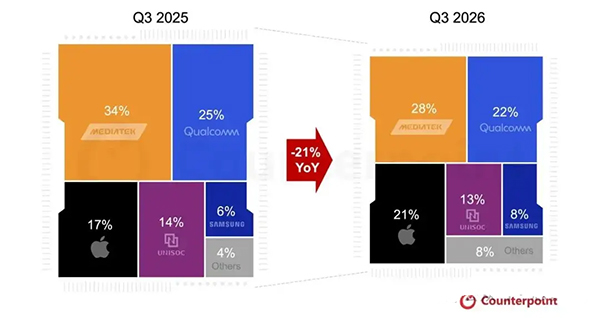
Counterpoint Research analysis states that due to original equipment manufacturers reducing the number of entry-level models and prioritizing profit margin protection, the mid-range and entry-level price tiers are most affected. The premium portion that was initially expected to maintain elasticity has also been affected, albeit to a lesser extent.
Among them, Apple and Samsung have a high degree of supply chain integration and mature high-end products, which are better able to withstand the impact of this round of declining demand. Ziguang Spreadtrum and MediaTek rely more on the mid to low end market and face greater challenges. Qualcomm is facing two pressures: on the one hand, Samsung has decided to mix Snapdragon 8 Elite Gen 5 and self-developed Exynos 2600 on the Galaxy S26 series; On the other hand, the sales of Chinese mobile phone customers are weak.
According to Shivani Parashar, Senior Analyst at Counterpoint Research, there will be three prominent flagship chips released in September 2026, all based on TSMC's 2-nanometer process, namely the Apple A20 series, MediaTek Dimensity 9600 Pro, and Qualcomm Snapdragon 8 Elite Gen 6 series. These new products are expected to boost high-end mobile SoC shipments in the fourth quarter of 2026, but shipments may still be lower than in the fourth quarter of 2025. ”
Storage price increases continue to squeeze BOM costs
According to Counterpoint Research's forecast, the price increase of mobile storage will slow down to 5% to 10% in the third quarter of 2026 compared to the second quarter; The fourth quarter is expected to see a further 5% month on month increase.
The report points out that most storage suppliers are keeping a relatively low profile on price increases, but some entry-level mobile phone manufacturers have begun to adopt recycled storage to control the overall Bill of Materials (BOM) cost. However, the deep integration of SoC with peripheral circuits and RF devices poses significant technical barriers for recycling and reuse, and adoption remains at a niche level.
Soumen Mandal, Chief Analyst at Counterpoint Research, predicts that global smartphone SoC shipments will decrease by 20% year-on-year in 2026, and another 3% to 4% year-on-year in 2027.
Mandal said, "Storage prices are expected to continue to rise, but price fluctuations next year are expected to ease compared to 2026. Although migrating to 2-nanometer processes will bring higher prices, flagship SoC shipments are expected to remain largely stable in 2027.
