


UMC's production capacity is fully loaded, politely refusing Samsung's urgent orders. Mature process outsourcing supply and demand pattern is reversed
Ten thousand urgent orders were delivered to the doorstep, but the connected phone said 'no'. Global smartphone giant Samsung recently urgently added tens of thousands of OLED driver ICs to wafer foundry UMC, but received a response that production capacity is already full and there is nothing they can do to assist. In the OEM market, which used to be "the customer's decision", even the production capacity of temporary card stands for heavy customers is now facing a wall. Behind the gentle refusal of a piece of paper is a deep reversal of the supply and demand pattern of mature process wafer foundry, and it is also the most vivid footnote to this round of global semiconductor boom rotation.
From cutting orders to urgent orders, Samsung's "bottleneck" production capacity hits a wall
Recently, there have been reports in the market that Samsung urgently added tens of thousands of OLED panel driver ICs to UMC due to better than expected smartphone sales. However, UMC considered its production capacity to be close to full capacity and ultimately "politely declined" this heavyweight customer's urgent order, highlighting the reversal of the supply and demand structure of mature process wafer foundry.
The reversal of "cutting orders - chasing orders" is quite dramatic. Sources pointed out that Samsung had previously assessed that smartphones were affected by factors such as memory shortages, significant price increases, and continued global inflationary pressures, and had cancelled orders for up to tens of thousands of OLED driver ICs originally scheduled for production at UMC. But recently, mobile phone sales have been better than expected, and the popularity of the new folding machine is strong. Samsung needs more OLED driver ICs to cope with mobile phone shipments. When they turned to Liandian to "get back" the cancelled production capacity of tens of thousands of pieces, the related production capacity has already been filled by other manufacturers. Considering that the existing production line has already arranged orders for other customers, UMC is unable to temporarily adjust the production schedule and reportedly politely declined Samsung's urgent order.
Earlier leaked details indicate that the impact of supply-demand mismatch has already been transmitted internally to Samsung. According to reports from Korean media, the demand for the Galaxy Z Fold 8 foldable phone released in July far exceeded Samsung's expectations, and sales in the European market increased by 50% compared to the previous generation Z Fold 7 during the same period after its launch. Samsung immediately contacted DDI's exclusive contract manufacturer, UMC, requesting to increase production through a "super urgent order" method. However, UMC's 22nm DDI production line was already operating at full capacity and could not handle urgent orders - accepting Samsung's order would mean delaying delivery to other customers. Samsung was forced to reduce the production plan for Z Fold 8 components originally scheduled for September by about 10% and postpone it to October, and used DDI inventory originally reserved for the development of the next generation of products.
It is worth noting that UMC has long been in an exclusive supply position in the DDI outsourcing of Samsung Galaxy OLED smartphones, and is solely responsible for outsourcing the DDI of Samsung OLED smartphones, including the 22 nanometer process DDI required for the folding machine Galaxy Z Fold 8. The single supply structure, coupled with repeated operations of cutting orders first and then urgent orders, ultimately resulted in this global mobile phone giant being "shut out" in front of the wafer foundry.
Both shipment and revenue reached new highs, with a production capacity utilization rate of 92%
Liandian dares to politely reject Samsung, relying on its fully loaded production lines and solid performance.
On October 28th, UMC held a press conference for the third quarter of 2026 and released its financial report: the consolidated revenue for the third quarter was NT $74.24 billion, an increase of 8.0% month on month and a significant increase of 25.6% compared to the same period in 2025; The shipment volume of wafers in a single quarter exceeded 1.2 million pieces (equivalent to 12 inch wafers), with a quarterly increase of 7.3%, setting a new historical high; The capacity utilization rate has risen to 92%. The cumulative consolidated revenue for the first three quarters was NT $204.01 billion, with a net profit attributable to the parent company of NT $74.865 billion.
The core operating data of UMC in the third quarter of 2026 is shown in the following table:
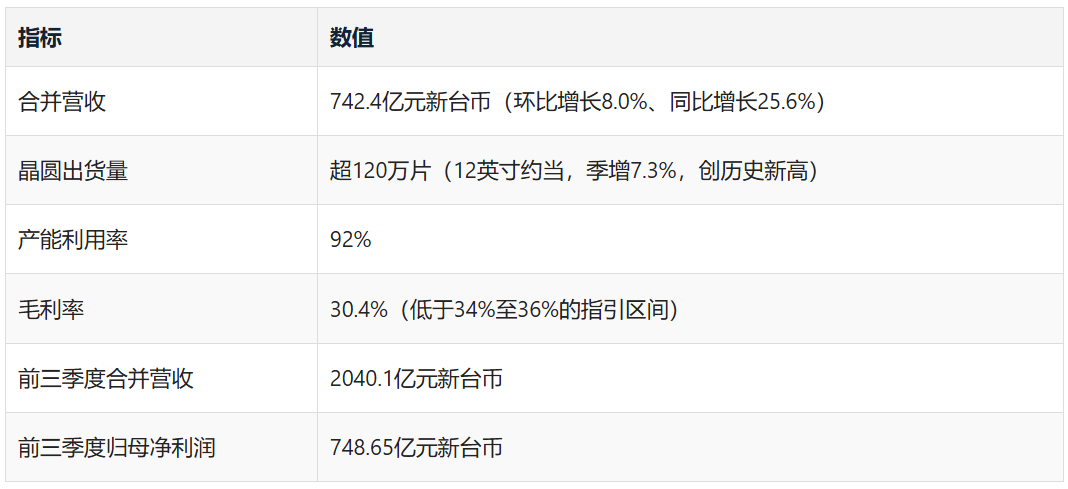
It should be pointed out that the gross profit margin for this quarter was 30.4%, lower than the previous guidance range of 34% to 36%, and profit related indicators fell short of market expectations. UMC previously estimated in France that wafer shipments in the third quarter would increase by 7% to 9%, average selling prices would remain stable, production capacity utilization would exceed 90%, gross profit margin would be around 35%, and revenue, shipment volume, and utilization rate had basically met the guidelines.
The monthly operating pace is also strong: the consolidated revenue in July was NT $23.844 billion, reaching a new high in nearly 45 months, a year-on-year increase of 18.98%. The cumulative consolidated revenue for the first seven months was NT $153.615 billion, a year-on-year increase of 12.41%; In September, the consolidated revenue reached NT $25.35 billion, setting a new monthly record high.
From the perspective of process structure, 22/28 nanometer is the revenue pillar and technological moat of UMC. In the second quarter of 2025, the revenue share of UMC's 22/28 nanometer wafers will increase to 40%, reaching a historic high; Jason Wang, President of UMC, previously stated during a performance conference call that customers are inclined to migrate their next-generation network and display driver applications to UMC's 22 nanometer special process platform. Compared to the 28 nanometer solution, this platform has more advantages in energy efficiency and performance, and the chip speed of 22 nanometer products is accelerating.
In the sub field of OLED driver chip foundry, UMC has been deeply involved in embedded high-voltage process (eHV) for many years. This platform is built on the basis of logic CMOS, integrating logic operation and high-voltage driving functions, supporting LCD and OLED panel requirements, and extending to emerging display applications such as Micro LED and Micro OLED. In May 2026, UMC launched a 14 nanometer eHV FinFET platform, which has been validated at the South China Science and Technology Corporation's 12A factory. It uses fin transistors to replace traditional planar architectures, connecting existing 22 nanometer and 28 nanometer layouts, and further expanding the competitive advantage of advanced display driver chips.
In terms of production capacity layout, the board of directors of UMC has approved an additional capital expenditure of approximately USD 3.2 billion (approximately NTD 103.2 billion) to accelerate the expansion of production in Singapore and Tainan, and to fully deploy silicon photonics, 3D ICs, and advanced packaging; The cash base capital expenditure will remain unchanged at $2 billion in 2026. UMC has previously raised its capital expenditure to $2 billion this year, accelerating the layout of new factories in Singapore and Tainan, and striving to break through $1 billion in AI related revenue within three years. Among them, the third phase of Fab12i's new factory in Singapore is planned to have a monthly production capacity of 30000 pieces, and gradually increase production capacity by 2026; The 12 nanometer FinFET process platform, in collaboration with Intel, is expected to be put into production in 2027.
Market research firm Sigmientell predicts that the mature process capacity utilization rate of UMC will reach 93% in the fourth quarter of 2026.
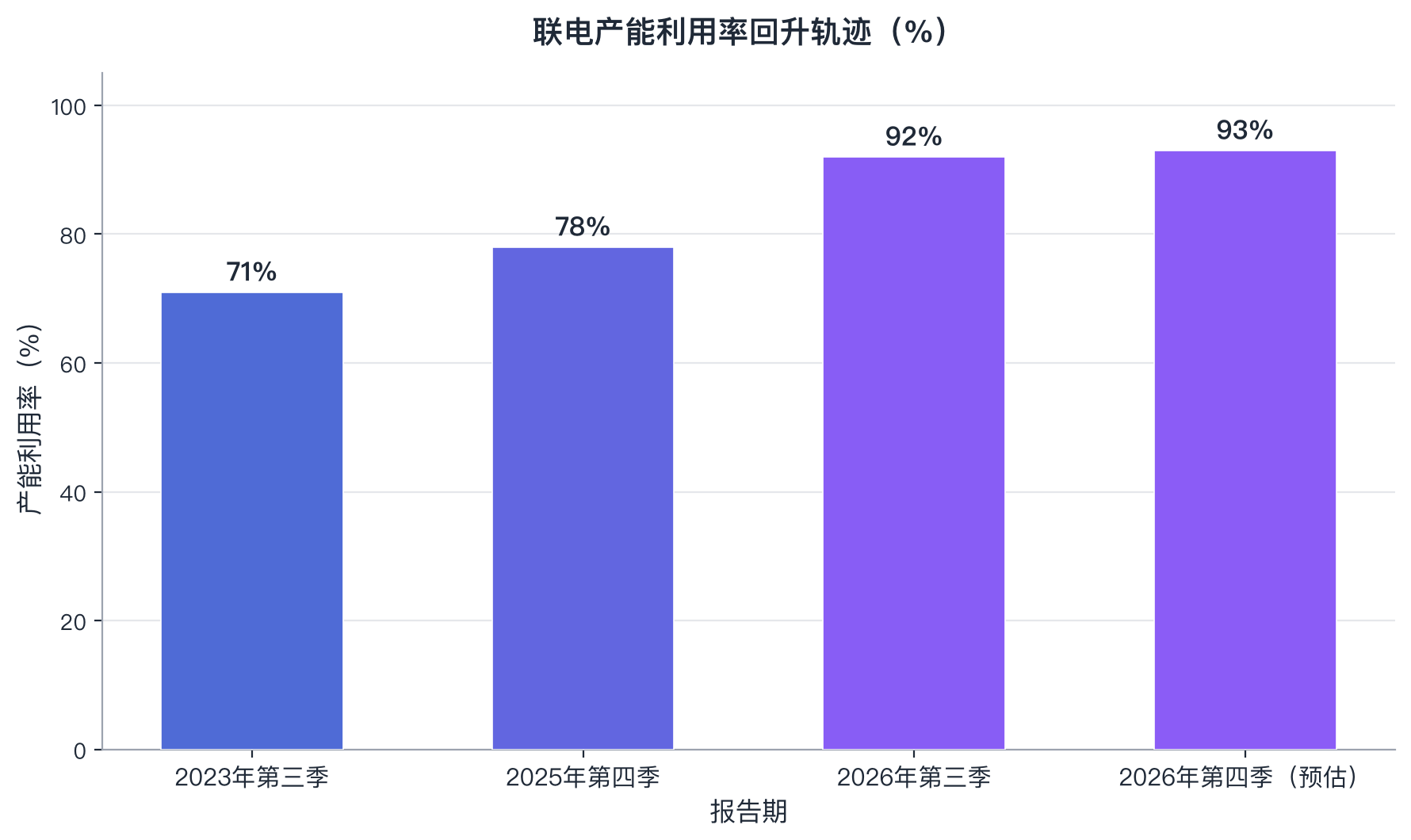
Chart interpretation: The capacity utilization rate of UMC has rebounded from 71% in the third quarter of 2023 to 78% in the fourth quarter of 2025, and then to 92% in the third quarter of 2026. It is expected to reach 93% in the fourth quarter of 2026. The sharp rebound in the utilization rate of UMC's production capacity, which has been hovering around 70% for seven consecutive quarters in the industry downturn cycle and is now approaching full load, is the most intuitive footnote to the supply and demand reversal of mature processes in this round.
Mature processes shift from 'surplus anxiety' to 'comprehensive shortage'
UMC's polite rejection of Samsung is not an isolated incident, but a microcosm of the current reversal in the mature process industry.
According to a forecast report released by research and research firm Sigmaintell, benefiting from the recovery of the semiconductor market and rising energy and material costs, the average capacity utilization rate of mature process wafer foundries worldwide will reach 91% in the fourth quarter of 2026. TrendForce also predicts that by 2026, the average capacity utilization rate of the top ten global wafer foundries for eight inch wafers will rebound to nearly 90%, significantly higher than about 80% in 2025.
The current reversal of supply and demand structure is jointly driven by three forces.
Firstly, the expansion of AI infrastructure has driven a significant increase in demand for peripheral chips. The expansion of AI infrastructure construction has driven a significant increase in demand for NOR Flash, high-performance MCU, and high-performance power management chips mainly produced at 55nm and 90nm; The demand for power management in AI servers has increased, allowing the 8-inch production line to maintain high load operation. Some AI servers still mainly use the 8-inch process for 48V high-voltage PMIC, and order visibility is generally close to half a year.
Secondly, leading manufacturers are shrinking their supply of mature processes. TSMC, Samsung and other manufacturers have reduced some 8-inch production capacity and shifted resources to advanced processes. It is expected that the global 8-inch wafer foundry capacity will decrease by about 6% year-on-year in 2026, and will continue to decline in 2027; Due to the long release cycle of new production capacity, the tight supply and demand situation of 8 inches is still difficult to alleviate in the short term. TrendForce points out that international giants are shifting their resources towards 12 inch and advanced processes, leading to conservative investment in 8-inch production capacity, a shift in supply and demand structure, and strengthening the bargaining power of contract manufacturers over prices.
Thirdly, the OEM actively optimizes the product portfolio. Due to the surge in demand for power management chips, contract manufacturers are shifting their production capacity towards high margin applications such as AI related power management ICs and power devices, while compressing the production capacity configuration of low margin products such as display driver ICs. Some mature 12 inch processes with limited production capacity have seen a price increase of 5% to 10%.
The tightening of supply and the warming of demand jointly drive the prices of mature processes into an upward channel. Sigmaintell data shows that mature process prices have diverged in the fourth quarter of 2026: the prices of 28 nanometer and 40 nanometer wafers remain at $2500 and $1900, respectively, unchanged from the previous quarter; The price of 90nm wafers increased by 4% month on month to $1250. The institution expects that the prices of 12 inch and 8-inch mature process wafer foundries will increase comprehensively in the first quarter of 2027, with a month on month growth rate ranging from 4% to 8%: the price of 28 nanometer wafer foundries is expected to increase by 6% to $2650, and the price of 40 nanometer wafers is expected to increase by 5% to $2000; The 90 nanometer process has the most significant upward trend, with an additional 8% increase to $1350.
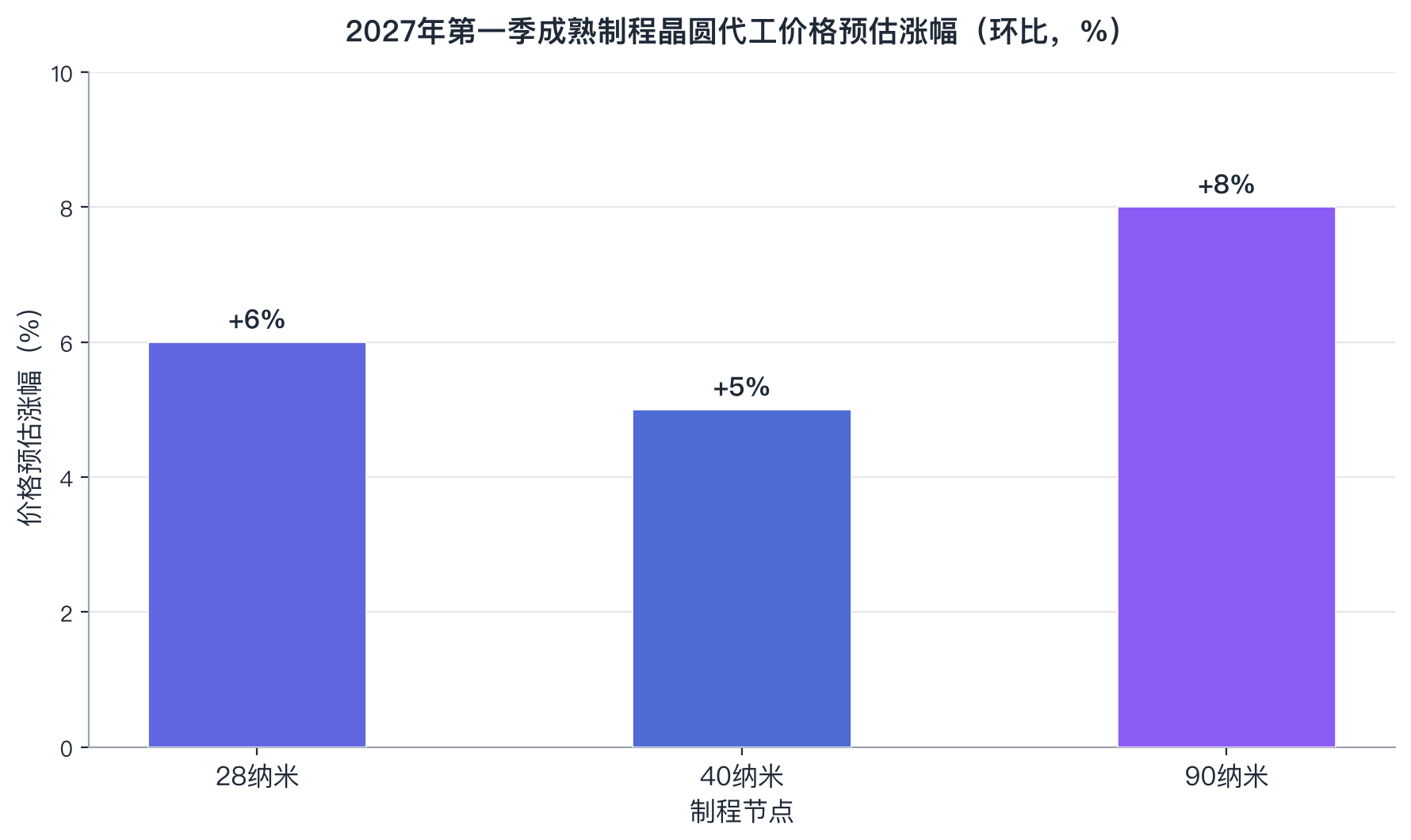
Chart interpretation: In the first quarter of 2027, prices of various mature process nodes will rise comprehensively, with an estimated increase of 8% for 90 nanometer, ranking first among all nodes; 28nm and 40nm are expected to increase by 6% and 5% respectively. In absolute terms, 28nm will increase from $2500 to $2650, 40nm from $1900 to $2000, and 90nm from $1250 to $1350. Mature process prices have risen across the board, confirming that the supply-demand balance has tilted towards the seller.
The wave of price increases is also spreading among Taiwanese industry peers. In July, TSMC raised the DRAM chip investment price by about 45%, and the 8-inch and 12 inch logic foundry chip investment prices were simultaneously increased by 10% to 15%; Industry research suggests that price increases for mature processes may continue until 2027, with some processes facing tight supply showing a 5% to 10% increase intention between the second and third quarters of 2026.
Under the economic downturn, the management philosophy of contract factories has also changed accordingly. Liandian emphasizes adhering to the discipline of price and gross profit margin, and not sacrificing profits for the pursuit of market share. The industry believes that there has been a structural change in the global wafer foundry market, with some mature process capacity becoming tight and contract manufacturers having increased options to take orders. Only by confirming that demand is structural can manufacturers have the confidence to abandon the "price for quantity" policy.
Samsung urgently seeks a second supplier, DDI's OEM pattern is brewing to loosen
After being politely rejected by UMC, Samsung has started to break the single supply pattern.
According to South Korean media ZDNet, Samsung is considering introducing a second foundry partner for the OLED display driver chip of Galaxy phones. The US wafer foundry, GlobalFoundries, has become the main evaluation target, and Samsung is inspecting GlobalFoundries' 22nm and 28nm production facilities in Singapore and Germany. If the cooperation is implemented, DDI chips manufactured by Gexin may enter the Galaxy mobile phone supply chain as early as the end of 2027 and be used first in mid to low end Galaxy A series models equipped with OLED screens.
The reason why DDI has become a bottleneck link in this round is closely related to its technical characteristics. The display driver chip can be regarded as the "traffic command system" of mobile phone screens, responsible for converting the image data sent by the processor into voltage, current, and timing signals that can be recognized by each pixel of the screen; In OLED phones, DDI requires precise control of the current and grayscale of each pixel to achieve high contrast, wide color gamut, and high refresh rate. Samsung's mobile DDI also supports variable refresh rates from 1Hz to 144Hz, seeking a balance between smoothness and power consumption.
From the perspective of market space, the demand for OLED driver chips is still steadily expanding. According to Omdia data, global OLED DDIC shipments will reach 835 million units in 2024, and are expected to reach 1.084 billion units by 2030, with a compound annual growth rate of approximately 4.5%; The global market size of display driver chips has exceeded 12 billion US dollars. In the next three to five years, with the continuous penetration of downstream application fields such as mobile terminals, smart wearables, industrial control, and car displays, as well as new display technologies such as AMOLED, the market size is expected to exceed 15 billion US dollars. Omdia data also shows that by 2025, the penetration rate of OLED in the total demand of the world's top 10 mobile phone manufacturers will reach 65%.
Folding screens are a new growth variable in DDI demand. Compared to traditional smartphones, foldable screens have tighter available space behind each panel and more complex display system designs. The highly integrated OLED TDDI is expected to become the mainstream design of foldable phones faster and gradually expand to ordinary smartphones. In the second half of 2026, Apple's first foldable screen phone is expected to debut, and the Android brand is also expected to expand its layout around this niche market, injecting new momentum into the demand for high-end OLED driver chips.
For Liandian, politely refusing urgent orders may seem like giving up orders in the short term, but in the long run it maintains the stability of production line scheduling and relationships with other customers; For Samsung, this setback has exposed the fragility of a single supplier structure in the face of demand fluctuations, and the pattern of Galaxy OLED DDI outsourcing "one supplier only" is brewing to loosen.
In the era of bargaining power transfer, the "sweet troubles" of contract factories
UMC politely declined Samsung's urgent order, which is a landmark event in the deep reversal of the supply and demand relationship of mature process wafer foundry. From multiple quarters of capacity utilization hovering around 70% in 2023, to full load operation in the third quarter of 2026 and an expected surge to 93% in the fourth quarter, contract factories will regain control over order taking and pricing; With the upcoming comprehensive increase in mature process prices in the first quarter of 2027, the prosperity of both volume and price of mature process outsourcing is expected to continue.
Variables also exist. Some manufacturers have warned in their financial reports that although mature processes may experience temporary price increases, the concentrated expansion of production in the industry may lead to the continued accumulation of long-term overcapacity risks; The future of the terminal is uncertain, and the price increase of storage and advanced processes is squeezing the material cost of the whole machine. The rhythm of the price increase still remains variable. For contract manufacturers, balancing production capacity allocation and maintaining customer structure during the boom period will be more crucial than simply pursuing utilization rate; For the entire industry, the return of the era of "customer queues and OEM orders" is rewriting the competitive rules of mature process links.
