

Murata Manufacturing announced an investment of 1 trillion yen to expand MLCC production capacity, aiming to double production capacity by 2030 and meet the demand for AI data centers
On October 30th, Murata Manufacturing, a global leader in MLCC (multi-layer ceramic capacitors), announced that it will invest approximately 1 trillion yen over the five years from fiscal year 2026 to fiscal year 2030 to expand MLCC's global production capacity. The goal is to achieve MLCC sales at least twice that of fiscal year 2025 by fiscal year 2030.
(Murata Production Press Release Title)
According to Murata's announced plan, out of this approximately 1 trillion yen investment, factory construction accounts for about 350 billion yen and production equipment accounts for about 650 billion yen. Specific actions include building new factories, installing production equipment, increasing existing equipment production capacity, and purchasing some land in existing production bases both domestically and internationally in Japan.
In Japan, the company will establish a new Okayama Oda Manufacturing Plant and build an electronic component factory for Izumura Oda Manufacturing Plant in Anlai City, Shimane Prefecture. As a result, Murata's MLCC production in Japan will form a pattern of three bases, Fukui, Izumo, and Okayama, standing side by side. The total investment for the Okayama base is about 150 billion yen. The new MLCC production building is expected to be completed by the end of 2028, and the MLCC wafer and raw material production building is expected to be completed by 2030. The company plans to build a workforce of 1500 to 2000 people at the base by 2030.
Overseas, Murata Electronics in Thailand plans to build a new production building before 2030, while the Philippine factory plans to renovate its production line using idle areas of existing factories before 2027. Existing factories in Japan, ASEAN, and China will also systematically add equipment every year. Murata stated that in addition to capital investment, the company will also simultaneously promote talent assurance and training, production technology upgrading, stable procurement of raw materials, and strengthen cooperation with suppliers including equipment manufacturers.
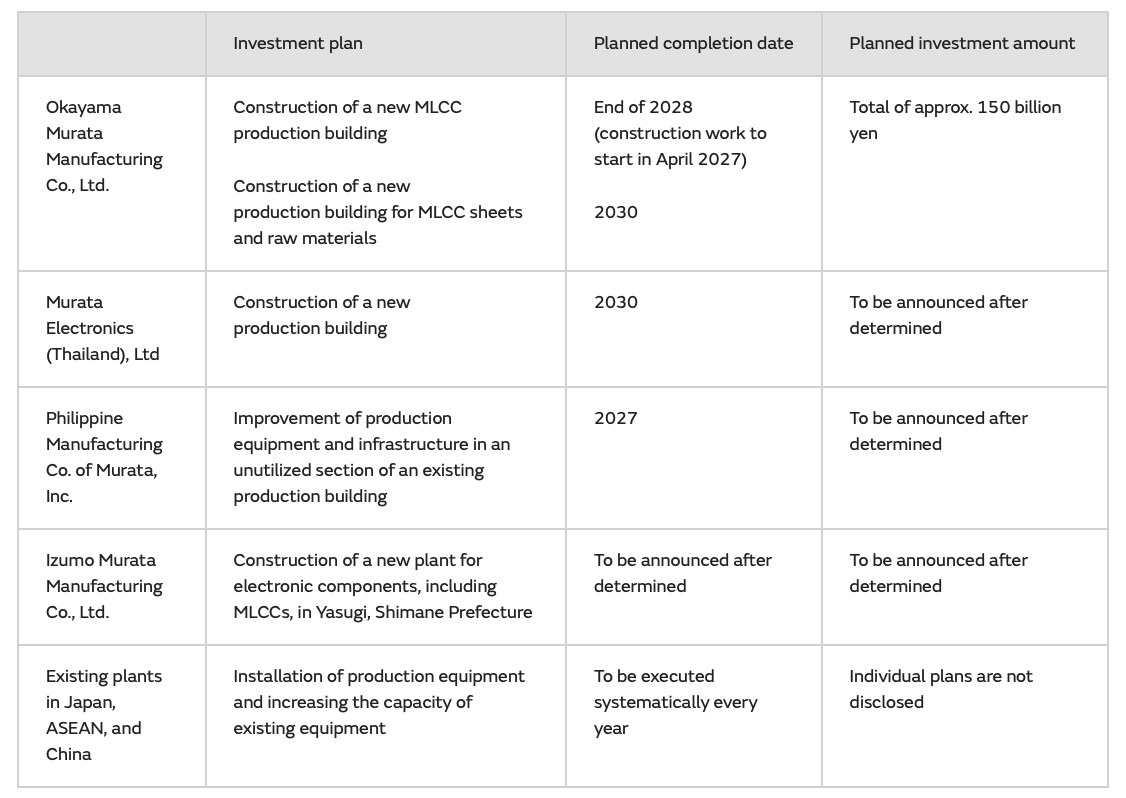
(Overview of Murata Investment Plan)
Murata has launched a trillion yen expansion plan at this point, against the backdrop of the entire industry being driven by the demand for AI servers. The company has previously arranged an additional investment of approximately 80 billion yen in MLCC production equipment for the two years ending in fiscal year 2027, and the new factory in Izumo is expected to reach full production in 2027.
AI servers have a strong demand for capacitors
The function of MLCC is to store energy and stabilize voltage. During the operation of AI chips, microsecond level power fluctuations may occur, making it difficult for traditional power systems to respond. MLCC deployed closely to the chip can instantly release power and avoid server failures.
The surge in usage is more indicative of the problem. Goldman Sachs' research report points out that MLCC has risen to become the third largest item in the material cost of AI servers, second only to GPUs and storage chips. According to TrendForce data, the Nvidia VR200NVL72 server uses approximately 600000 MLCCs, which is over 30% higher than the previous generation GB300 platform.
The supply-demand gap has been revealed in the data. According to a TrendForce survey, in June 2026, MLCC shipments from three major Japanese and Korean manufacturers, Murata, Samsung Electric, and Sunac, simultaneously reached a new high in nearly five years, with Murata shipping approximately 140 billion units per month. The BB values (order to shipment ratio) of the three companies during the same period reached 1.30, 1.31, and 1.25, respectively, the highest level since the outbreak of the epidemic. The institution also pointed out that the expansion cycle of high-end MLCC takes 18 to 24 months, and the tight delivery schedule may continue until 2027.
Murata is not the only company expanding MLCC production. Kyocera President and CEO Shiro Sakishima revealed in an interview with Nikkei News that Kyocera will invest approximately 100 billion yen in MLCC production equipment between fiscal years 2024 and 2030 for the expansion of MLCC production for AI servers. Sun Electric's President, Ke Sase, also stated that the company's mid-term plan for the 2026-2030 fiscal year was to expand MLCC production by about 10% per year. "Depending on the trends of customers such as ultra large scale cloud service providers, it is possible to increase the expansion rate to 15% per year. Samsung Electric announced in September 2026 that it had secured a large AI server MLCC order worth $760 million and is accelerating the construction of a new factory in the Philippines.
Record breaking performance and doubled guidance
The confidence in this round of production expansion comes from performance. Murata's financial report for the fiscal year 2025 (ending in March 2026) shows that the company's revenue reached 1.8309 trillion yen, setting a historical record and increasing by 5.0% year-on-year; Operating profit was 281.8 billion yen, a year-on-year increase of 0.8%. Among them, the revenue of the capacitor business was 936.4 billion yen, a year-on-year increase of 12.6%. The company clearly attributed the growth to the "increase in demand for servers as the main purpose".
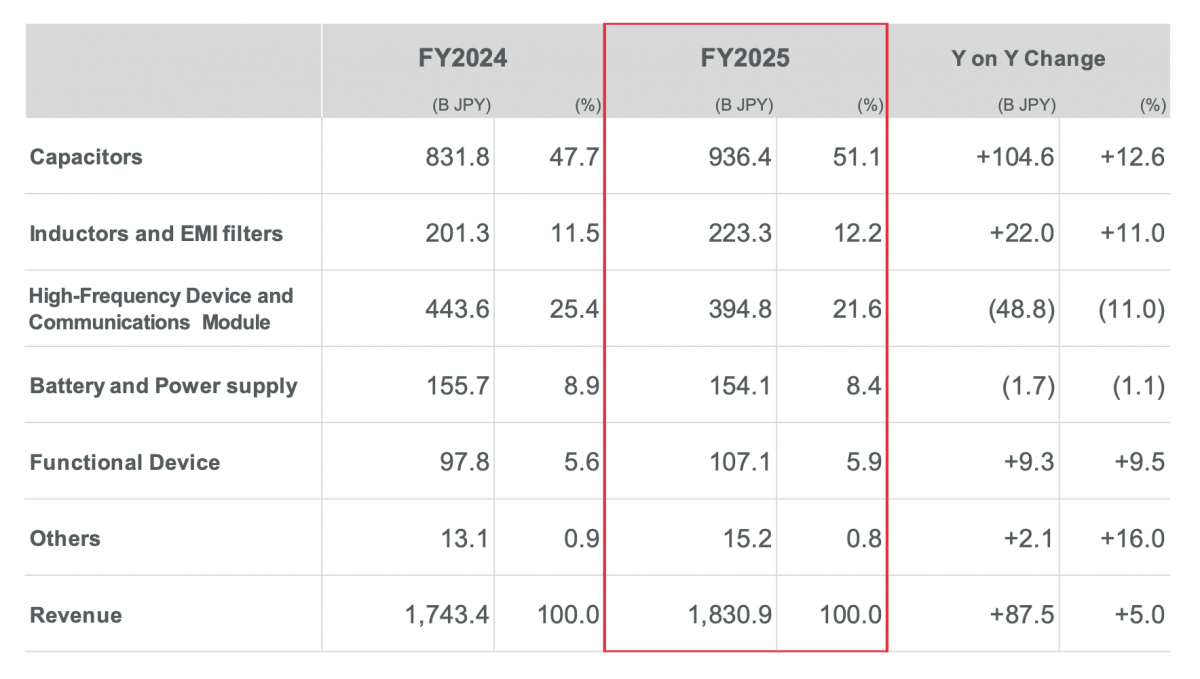
(Murata's revenue for fiscal year 2025, divided by business)
On April 30, 2026, Murata gave aggressive guidance for the 2026 fiscal year: expected revenue of 1.96 trillion yen, a year-on-year increase of 7.1%; Operating profit was 380 billion yen, a year-on-year increase of 34.8%. On July 31st, Murata raised its annual revenue forecast to 2.11 trillion yen and operating profit to 430 billion yen, with the capacitor business expected to generate 1.1575 trillion yen in revenue, a year-on-year increase of 23.6%.
Murata Productions' President, Keiju Nakajima, previously stated at a financial statement that the demand for MLCC related to AI servers is expected to double in the 2025 fiscal year, and the company plans to use MLCC business for AI servers at an average annual growth rate of about 30%.
