


AI production capacity investment is' cashing out ': semiconductor equipment prosperity seen from ASM financial report
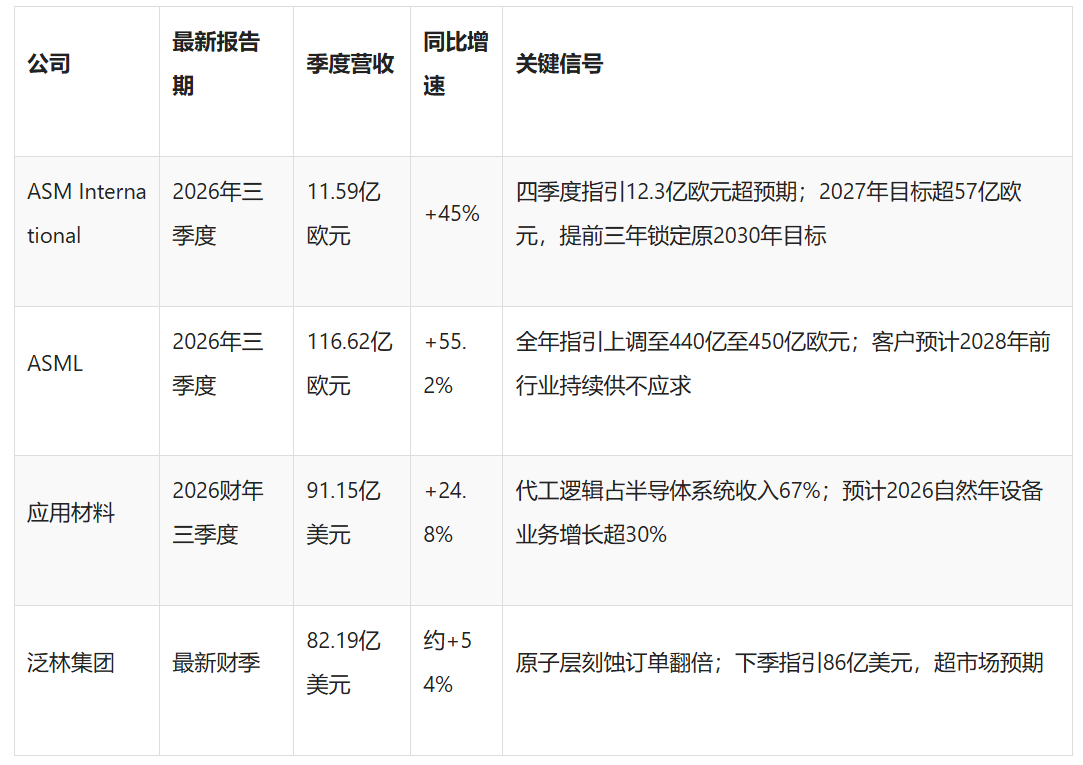
ASM International's third quarter report exceeded expectations three times: revenue increased by about 45% year-on-year, fourth quarter guidance was higher than consensus expectations, 2027 target was raised to over 5.7 billion euros, and the company locked in its 2030 target three years ahead of schedule, attributed to AI related capacity investment.
Core Viewpoint
The rarity of ASM's third quarter report lies not in the unexpected magnitude, but in the way it is "fulfilled": the revenue for the current quarter, the guidance for the next quarter, and the mid-term target all exceed the three lines. For the first time in the company's history, the 2027 guidance has been given ahead of schedule, locking in the sales target originally scheduled for 2030 three years ahead of schedule. As a result, AI energy investment has changed from a "narrative" in the financial conference call to a falsifiable fiscal year target.
2. Clear and verifiable transmission chain: Cloud manufacturers' AI capital expenditures are flowing towards AI chips and high bandwidth storage expansion, and advanced process unit capacity investment is increasing generation by generation. ALD, as a "standard" for advanced process thin film technology, has become a deterministic beneficiary link, and ASM holds the core position of the world's largest ALD market share.
3. Industry cross-section confirms the resonance of prosperity: ASML's revenue in the third quarter increased by 55.2% year-on-year, applied materials increased by 24.8%, and Panlin Group increased by about 54%. SEMI has raised its global equipment sales forecast for 2026 to $165.9 billion; The proportion of AI related equipment expenditure has jumped from about 15% to about 35%, becoming the dominant variable in equipment demand.
4. Under high expectations, it is necessary to focus on verification variables: supply chain and clean room bottlenecks constrain delivery pace, structural differentiation in storage expansion, and geopolitical disturbances in export controls are all key observation items for judging the "second half" of the economic boom; The matching degree of order shipment and the progress of fulfilling the 2027 guidance will determine the degree to which the market shifts from narrative driven to performance driven.
Triple Exceeding Expectations: The Value of a 'Cash in' Financial Report
The rarity of this financial report lies not in the unexpected magnitude, but in the way it is' fulfilled '. ASM International's revenue for the third quarter was 1.159 billion euros, a year-on-year increase of 45% (with a fixed exchange rate growth of 44%), falling within the guidance range and setting a single quarter record, significantly higher than the market expectation of 1.1 billion euros; The gross profit margin remained at a high level of 52.0%, with a net profit of 308.1 million euros. The guidance for the fourth quarter is 1.23 billion euros, with a fluctuation of 5%, which is also higher than the average analyst estimate of 1.18 billion euros in the London Stock Exchange Group survey.
What really surprises the market is the mid-term target. ASM expects its revenue to exceed 5.7 billion euros in 2027 at a fixed exchange rate, a significant increase of about 24% from the original forecast of "over 4.6 billion euros" in July this year, and also higher than the average analyst estimate of 5.41 billion euros. This means that the company's originally planned sales target for 2030 will be achieved three years ahead of schedule in 2027. Michael Rogge, a senior analyst at Degroof Petercom, summarized this financial report as a "triple beat": third quarter performance, fourth quarter guidance, and annual outlook, all three lines exceeded expectations.
JPMorgan Chase has highlighted a deeper signal in its latest report: for the first time in ASM's history, it has provided guidance for the next fiscal year before the start of the fourth quarter. In the company's view, this action conveys the judgment that the visibility of orders is "very strong"; However, given ASM's cautious guidance style, the numbers given in advance are likely to be conservative - the guidance implies a revenue growth rate of about 34% in 2027, which is even lower than JPMorgan's forecast of a 38% increase in wafer fab equipment (WFE) spending in 2027, and there is still room for upward adjustment in the future.
The capital market's response was direct and sufficient: on the day of the financial report release, ASM's American Depositary Receipts rose 7.89% to $836.74, and the company simultaneously announced a stock repurchase plan of up to 300 million euros. CEO Hichem M'Saad's statement is the key to understanding this financial report: "The demand environment remains very strong, and our customers are generally facing tight production capacity, and are quickly taking action to increase production." The company also acknowledges that the supply chain is under tension and is working with suppliers and customers to accelerate equipment delivery. The strong demand has forced companies to discuss supply side constraints, which has always been a confirmation signal of business strength in the equipment industry.
From AI capital expenditures to equipment orders: the transmission chain is running smoothly
How can AI production capacity investment become a revenue statement for equipment manufacturers? The transmission chain can be broken down into three levels: the capital expenditure of cloud manufacturers and Internet platforms flows to AI accelerated chips and high bandwidth storage (HBM), and the demand for chips drives the expansion of foundry and storage manufacturers, which ultimately falls into equipment orders.
The upstream of the chain is still being strengthened. Gartner predicts that global artificial intelligence spending will reach $2.67 trillion in 2026, a year-on-year increase of 49.5%, with over half of it going towards infrastructure. The confirmation on the manufacturing side is more specific: ASM's main customer TSMC's capital expenditure plan for 2026 exceeds 52 billion US dollars, with some guidelines ranging up to 64 billion US dollars; Intel also plans to invest approximately $20 billion in the construction of new factories and equipment procurement.
The structural changes in the middle section are more worthy of attention. The "unit capacity investment" of advanced processes is gradually increasing - the unit capacity investment of 3-nanometer nodes has increased by 38% to 55% compared to 5-nanometer nodes, and the unit capacity investment of 2-nanometer nodes has increased by about 50% compared to 3-nanometer nodes; More than 70% of the capital expenditure in the semiconductor manufacturing process is directly invested in equipment. In other words, even with the same expansion of wafer production capacity, the proportion of "cake" that flows into the hands of equipment manufacturers in the advanced process era is naturally increasing. According to statistics from Nikkei Asia, the demand for AI related equipment such as HBM stacking, CoWoS advanced packaging, and GAA surround gate has risen from about 15% to about 35% of global equipment spending, more than doubling in three years.
The end of the chain was confirmed by ASM itself. The company has clearly stated that the growth momentum for 2027 will mainly come from strong demand from storage chip and advanced logic chip manufacturers - as technology companies expand their AI data centers, semiconductor manufacturers are accelerating production expansion and increasing investment in advanced equipment. ASML provided side validation during the same cycle: during the third quarter earnings conference call, management stated that the current planned supply for 2027-2028 is still insufficient to meet demand, and some customers are already discussing orders for 2029 and even 2030.
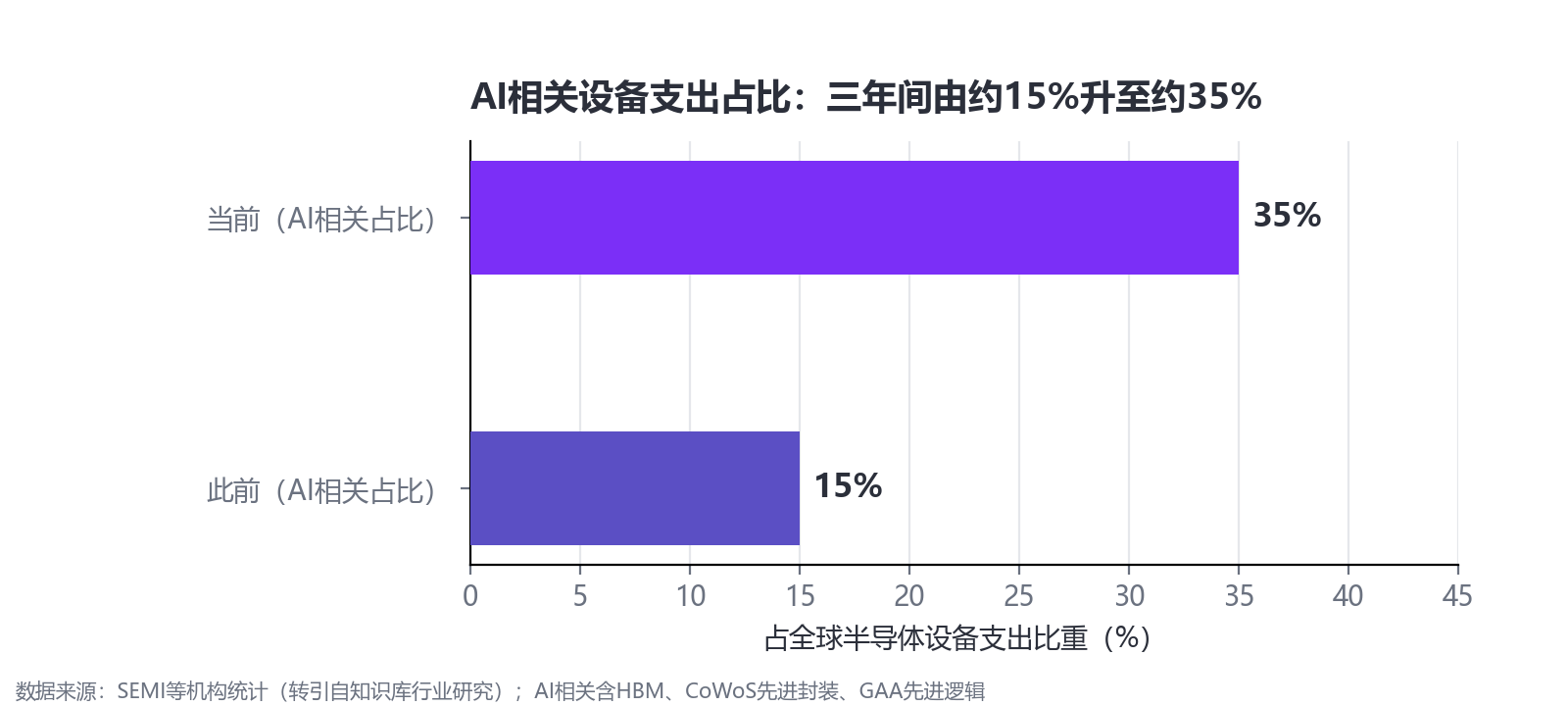
The transition from 15% to 35% in proportion means that the dominant variable of device demand has switched: in the previous cycle, we looked at the pace of phone and PC replacement, and in this cycle, we looked at the progress of AI computing infrastructure construction. Structural forces are replacing cyclical forces, which is the core characteristic that sets this round of equipment market apart from the past, and also the reason why the three words "prosperity" can be discussed as growth in the current context.
ALD card position: a technical barrier for depositing one atomic layer at a time
Why can ASM achieve excess growth in AI expansion? The answer lies in the process characteristics of its main business - atomic layer deposition (ALD). ALD only deposits one atomic layer onto the wafer at a time, with precise thickness control to the angstrom level, achieving almost 100% step coverage on complex three-dimensional structured surfaces. The more advanced the chip process, the deeper the dependence on the ability to "build atom by atom": High-K gate dielectric, alternating stacking of silicon and germanium in GAA nanosheets, and high aspect ratio step filling in 3D NAND all rely on conformal deposition by ALD.
More importantly, the direction of technological evolution. With the migration of DRAM memory to logic like high dielectric constant metal gates and even 4F2 architectures, and the advancement of logic chips towards backside power supply networks and 1.4 nanometer nodes, the number of layers and complexity of ALD and epitaxial processes will continue to increase - as advanced processes advance, the number of ALD processes will not remain the same but increase. This is the underlying logic behind ASM's ability to outperform the WFE industry in the long term, and it is also the industry basis for JPMorgan Chase's judgment that its 2027 profit forecast will continue to be revised upwards.
ASM's bottleneck in this stage is almost textbook level. In 2007, the company's Pulsar ALD equipment became the world's first system for large-scale production of hafnium based High-K materials, establishing its position as the world's largest ALD equipment supplier with a market share of over 50% at one point; According to Gartner, ASM's global ALD market share reached 46% in 2020, ranking first; According to VLSI Research, the market share of single wafer ALD equipment in 2019 reached 53%. Morgan Stanley's statement is more straightforward: ASMI has taken a dominant position in the logic chip market of ALD equipment, and major advanced process manufacturers worldwide have adopted its equipment in 5-nanometer, 3-nanometer, and 2-nanometer processes.
The market space itself is also expanding. According to ASM's forecast disclosed on Investor Day in 2023, the global ALD market size is expected to reach approximately $2.6 billion in 2022, $3.1 billion to $3.7 billion in 2025, and $4.2 billion to $5 billion in 2027, with a compound annual growth rate of 10% to 14% from 2022 to 2027. Compared to the current AI driven expansion pace, the probability of this prediction being conservative is not low - ASM has advanced its 2030 target to 2027, which is itself the most direct repricing of the industry's growth rate. In addition, the company acquired Italian LPE in 2022 to enter the silicon carbide epitaxial equipment market, providing a second growth curve for electric vehicle power device demand beyond ALD.
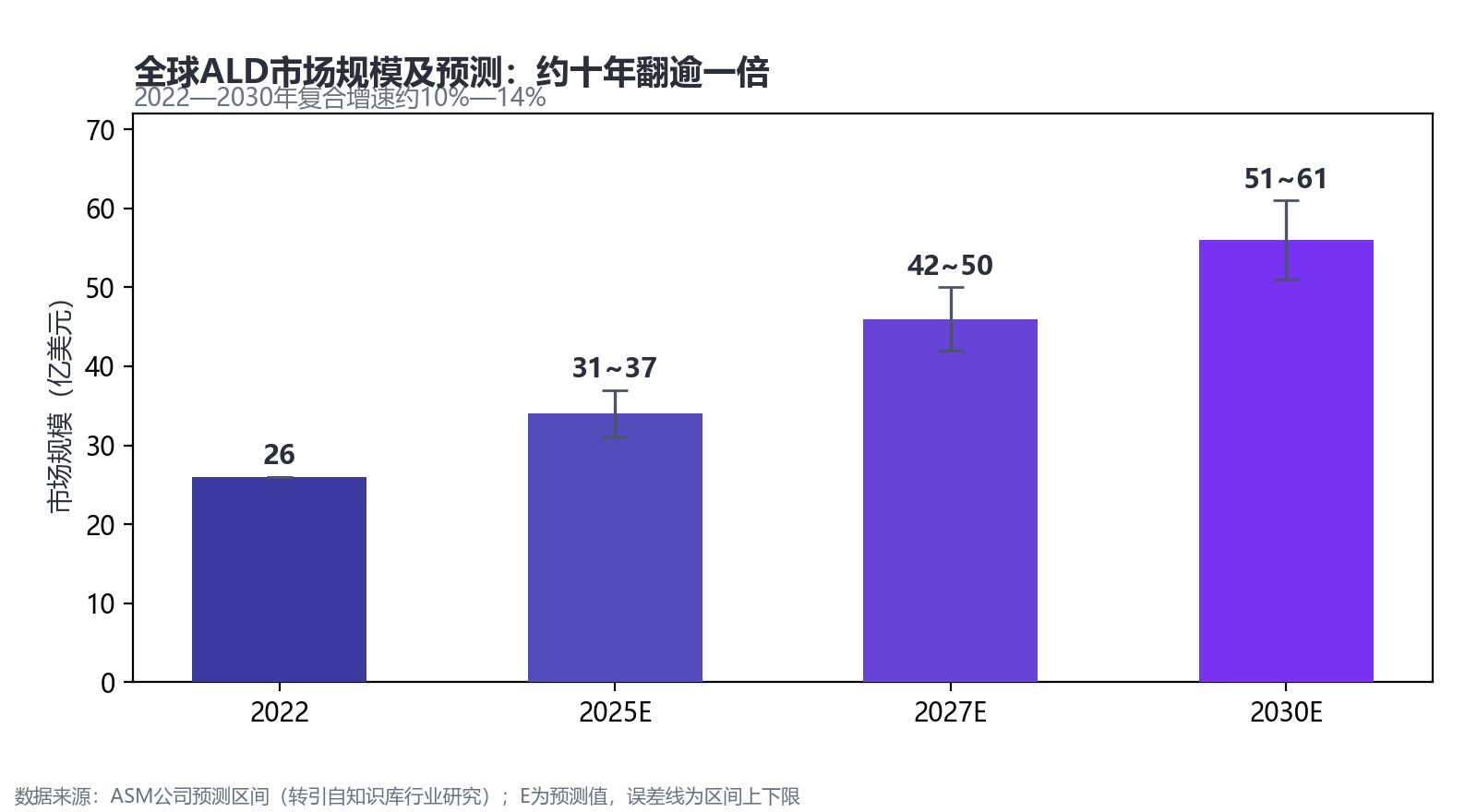
ALD is a link that promotes both "advanced process penetration rate" and "single machine value": with each generation of process nodes, the increase in ALD process layers leads to an increase in equipment usage, while the technical barriers brought by angstrom thickness control support equipment unit price and gross profit margin. The mapping on the domestic production chain is also clear: Micro conductive Nano is the first manufacturer in China to apply mass-produced High-K ALD equipment to the front-end production line of integrated circuits. Its ALD products have ranked first among similar domestic enterprises in terms of revenue scale, total orders, and market share for consecutive years; Tuojing Technology's ALD equipment revenue surged by 191.8% year-on-year, with a cumulative shipment of over 140 reaction chambers. When the global ALD cake expands at a double-digit compound growth rate, the technology card holders in the equipment sector, whether in Amsterdam or on local production lines, are sharing the dividends of the same advanced process.
Industry Cross Section: Resonance of ASML, Applied Materials, and Panlin's Prosperity
The unexpected performance of a single company may be explained as individual execution, but when leading equipment manufacturers collectively deliver unexpected results in the same cycle, there is cross-sectional evidence of industry prosperity.
In the photolithography process, ASML achieved a net sales revenue of 11.662 billion euros in the third quarter, a year-on-year increase of 55.2%, setting a new historical high; Net profit of 4.96 billion euros, a year-on-year increase of 133.4%; The company has also raised its net sales guidance for the full year of 2026 to € 44 billion to € 45 billion, and expects it to further increase to € 14.2 billion to € 15.2 billion in the fourth quarter. The signal on the order side is even more leading - in the previous quarter, its new orders reached a record high of 13.2 billion euros, far exceeding market expectations, with storage customers contributing more than half. On the production capacity side, ASML is promoting expansion based on a production capacity plan of approximately 65 low numerical aperture EUV machines by 2026, with plans to increase production by 30% in 2027 and another 30% in 2028; The high numerical aperture EUV with a unit price of up to 380 million US dollars has also received a total of 18 orders from TSMC, Intel, and Samsung.
In the deposition and etching process, Applied Materials achieved a revenue of 9.115 billion US dollars in the third quarter of fiscal year 2026, a year-on-year increase of 24.8%, with a gross profit margin of 50.3%; Among them, the semiconductor system business revenue was 7.04 billion US dollars, a year-on-year increase of 26.5%, with foundry and logic accounting for 67%, and DRAM revenue accounting for 26% from 22%, reflecting a significant recovery in storage capital expenditure driven by AI computing power. The management expects the company's semiconductor equipment business to grow by over 30% in the natural year 2026. Panlin Group's latest quarterly revenue was 8.219 billion US dollars, a year-on-year increase of about 54%. The next quarter's guidance is 8.6 billion US dollars, with a fluctuation of 400 million US dollars; Its Atomic Layer Etching (ALE) equipment orders have doubled, focusing on 3D NAND stacking with over 400 layers - ALE, which belongs to the same "atomic level processing" camp as ALD, has seen a surge in orders, confirming the density requirements of advanced structures for atomic level processes from the etching side. The management of Panlin has also made a scale judgment: approximately $2.5 trillion in AI data center capital expenditures over the next five years will correspond to approximately $200 billion in wafer fab equipment expenditures, of which more than half will flow towards storage.
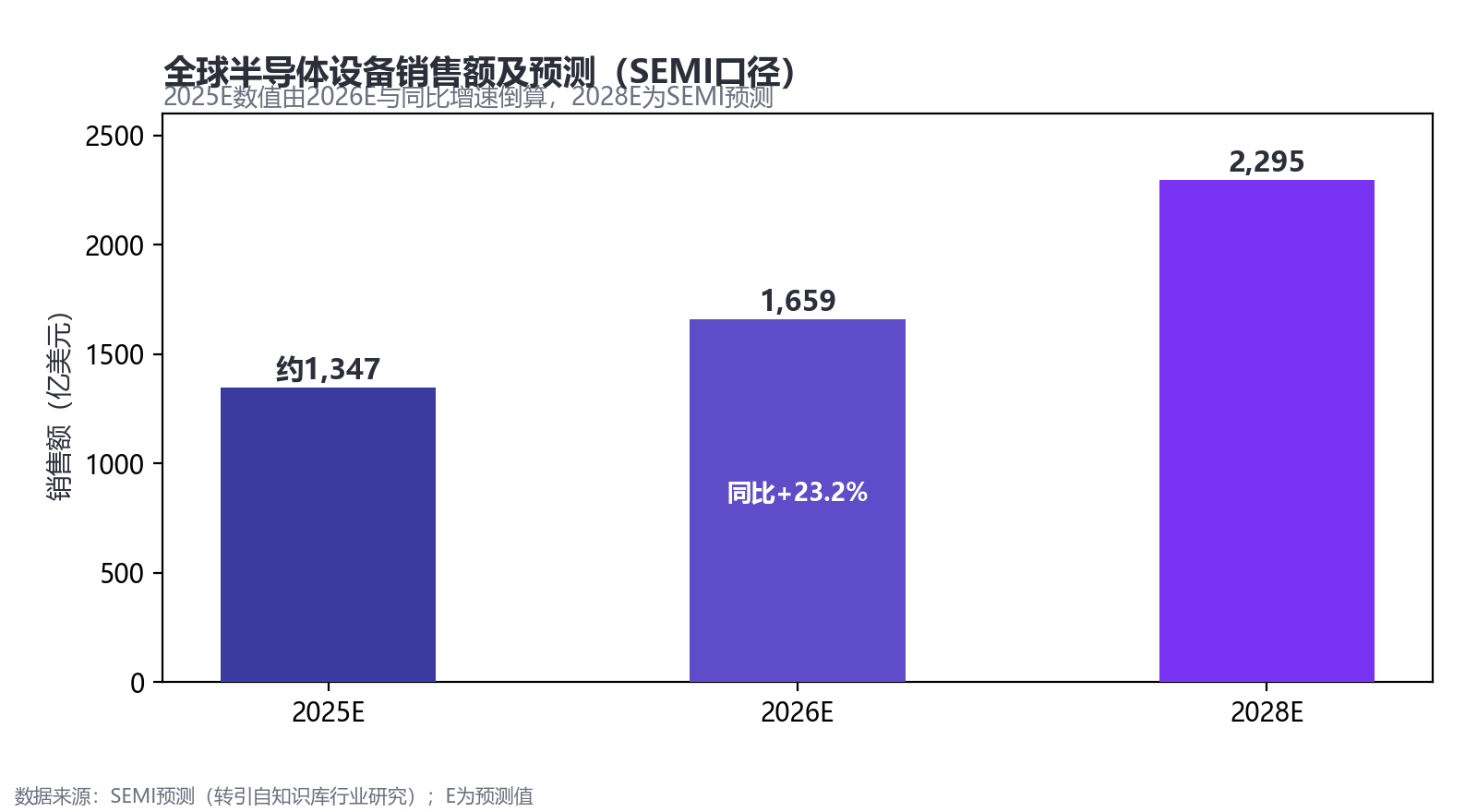
The total caliber is also undergoing revision. SEMI predicts that global semiconductor manufacturing equipment sales will reach $165.9 billion in 2026, a year-on-year increase of 23.2%, reaching a historic high. It is expected to further increase to $229.5 billion in 2028, achieving five consecutive years of growth; The investment in front-end equipment for 300mm wafer fabs is expected to reach 149 billion US dollars in 2026, a year-on-year increase of 31%. CITIC Securities is more aggressive, predicting that the global semiconductor equipment market size will exceed $290 billion by 2028.
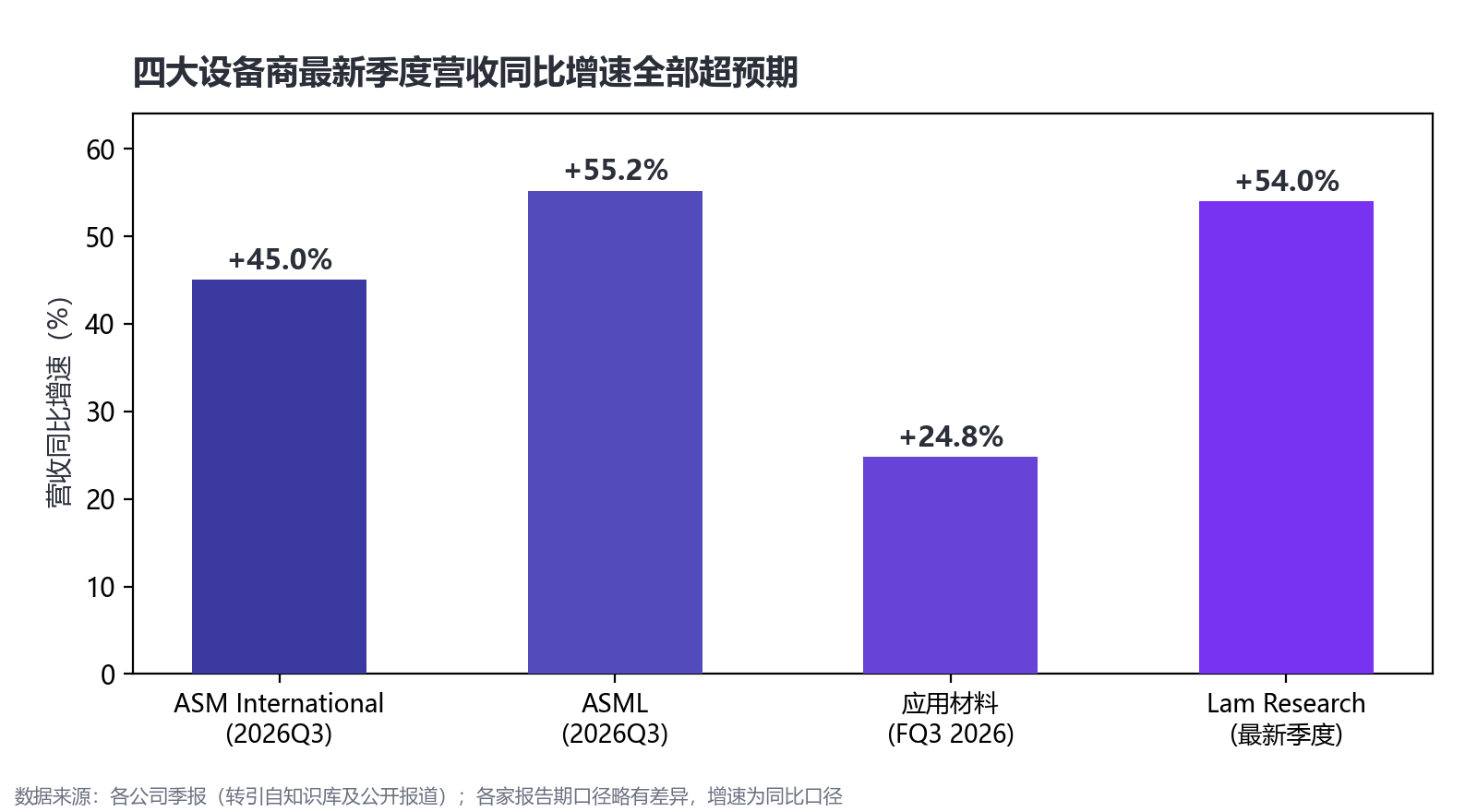
Although there are differences in the growth rates of the four leading companies - application materials have relatively moderate growth rates due to mature processes and display businesses, while the other three are all above 45% - their directions are completely consistent and all are driven by AI related demand. The "boom resonance" in the equipment industry rarely occurs with such a slope: in the previous 2017 cycle driven by smartphones, the single quarter growth rate of leading equipment manufacturers was generally in the range of 20% to 30%, and the current growth rate of 45% to 55% means that the demand intensity has reached the level of a "super cycle".
In terms of regional structure, a rebalancing is also taking place at the same time: the growth rate of equipment investment in new fabs in Arizona, Texas and New York reached 45%, higher than 28% in Taiwan, China and 22% in South Korea; Applied Materials is expected to increase the revenue share of the U.S. market from 25% to 35% in 2026, surpassing the Chinese Mainland market, which accounts for about 28% for the first time. The geographical focus of equipment demand is shifting towards the return of US production capacity, which is not only the result of AI computing power geopolitical competition, but also will in turn enhance the visibility of equipment manufacturers' orders.
Second half: How to verify the sustainability of business prosperity
Putting ASM's financial report into the industry coordinate system, its signal significance becomes clear: AI production capacity investment is no longer just a narrative in the capital market, but has been written into the performance commitments of equipment manufacturers in the most difficult form of "three years ahead of fiscal year targets". The equipment sector is shifting from "narrative driven" to "performance driven", and the target of 5.7 billion euros by 2027 has become a traceable and falsifiable public landmark.
But high expectations themselves are risks. Investors are closely monitoring financial reports in search of evidence of whether demand can keep up with massive investments - this statement, when read in reverse, means that if there is insufficient evidence, the pullback will also be equally severe. In the previous cycle, ASML experienced a significant drop of 16% in a single day due to orders falling below half of market expectations. To verify the "second half" of the current economic climate, it is necessary to focus on three sets of variables.
The most direct test comes from the constraint of supply bottlenecks on delivery pace. ASM warns itself that the supply chain is in a state of tension; The delivery time for key components such as Zeiss optical components and vacuum systems has been extended to 12 months; Applied Materials has found that it has tracked over 100 wafer fab projects globally in the past two quarters. Whether customers can add enough clean room space will determine the realization speed of mid-term equipment market growth. There is no shortage of demand, what is lacking is the delivery ability to turn demand into revenue on time - this not only protects the "certainty" of orders in hand, but also constrains the "slope" of revenue recognition.
Equally alarming is the structural differentiation of storage expansion. Under the Pan Lin perspective, current storage investment is mainly focused on DRAM, while NAND is still primarily focused on technology upgrades rather than new production capacity. Large scale new NAND production capacity may not be built until 2027 or 2028. If the storage super cycle cools down prematurely in a certain category, the quarterly rhythm of device orders will fluctuate - SK Hynix's judgment that the storage shortage will continue until 2030 has certainly boosted device stocks, but the capital expenditure of storage manufacturers has always been the biggest source of volatility in the device industry.
Geopolitical and export control disturbances are another variable. If ASML's sales to Chinese Mainland are further restricted, the growth rate of the global equipment market may be revised down by 3 to 5 percentage points; The equipment market in Chinese Mainland is expected to account for about 28% in 2026. The demand for DUV, etching and film equipment in mature processes is still robust, but every rumor of regulation upgrading will amplify the fluctuations of the sector.
The best way to verify the prosperity of semiconductor equipment is not to predict the numbers for the next quarter, but to track the three most honest indicators: the order shipment matching of ASM and other manufacturers, the progress of removing bottlenecks in advanced packaging capacity, and the fulfillment trajectory guided by 2027. If ASM stands at 5.7 billion euros as scheduled in 2027, this AI reshaped equipment cycle will prove itself to be the beginning of a growth cycle, rather than a simple repetition of prosperity and decline. Looking back at it at that time, this' triple unexpected 'third quarter report may have been the starting point for the industry's pricing logic shift.
