

US chip agency: China can sustain a semiconductor equipment industry chain on its own
In recent years, with the global chip manufacturing boom, many countries and regions have been aggressively expanding their wafer fabs and increasing chip production capacity, leading to a sustained increase in the size of the global semiconductor equipment market.
According to SEMI's forecast, global semiconductor equipment sales will reach $165.9 billion in 2026, a year-on-year increase of 23.2%. It is expected to rise to $229.5 billion in 2028, and may approach $300 billion by 2030.
And the Chinese market is one of the fastest-growing. For example, in 2021, the size of the Chinese semiconductor equipment market was only 30 billion US dollars. By 2025, it will reach nearly 50 billion US dollars, and it is expected to reach nearly 100 billion US dollars by 2030, accounting for about one-third of the global market.
Because the Chinese semiconductor equipment market is large and growing rapidly, American chip institutions believe that the Chinese semiconductor equipment market will form a perfect industrial chain in the future. China does not even need orders from overseas wafer fabs, it can rely solely on itself, which will be very scary.
We know that the United States, Japan, and the Netherlands have always been the market monopolists in semiconductor equipment. The top five manufacturers ASML, Applied Materials, Panlin, Koley, and Tokyo Electronics are all companies from these three countries, and even nine out of the top 10 are companies from these three countries.
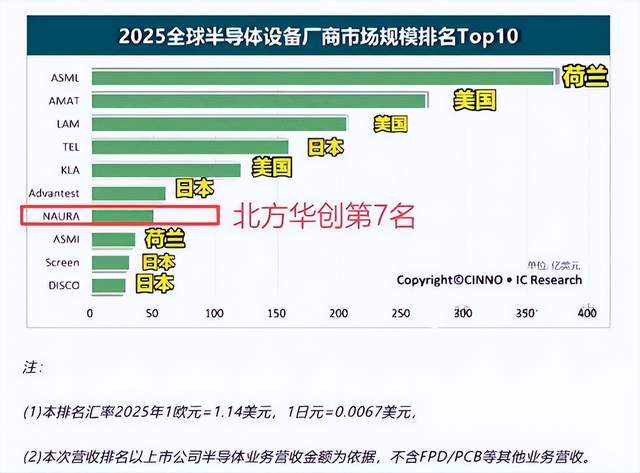
In the past, we relied heavily on importing semiconductor equipment from the United States, Japan, and the Netherlands to make chips.
Domestic equipment is not lacking, but it is not awesome. The technology is relatively backward and unstable, so the fabs do not dare to use it. After all, once the yield of core making goes wrong, it will have a huge impact.
But later on, with the United States imposing a blockade on our chip industry and joining forces with Japan, the Netherlands, and others to restrict our purchase of advanced equipment, the situation changed. Wafer fabs began to produce domestically and reduce equipment imports from the United States.
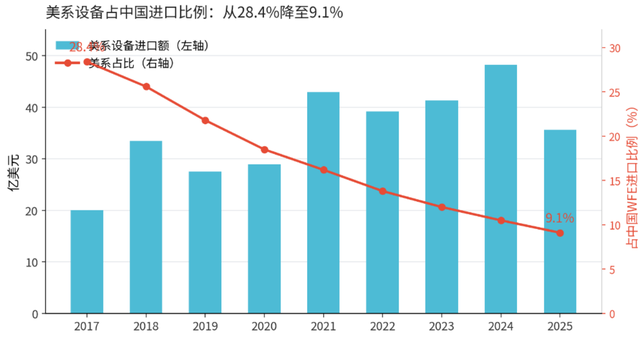
Data shows that the proportion of imported American equipment has dropped sharply from 28.4% in 2017 to 9.1% last year, while domestic substitution has been on the rise, reaching around 30% so far.
American institutions believe that as the self-sufficiency rate of domestic chip equipment continues to increase, China's chip equipment will form a complete industrial chain, as the scale of nearly 100 billion US dollars is sufficient to develop a complete ecosystem.
Once it develops and forms a complete industrial chain, chip equipment manufacturers in the United States, Japan, and the Netherlands will encounter huge problems. At that time, their equipment will be impacted by Chinese companies and have little resistance.
After all, Chinese chip equipment companies have the ability to attack the global market and defend the Chinese market without fear of market changes. On the other hand, companies from the United States, Europe, and Japan cannot rely on the global market, and even the Chinese market. This will be their biggest weakness.
