


Analysis of Main Types of Players and Key Companies in China's Autonomous Driving in 2026 (Chart)
China Business Intelligence Network reports: The domestic autonomous driving market has already formed an industrial structure characterized by diversified division of labor and coexistence of competition and cooperation, mainly divided into six types of players. Vehicle manufacturers use intelligent driving as the core selling point of their vehicle products, focusing on L2 and urban NOA mass production, relying on vehicle manufacturing, chassis, and OTA capabilities, following two main routes: full-stack self-development and self-development combined with external procurement solutions; full-stack intelligent driving solution providers do not manufacture vehicles, but provide car companies with packaged systems including perception, domain control, and algorithms, serving as key partners for rapid deployment of high-level intelligent driving for independent brands; L4 native autonomous driving technology companies start from fully unmanned technology on public roads, operating Robotaxi services while delivering mature technology to downstream car companies; limited closed-scenario service providers focus on environments such as mines, ports, and industrial parks, achieving early commercialization through transportation service models; upstream core component and computing power suppliers provide underlying products such as chips, LiDAR, and high-precision maps, building barriers through automotive-grade capabilities and ecosystem development; mobility platform players focus on dispatch and traffic operations, often collaborating with tech companies and automakers to operate autonomous vehicles. Each entity leverages its own differentiated advantages to jointly drive the continuous evolution of autonomous driving from assisted driving to fully unmanned commercialization.
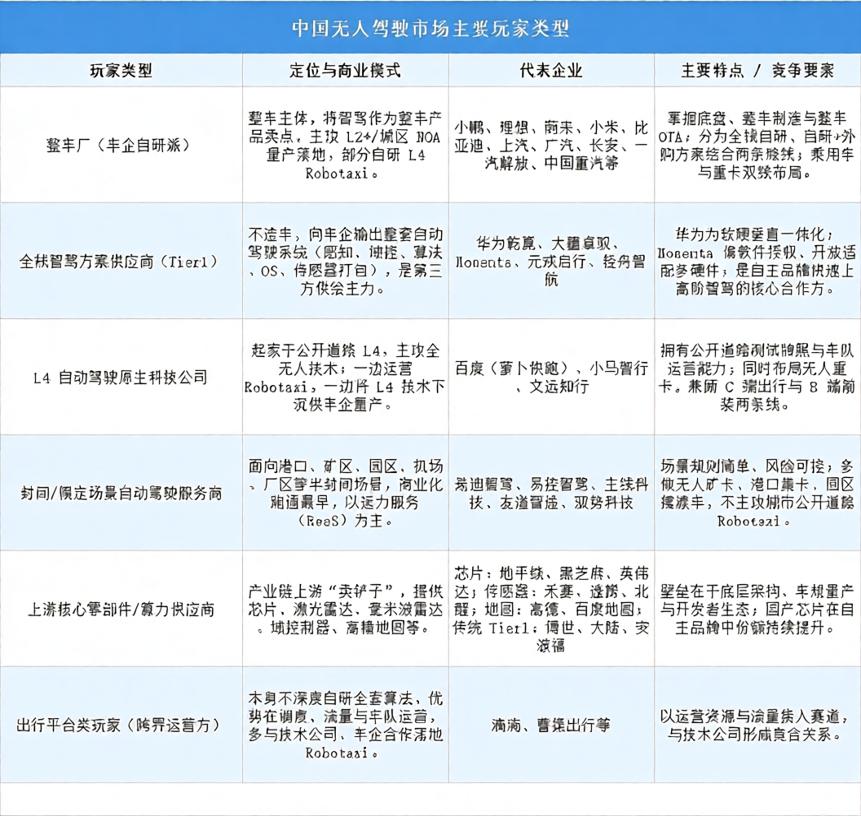
Source: Compiled by China Business Industry Research Institute
The domestic autonomous driving sector has formed a diversified competitive and cooperative landscape, with different players accelerating implementation through differentiated approaches. Baidu leverages Apollo and Luobo Kuaipao, leading in the scale of Robotaxi commercial operations; Pony.ai and WeRide are deeply focused on L4 full-stack technology, deploying across multiple scenarios such as mobility, freight, and sanitation, while also advancing overseas implementation. Huawei, with its ADS advanced driving solution in collaboration with HarmonyOS-enabled vehicle partners, achieves coordinated hardware and software production; automakers like XPeng, Li Auto, NIO, and BYD are advancing high-level driver assistance development based on their own models, continuously accumulating data through vehicle ownership. Momenta, Horizon Robotics, QCraft, and Mobvista, as third-party autonomous driving solution providers, focus on pre-installed production, mapless NOA, and integrated driving and parking solutions, balancing cost and scalable deployment; Desay SV, as a leading Tier1, concentrates on domain control and other hardware integration; Horizon and Black Sesame focus on automotive-grade AI chips, providing foundational computing power to support domestic autonomous driving. All parties collectively promote the transition of autonomous driving from testing and demonstration to large-scale commercial use.
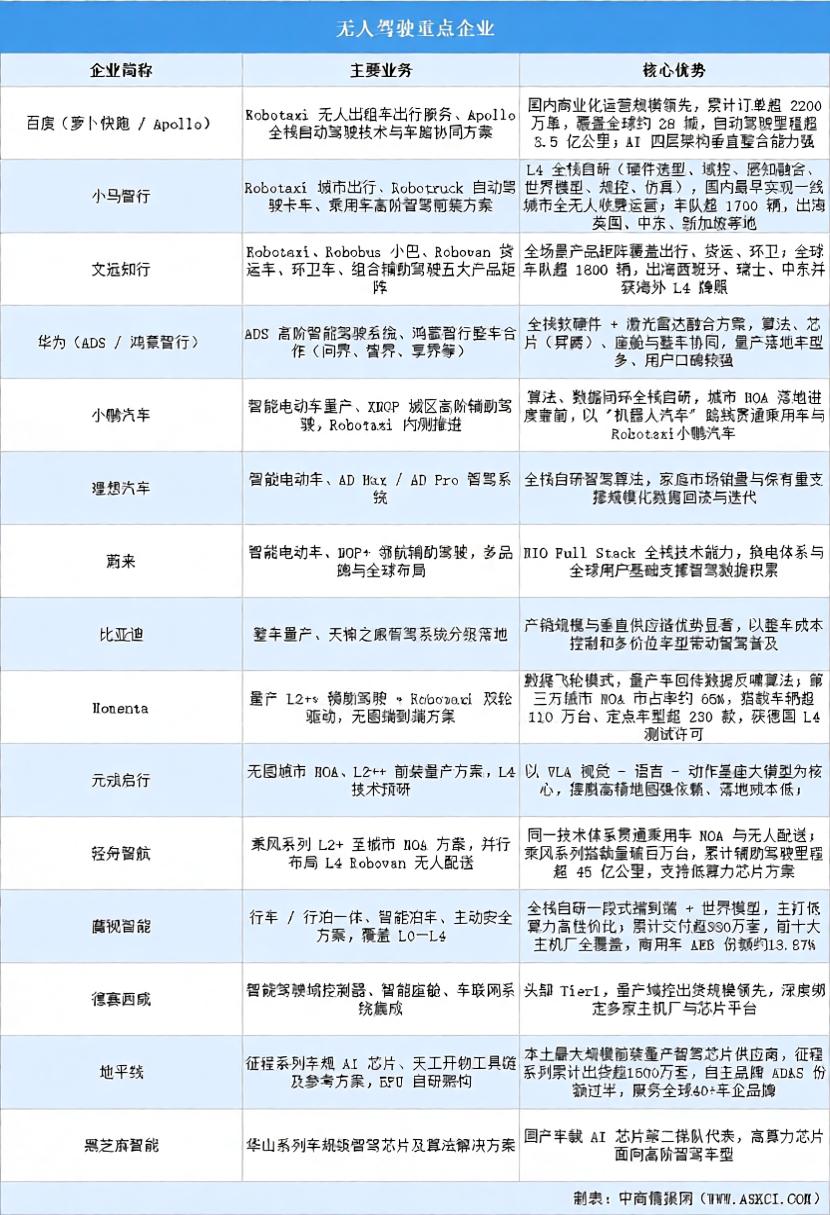
Source: Compiled by China Business Industry Research Institute
