


2026 China Autonomous Driving Industry Chain Map and Investment Layout Analysis (with Full Industry Chain Panorama)
China Business Intelligence Network reports: The autonomous driving industry chain covers upstream core hardware and software, midstream system integration and complete vehicle manufacturing, and downstream multi-scenario commercial applications. With the accelerated domestic production of core components such as LiDAR, millimeter-wave radar, intelligent driving chips, and domain controllers, combined with the joint driving forces of policy, capital, and scenario demand, the scale of the domestic autonomous driving industry continues to expand. Technological iteration and commercial implementation are accelerating simultaneously, and the industry is entering a critical window for scaled development.
1. Industrial Chain
The upstream of the autonomous driving industry chain focuses on core hardware and software, covering lidar, millimeter-wave radar, ultrasonic radar, cameras, image sensors, high-precision maps, high-precision positioning, algorithm software, intelligent driving chips, domain controllers, and so on; the midstream consists of system integration and vehicle manufacturing, gathering Tier 1 suppliers and vehicle manufacturers; the downstream extends to diverse application scenarios such as Robotaxi, unmanned freight, unmanned vehicles in closed scenarios, and the consumer market.
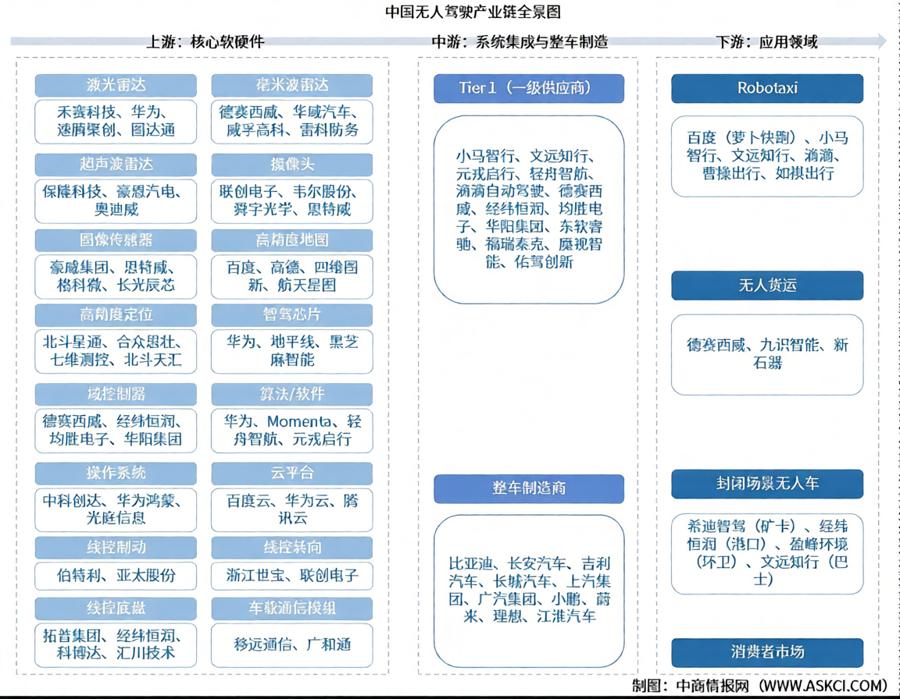
Source: Compiled by China Business Industry Research Institute
2. Upstream Analysis
1. LiDAR
(1) LiDAR Market Size
Driven by the expansion of autonomous vehicle fleets, the increasing penetration of LiDAR applications in advanced driver-assistance systems, and demand in areas such as robotics and smart city construction, the Chinese LiDAR market is entering the fast lane. According to the "2026-2031 China LiDAR Industry Market Outlook and Future Development Trends Report" released by the China Business Industry Research Institute, the Chinese LiDAR market is expected to reach approximately 24.07 billion yuan in 2025. Analysts from the China Business Industry Research Institute predict that the Chinese LiDAR market will reach 43.18 billion yuan in 2026.
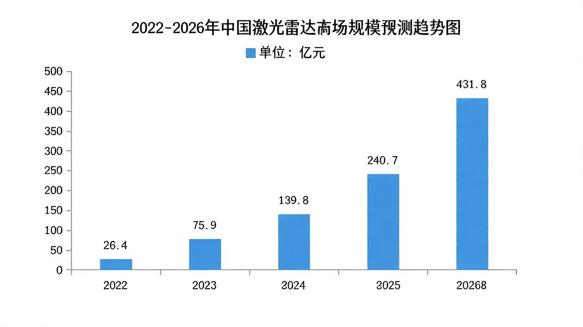
Data source: Compiled by Frost & Sullivan and China Business Industry Research Institute
(2) LiDAR Installation Capacity on Vehicles
From 2021 to 2025, the installed capacity of LiDAR in China experienced an explosive growth from 'almost zero' to 'full-scale adoption.' The "2026-2031 China LiDAR Industry Market Outlook and Future Development Trend Report" released by the China Business Industry Research Institute shows that by 2025, the annual LiDAR installation in vehicles reached 3.386 million units, a year-on-year increase of 120.1%. Analysts from the China Business Industry Research Institute predict that by 2026, China's LiDAR installation in vehicles is expected to approach 4 million units.
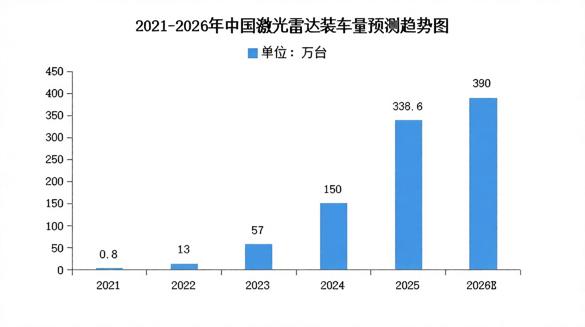
Data source: Gasgoo, compiled by China Business Industry Research Institute
(3) Competitive Landscape of LiDAR
In 2026, Hesai ranked first in China's automotive LiDAR market with a market share of 40.94%. Huawei and RoboSense ranked second and third with market shares of 28.3% and 23.51%, respectively.
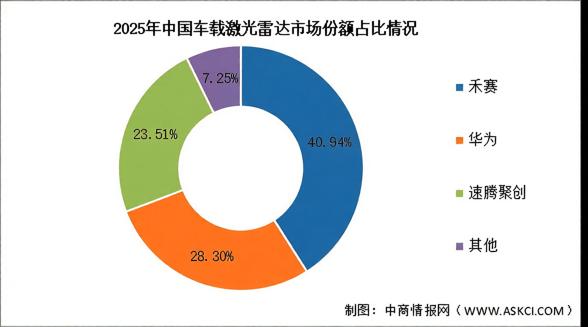
Data source: Compiled by China Business Industry Research Institute
2. Millimeter-wave radar
(1) Market Size of Vehicle-Mounted Millimeter-Wave Radar
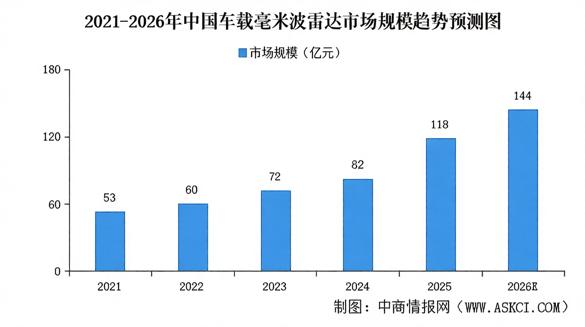
Against the backdrop of rapid growth in the intelligent driving industry, the automotive millimeter-wave radar industry has entered a golden period of growth, with the market size continuing to expand. According to the "2026-2031 China Millimeter-Wave Radar Market Survey and Industry Outlook Forecast Special Research Report" released by Zhongshang Industrial Research Institute, the market size of China's automotive millimeter-wave radar grew from 5.3 billion yuan in 2021 to 11.8 billion yuan in 2025. Analysts at Zhongshang Industrial Research Institute predict that the market size of China's automotive millimeter-wave radar will reach 14.4 billion yuan in 2026.
Data source: Compiled by China Business Industry Research Institute
(2) Millimeter-wave radar carrying capacity
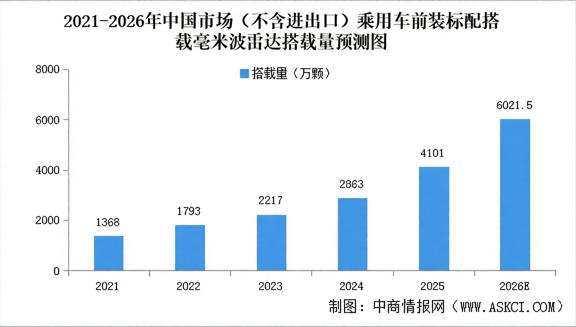
The '2026-2031 China Millimeter Wave Radar Market Survey and Industry Outlook Forecast Special Research Report' released by the China Business Industry Research Institute shows that in 2025, the scale of pre-installed millimeter wave radars in passenger cars in the Chinese market (excluding imports and exports) will exceed 40.01 million units, reaching 41.01 million units, a year-on-year increase of 43.24%. Analysts from the China Business Industry Research Institute predict that in 2026, the scale of pre-installed millimeter wave radars in passenger cars in the Chinese market (excluding imports and exports) will exceed 60 million units.
Data source: Compiled by Gaogong Intelligent Automotive Research Institute and China Business Industry Research Institute
(3) Key Enterprises in Millimeter-Wave Radar
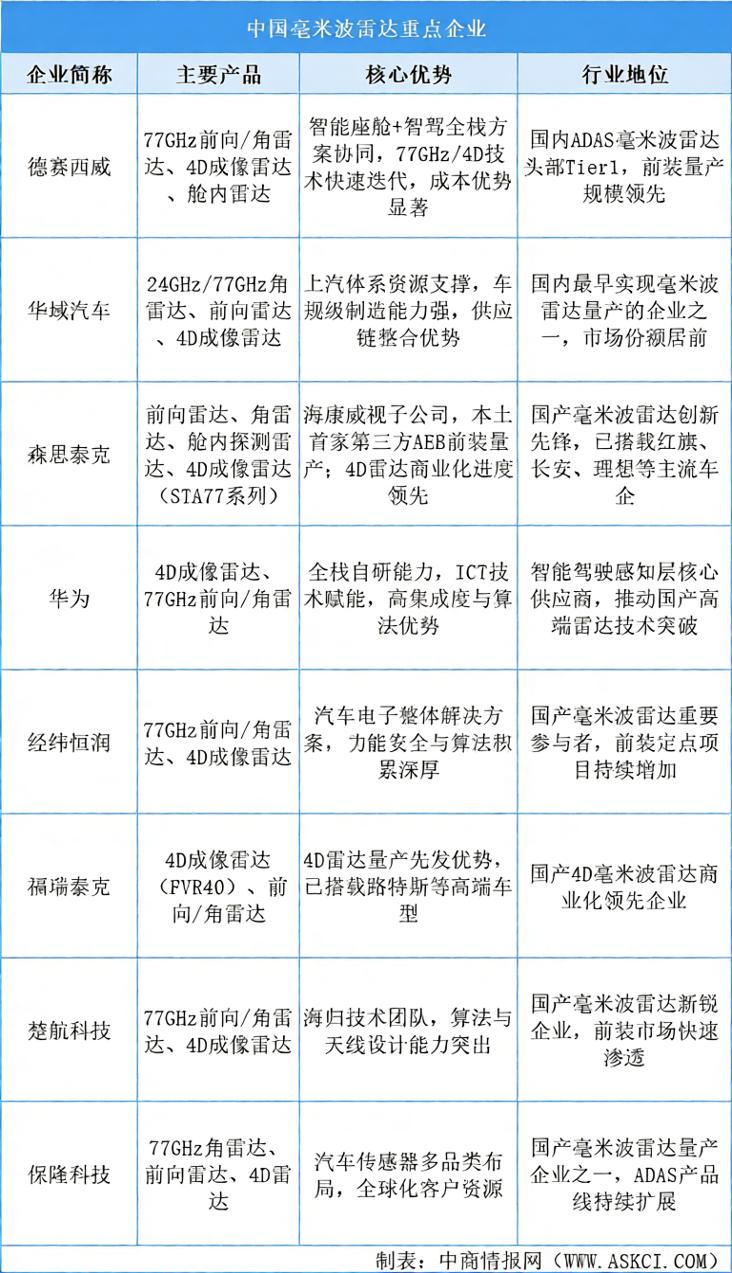
The Chinese millimeter-wave radar market is still dominated by international companies such as Bosch and Continental, but domestic manufacturers are accelerating their rise. Desay SV, Huayu Automotive maintain their position in the first tier thanks to deep integration with automakers and mass production capabilities; SenseTime, as a subsidiary of Hikvision, has become an innovation benchmark by leading in AEB pre-installation mass production and 4D imaging radar commercialization; Huawei, on the other hand, promotes breakthroughs in high-end technology through full-stack in-house development. With the mandatory installation of AEBS, the mainstream adoption of 77GHz, and the rapid scale-up of 4D imaging radar, domestic substitution and technological upgrades are driving the industry under a dual-engine momentum, continuously reshaping the market landscape.
Source: Compiled by China Business Industry Research Institute
3. Intelligent Driving Chip
(1) Intelligent Driving Chip Market Size
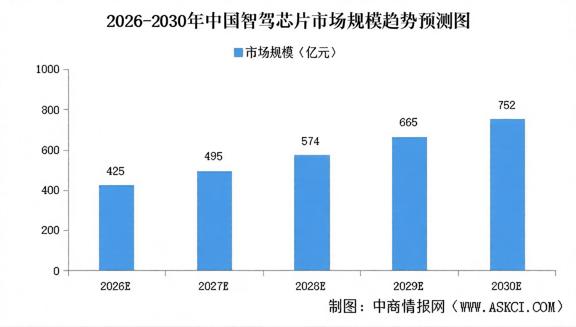
The '2026-2031 China In-Vehicle Camera Industry Market Analysis and Investment Prospects Consulting Report' released by the China Business Industry Research Institute shows that the Chinese smart driving chip market size will be approximately 42.5 billion yuan in 2026. Analysts from the China Business Industry Research Institute predict that the Chinese smart driving chip market size will reach 75.2 billion yuan by 2030.
Data source: Compiled by China Business Industry Research Institute
(2) Competitive Landscape of Intelligent Driving Chips
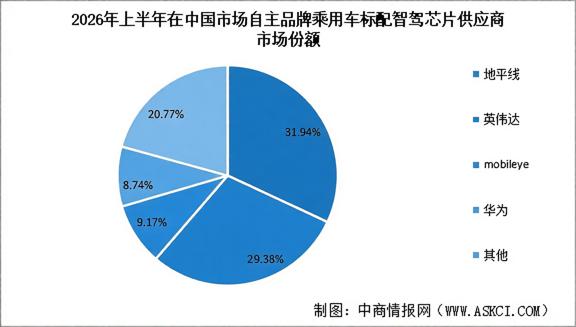
In the market for autonomous driving chips for domestic brand passenger cars, the top three suppliers in market share in the first half of the year were Horizon, NVIDIA, and Mobileye. Among them, Horizon continued to hold the first place in the industry with a market share of 31.94%; NVIDIA followed closely with 29.38%; Mobileye fell to third place, with a share of less than 10%. Huawei ranked fourth, with a share of 8.74%.
Data source: Compiled by GG Intelligence Automotive and China Business Industry Research Institute
4. Domain Controller
(1) Domain Controller Market Size
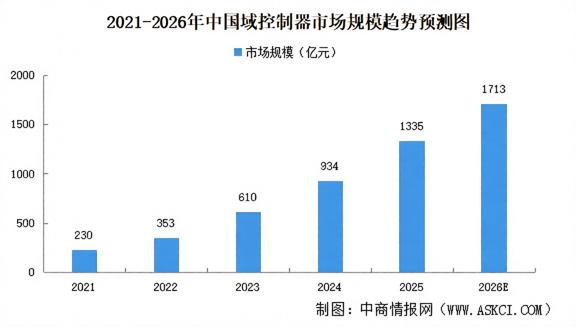
Domain controllers are a key component in the transition to E/E architecture, integrating multiple ECU functions into a unified, high-performance domain control and processing platform. In recent years, the domain controller market in China has expanded rapidly. According to the "2026-2031 China Intelligent Driving Domain Controller Research Analysis and Investment Prospect Forecast Report" released by China Business Industry Research Institute, the market size of domain controllers in China is expected to grow from 23 billion yuan in 2021 to 133.5 billion yuan in 2025, with a compound annual growth rate of 55.1%. Analysts at China Business Industry Research Institute predict that the Chinese domain controller market will reach 171.3 billion yuan by 2026.
Data source: Frost & Sullivan, compiled by China Business Industry Research Institute
(2) Key enterprises of domain controllers
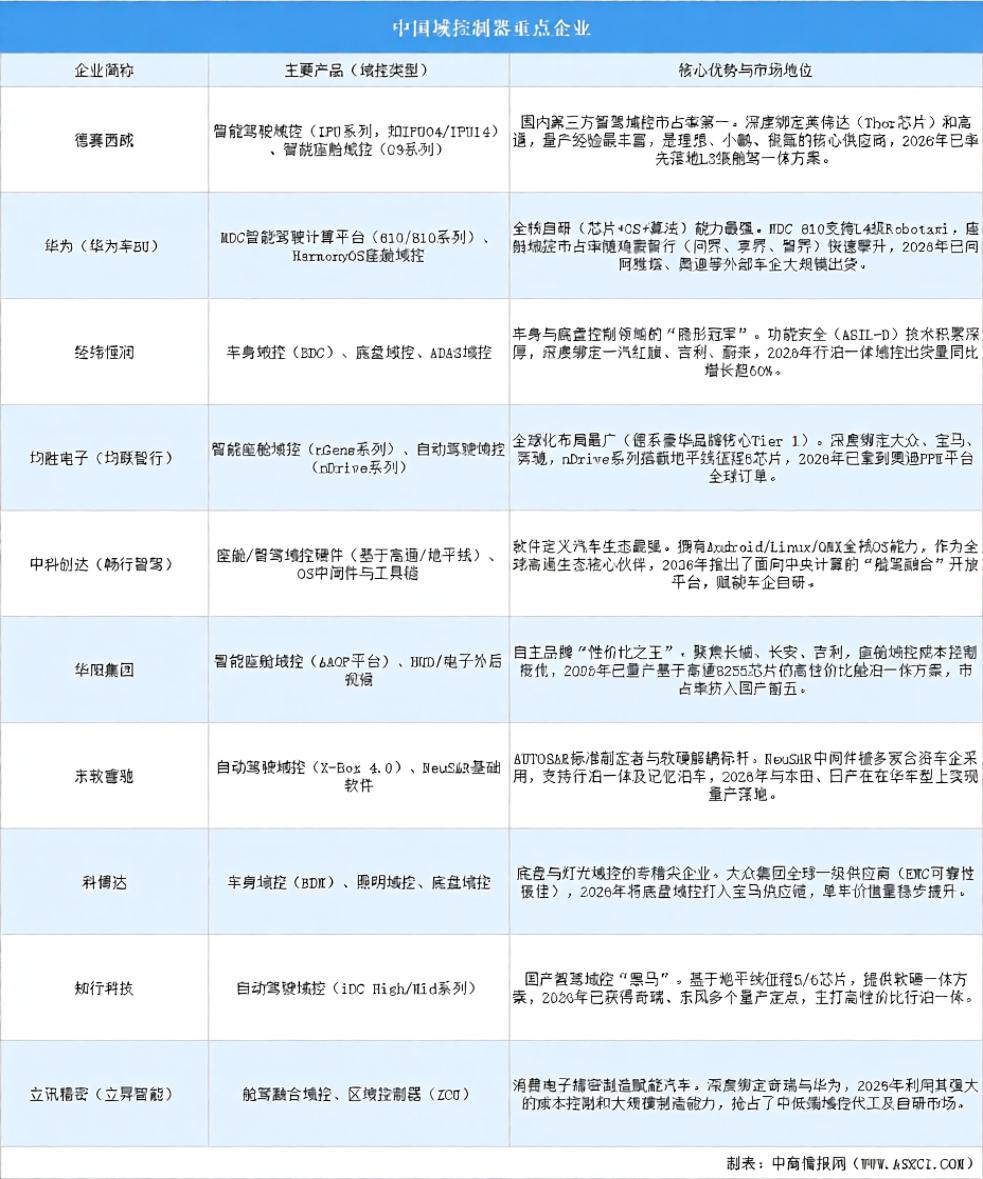
The Chinese domain controller industry has formed a situation where Desay SV, Huawei, and Jingwei Hengrun lead the way, with leaders in the segmented tracks (cockpit, intelligent driving, chassis) advancing together.
Source: Compiled by China Business Industry Research Institute
3. Midstream Analysis
1. Autonomous driving market size
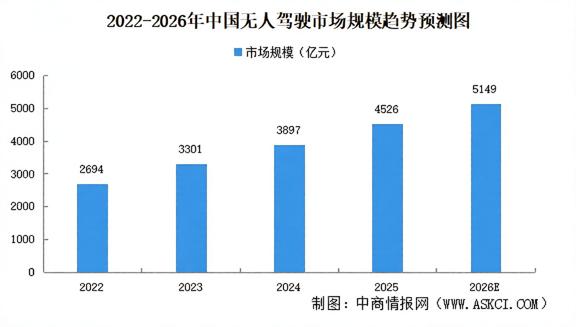
Currently, China is actively developing intelligent connected vehicles, and autonomous driving technology is further promoting companies like BAT to enter the market and increase investment in technology research and development. The autonomous driving market is in a rapid development stage. The "2026-2031 China Autonomous Driving Vehicle Market Demand Forecast and Development Trend Outlook Report" released by Zhongshang Industrial Research Institute shows that the size of China's autonomous driving market will exceed 450 billion yuan by 2025. Analysts from Zhongshang Industrial Research Institute predict that the size of China's autonomous driving market will surpass 500 billion yuan by 2026.
Data source: Compiled by China Business Industry Research Institute
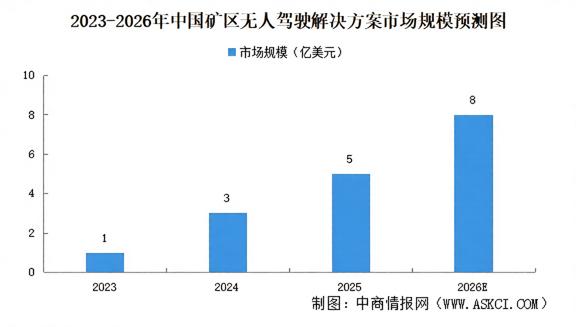
2. Market Size of Unmanned Driving Solutions in Mining Areas
The market for unmanned solutions in China's mining areas is currently in a phase of rapid large-scale penetration, with the market size steadily increasing. According to the "2026-2031 Global and China Unmanned Driving Industry Market Research and Investment Prospect Forecast Report" released by China Business Industry Research Institute, the market size of unmanned solutions in China's mining areas is expected to reach 500 million USD in 2025. Analysts at China Business Industry Research Institute predict that the market size of unmanned solutions in China's mining areas will reach 800 million USD in 2026.
Data source: Frost & Sullivan, compiled by China Business Industry Research Institute
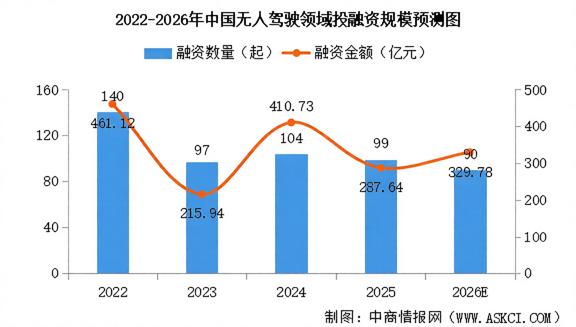
3. Autonomous Driving Investment and Financing
Recent financing in the autonomous driving sector has been active, with leading domestic and international companies consecutively receiving large sums of funding. In 2025, there were 99 investment and financing events in China's autonomous driving sector, with a total amount of 28.764 billion yuan. It is expected that in 2026, there will be 90 investment and financing events in China's autonomous driving sector, with a total amount of 32.978 billion yuan.
Data source: IT Juzi, compiled by China Business Industry Research Institute
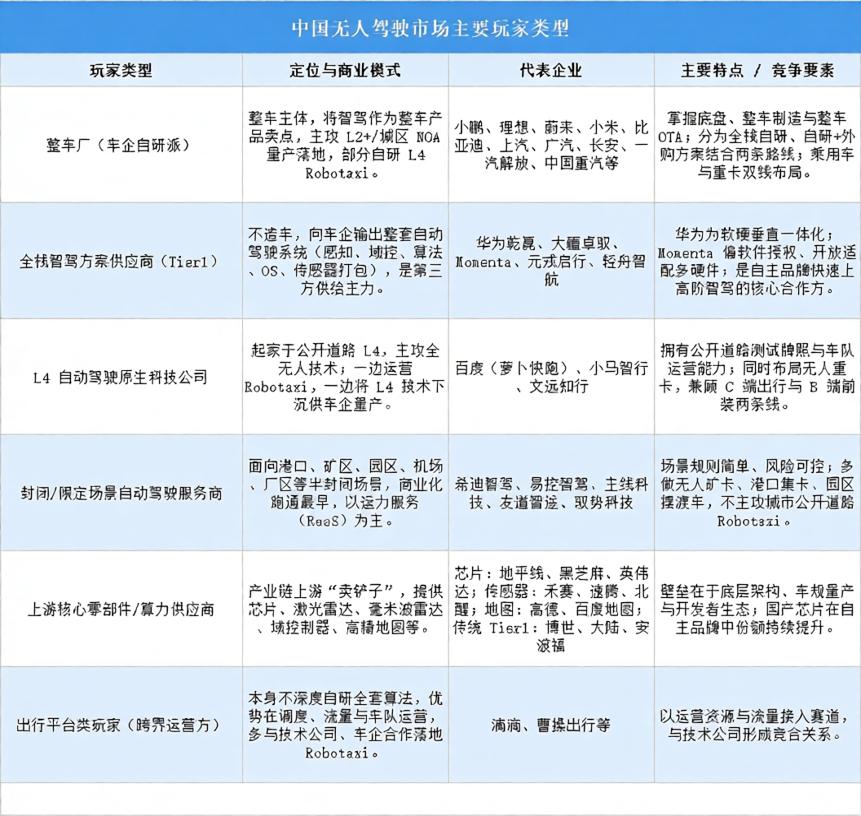
4. Major Players in Autonomous Driving
The domestic autonomous driving market has already formed an industrial structure characterized by diversified division of labor and coexistence of competition and cooperation, mainly divided into six types of players. Vehicle manufacturers take intelligent driving as the core selling point of their vehicle products, focusing on the mass production and implementation of L2 and urban NOA, relying on vehicle manufacturing, chassis, and OTA capabilities, and follow two routes: full-stack self-research and a combination of self-research and external procurement solutions; full-stack intelligent driving solution providers do not manufacture vehicles but package and provide car companies with complete systems including perception, domain control, algorithms, etc., serving as key partners for the rapid deployment of advanced intelligent driving for independent brands; L4 native autonomous driving technology companies start with fully unmanned technology on public roads, operating Robotaxi services while providing mature technology to downstream car companies; closed and restricted scenario service providers focus on environments such as mines, ports, and industrial parks, achieving earlier commercialization through transportation capacity service models; upstream core component and computing power suppliers provide foundational products such as chips, LiDAR, and high-precision maps, building barriers based on automotive-grade capabilities and ecosystem construction; mobility platform players focus on scheduling and traffic operation, often collaborating with technology providers and car companies to conduct autonomous vehicle operations. Each entity leverages its own differentiated advantages to jointly drive the continuous evolution of autonomous driving from assisted driving to fully unmanned commercialization.
Source: Compiled by China Business Industry Research Institute
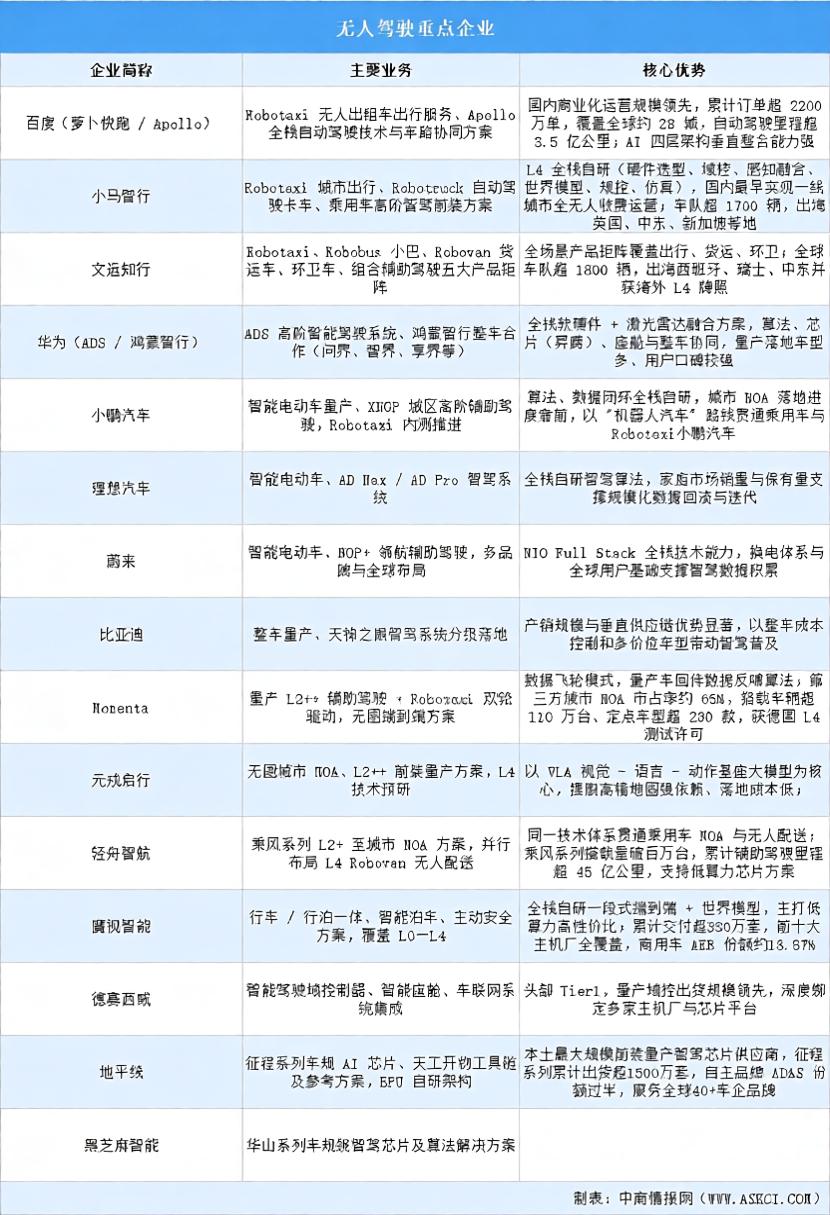
5. Key Companies in Autonomous Driving
The domestic autonomous driving sector has formed a diversified competitive and cooperative landscape, with different players accelerating implementation through differentiated approaches. Baidu leverages Apollo and Luobo Kuaipao, leading in the scale of Robotaxi commercial operations; Pony.ai and WeRide are deeply focused on L4 full-stack technology, deploying across multiple scenarios such as mobility, freight, and sanitation, while also advancing overseas implementation. Huawei, with its ADS advanced driving solution in collaboration with HarmonyOS-enabled vehicle partners, achieves coordinated hardware and software production; automakers like XPeng, Li Auto, NIO, and BYD are advancing high-level driver assistance development based on their own models, continuously accumulating data through vehicle ownership. Momenta, Horizon Robotics, QCraft, and Mobvista, as third-party autonomous driving solution providers, focus on pre-installed production, mapless NOA, and integrated driving and parking solutions, balancing cost and scalable deployment; Desay SV, as a leading Tier 1 supplier, concentrates on domain control and other hardware integration; Horizon and Black Sesame Intelligence are focusing on automotive-grade AI chips, providing foundational computing power for local autonomous driving. All parties are jointly promoting the transition of autonomous driving from testing demonstrations to large-scale commercialization.
Source: Compiled by China Business Industry Research Institute
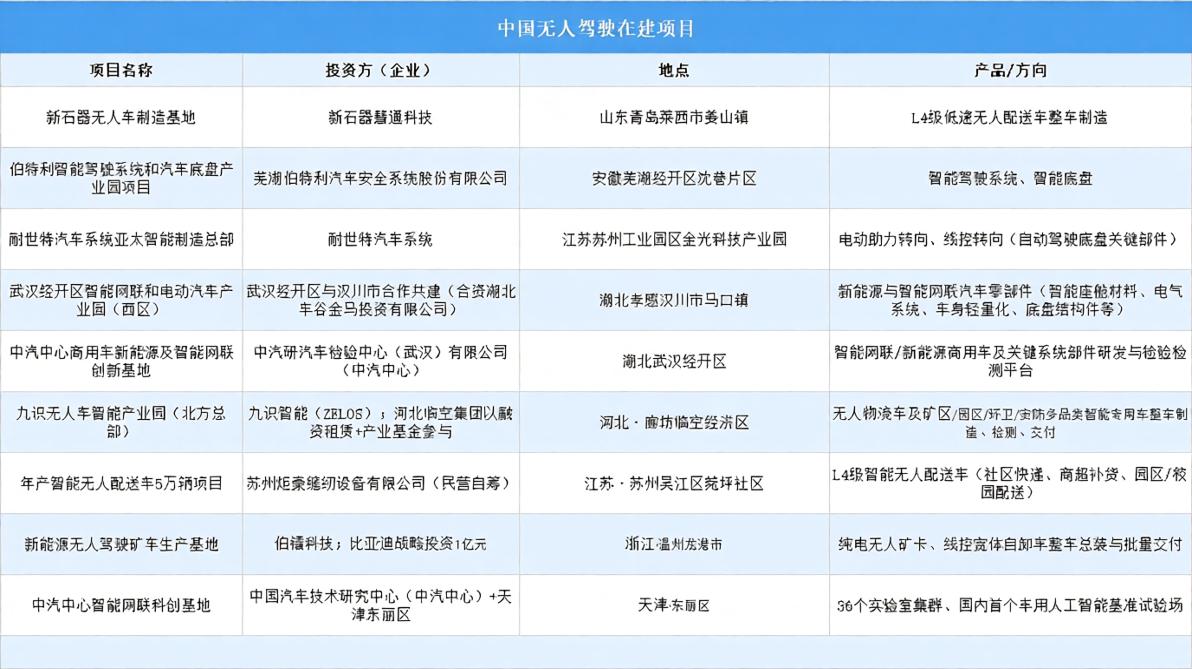
6. Unmanned Driving Projects Under Construction
Currently, domestic projects in the fields of autonomous driving and intelligent connected vehicles are being deployed at multiple locations, covering the entire industry chain, and are advancing simultaneously in Shandong, Anhui, Jiangsu, Hubei, Hebei, Zhejiang, Tianjin, and other regions. On the vehicle manufacturing side, Xinshiqi, Jiushi Intelligent, Suzhou Juhao, and Borui Technology have arranged production capacities for L4 low-speed unmanned delivery vehicles, unmanned vehicles for mining area sanitation and security, and new energy autonomous mining trucks, respectively; in the core components segment, Bertelli and Nexteer have launched industrialization projects for key components such as intelligent driving systems, intelligent chassis, and steer-by-wire systems.
Source: Compiled by China Business Industry Research Institute
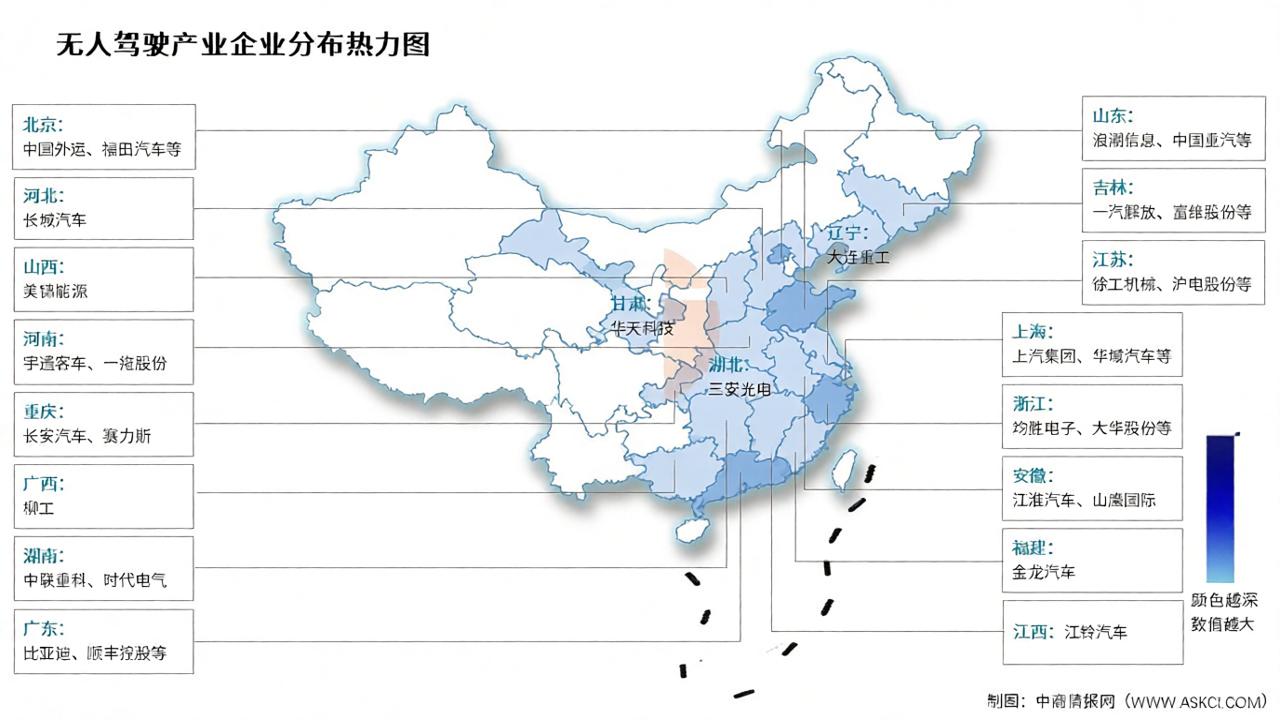
7. Heat Map of Autonomous Driving Companies
Source: Compiled by China Business Industry Research Institute
4. Downstream Analysis
1. Unmanned delivery vehicle
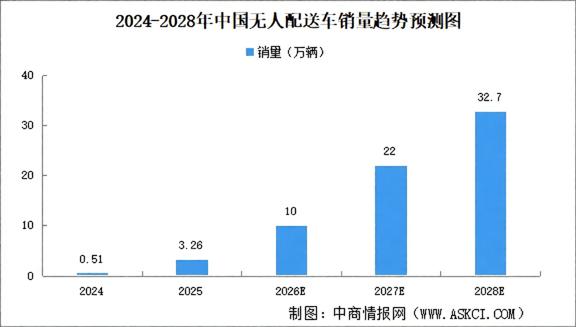
The '2026-2031 China Unmanned Delivery Market In-depth Research and Development Prospects Investment Forecast Analysis Report' released by the China Business Industry Research Institute shows that in 2025, the sales of unmanned delivery vehicles in China will be about 32,600 units, and it is expected that in 2026, sales will exceed 100,000 units, and by 2028, sales will surpass 320,000 units.
Source: Compiled by Dongwu Securities and China Business Industry Research Institute
