


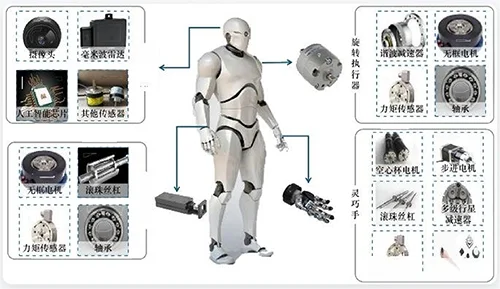
The driving system of humanoid robots consists of their "muscles" and "tendons", with the core requirements being "high power density" and "precise force control".
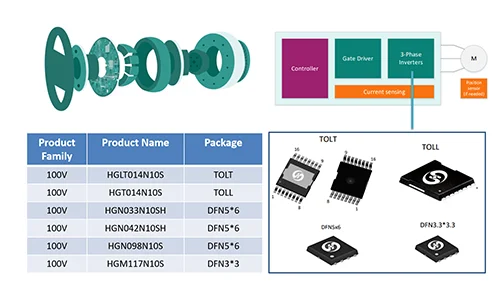
MOSFET (Metal Oxide Semiconductor Field Effect Transistor) is a crucial power switching device in humanoid robot motor drivers, especially widely used in low-voltage and high current joint motors.
· Efficiency And Heat Generation:
·MOS transistors with low on resistance (Rds (on)) can reduce on state losses, and low switching losses can reduce dynamic losses. High efficiency means less energy waste and heat generation, which is crucial for compact and highly integrated humanoid robot joints, directly related to endurance and operational reliability
· Volume and Integration: Adopting advanced packaging technology helps to effectively improve high power density, integrate the driver and motor body into a narrow joint space, and achieve modular joint design.
. Selection Considerations:
· Voltage and current levels: The joint motor of humanoid robots usually operates at a voltage below 48V DC, which belongs to low voltage and high current scenarios.
· Thermal management: High density joints are difficult to dissipate heat, and it is necessary to use MOS tubes with excellent thermal performance packaging and exquisite heat dissipation design (such as thermal conductive silicone and metal shell heat dissipation).
Integration trend: More and more drivers are adopting highly integrated intelligent power modules, which encapsulate MOS transistors, gate drivers, and protection circuits (overcurrent, overheating) together, greatly simplifying design, improving reliability and integration.
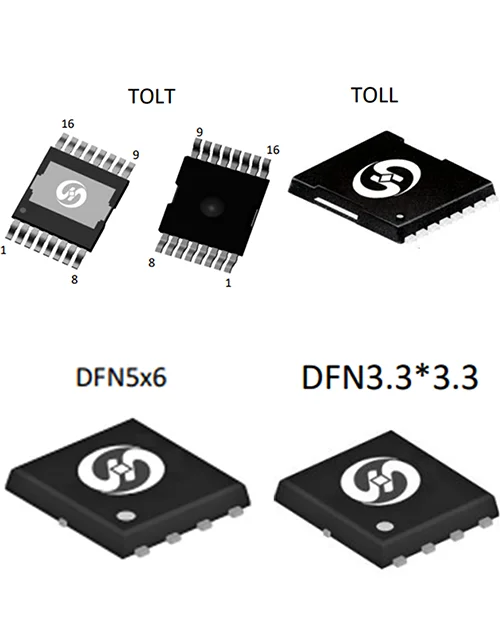
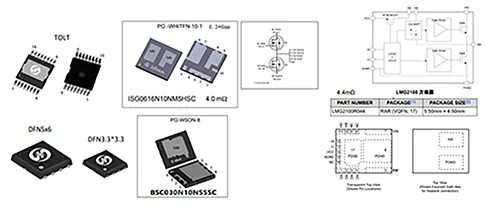
· Thermal management: High density joints face difficulties in heat dissipation, requiring the use of MOS tubes with excellent thermal performance packaging, surface heat dissipation, double-sided heat dissipation, smaller size, lower internal resistance, and higher integration requirements.
Tel: 0755-83740539Email: sales@consmart.cn
Copyright © 2026 Consmart 粤ICP备2026078933号Privacy PolicySitemapTechnical Support:Yibaixun - Shenzhen Web Development
