


Continuously writing new chapters of shared destiny in the Asia-Pacific region
The Asia-Pacific region gathers nearly 40% of the world's population, accounts for over 60% of the world's total economy, and nearly half of total trade, making it the most dynamic economic sector and key growth engine globally. As the highest-level, widest, and most influential economic cooperation mechanism in the Asia-Pacific region, APEC carries the important mission of promoting regional economic integration and achieving common prosperity among all economies. In a few days, the 33rd APEC Leaders' Informal Meeting will kick off in Shenzhen. This is the third time that the APEC Leaders' Informal Meeting has been held in China, following Shanghai in 2001 and Beijing in 2014, witnessing China's unwavering commitment to the Asia-Pacific partnership and further highlighting China's responsibility as a major power.
Since the 18th National Congress of the Communist Party of China, General Secretary Xi Jinping has attended or presided over informal APEC leaders' meetings and delivered important speeches. With the strategic vision of a major party and major country leader, he has put forward major concepts such as building an Asia-Pacific community with a shared future, pointing the way and drawing blueprints for Asia-Pacific cooperation at key historical milestones. The article "Joining Hands to Build an Asia-Pacific Community with a Shared Future" includes important statements by General Secretary Xi Jinping from October 2013 to November 2025, profoundly explaining the significance, rich connotations, and practical paths of building an Asia-Pacific community with a shared future. Studying and understanding the spirit of this important article is of great significance for us to deeply comprehend Xi Jinping's diplomatic thought, further consolidate consensus on Asia-Pacific cooperation, and steadily advance the construction of an Asia-Pacific community with a shared future.
Why is it important to jointly build an Asia-Pacific community with a shared future?
Any great idea requires the accumulation of time and the refinement of practice. To understand the importance of building an Asia-Pacific community with a shared future, we must start with the founding and development history of APEC. APEC was established in 1989 and currently has 21 members, including Australia, Brunei, Canada, and Chile. China officially joined APEC in 1991 and has actively and deeply participated in cooperation across various fields, playing an important and constructive role. Since its founding, APEC has promoted trade and investment liberalization and facilitation through pragmatic measures, enhancing regional economic integration, and making important contributions to creating the world-renowned "Asia-Pacific Miracle" and promoting global economic development. However, entering the second decade of the 21st century, global economic growth momentum is insufficient, the shadow of Cold War thinking and zero-sum games lingers, geopolitical risks in the Asia-Pacific are rising, and regional cooperation faces the test of whether it moves forward or falls behind. How to maintain the open and cooperative pattern of the Asia-Pacific and promote sustained economic growth and long-term prosperity in the region has become a common challenge that all Asia-Pacific economies must face.
Where is Asia-Pacific headed? What about APEC? The call of the times is guided by scientific concepts that can build consensus and enhance unity. In October 2013, at the APEC Business Leaders' Summit held in Bali, Indonesia, General Secretary Xi Jinping creatively proposed the concept of an Asia-Pacific community with a shared future, emphasizing "firmly establishing the awareness of an Asia-Pacific community with a shared future, using our own development to drive others' development, maximizing each other's strengths through coordinated linkage, transmitting positive energy, and forming a pattern of positive interaction and coordinated development among economies." With this as a sign, the concept of the Asia-Pacific Community of Shared Future officially took center stage on the international stage. This concept aligns with the common aspirations and interests of all Asia-Pacific parties seeking development, clarifies the proper way for them to coexist, and provides a compelling and leading Chinese solution for Asia-Pacific cooperation and long-term development.
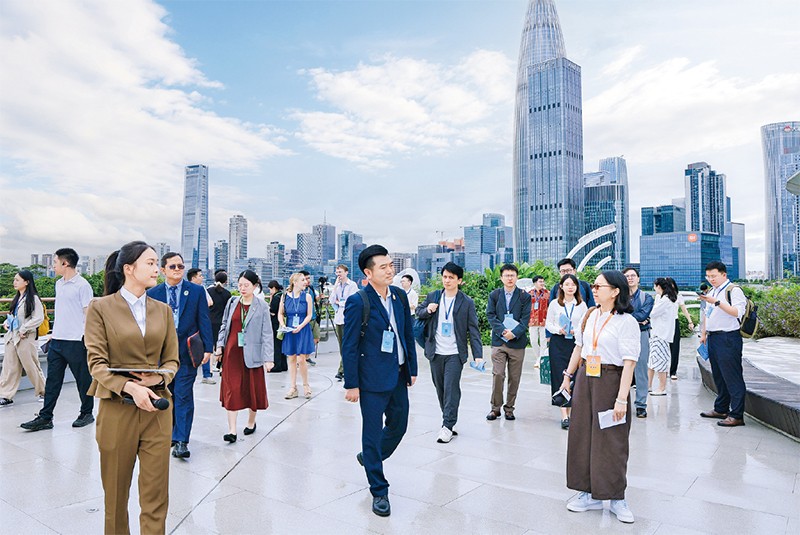
Some have raised the question: With such huge differences in economic development levels, social systems, and cultural traditions among APEC members, and their interests and demands vary, is it possible to build a community with a shared future? The differences among Asia-Pacific economies are vast, which is an objective reality, but differences have never been obstacles to cooperation, nor reasons for estrangement or confrontation. It is precisely because of differences in resource endowments, industrial structures, and development stages that all parties need and can complement each other's strengths more effectively. In today's era of deepening economic globalization, the industrial chains, supply chains, and market networks of all Asia-Pacific parties have long been deeply interconnected. Any fluctuation in any economy triggers chain reactions, and this objective integration of interests does not change despite differences in development levels. The Asia-Pacific economies are geographically close and connected by mountains and waters, making them neighbors that cannot be moved. The way neighbors get along lies in harmonious coexistence and mutually beneficial cooperation; If differences turn into barriers and disagreements escalate into confrontation, the outcome will only be mutually wounded. As General Secretary Xi Jinping pointed out, "The interests of Asia-Pacific economies are intertwined, their destiny is shared; if one prospers, all prosper; if one suffers, all suffer." Building an Asia-Pacific community with a shared future does not mean ignoring differences or smoothing out differences, but seeking common ground while preserving differences, unifying and integrating differences, and seeking opportunities for cooperation within differences. Because of this, although the international situation has undergone profound changes and geopolitical dynamics have continued to adjust over the years, this concept has become increasingly deeply rooted in people's minds. Ivan Timofeyev, Director General of Russia's International Affairs Council, stated that the ideas proposed by President Xi Jinping align with the global trend of progress and are conducive to promoting common prosperity among countries.
The concept of a community with a shared future aligns closely with the purposes and principles of APEC, effectively enhancing its institutional effectiveness in building consensus and coordinating actions. In 2014, by Yanqi Lake in Beijing, General Secretary Xi Jinping further proposed "jointly building an Asia-Pacific partnership based on mutual trust, inclusiveness, cooperation, and win-win outcomes." In 2019, General Secretary Xi Jinping profoundly elaborated on the connotation of the Asia-Pacific Community with a Shared Future, emphasizing "building an open, inclusive, innovative growth, interconnected, and win-win Asia-Pacific community with a shared future." Among these, openness and inclusiveness emphasize value orientation, innovation and growth clarify development drivers, connectivity points the path to realization, and win-win cooperation is the common goal. These four aspects are consistent with APEC's philosophy of openness, connectivity, and inclusiveness. In 2020, the 27th APEC Leaders' Informal Meeting adopted the Putrajaya Vision, which clearly set the goal of building an Asia-Pacific Community by 2040, building consensus for advancing Asia-Pacific cooperation in a new historical phase. In 2025, in Gyeongju, South Korea, General Secretary Xi Jinping proposed five suggestions: jointly maintaining the multilateral trading system, jointly creating an open regional economic environment, jointly maintaining stable and smooth industrial and supply chains, jointly advancing trade digitalization and greening, and jointly promoting inclusive and inclusive development. He emphasized that "building an Asia-Pacific community is the only way to achieve long-term development and prosperity in the Asia-Pacific region." Over more than a decade, from the emergence of awareness to partnership building, and then to the establishment of systematic concepts and long-term goals, the panorama of the Asia-Pacific Community with a shared future has gradually unfolded. A clear path from cognition to action, from vision to practice, is now clearly visible, guiding all APEC members to work together and move forward hand in hand.
From the overall framework of Xi Jinping's diplomatic thought, the Asia-Pacific Community with a Shared Future is an extension and practice of the core concept of a community with a shared future for mankind at the regional level. The goal of building a community with a shared future for mankind is to promote the creation of a world of lasting peace, universal security, common prosperity, openness and inclusiveness, cleanliness, and beauty. General Secretary Xi Jinping once said something meaningful: "Ancient Chinese people said 'in the same boat and working together.' I think now we need to 'work together in the same boat.'" "Transforming the beautiful vision of building a community with a shared future for mankind into rich practice requires coordinated efforts from multiple levels. For example, at the global governance level, promoting the building of a community of health for all and a community of ocean destiny; At the bilateral level, efforts will be made to build a China-Vietnam community with a shared future, and a China-Laos community with a shared future. At the Asia-Pacific level, the goal is to build an Asia-Pacific community with a shared future. This concept not only reflects China's diplomatic policies of good neighborliness, peaceful neighborliness, sincerity, inclusiveness, and shared destiny, but also embodies the advocacy of building an open world economy, opposing protectionism, and promoting regional economic integration. It is an integral part of Xi Jinping's diplomatic thought. Understanding and grasping it within the overall framework of Xi Jinping's diplomatic thought helps us deeply grasp the important status of the Asia-Pacific Community with a shared future, thereby transforming this concept into a joint action by all Asia-Pacific parties, so that the vision of a community with a shared future for mankind can truly be realized in the Asia-Pacific.
What progress and achievements have been made in jointly building an Asia-Pacific community with a shared future?
The Asia-Pacific Community with a Shared Future is not just an idea or a goal, but a concrete action. For more than a decade, Asia-Pacific economies have deeply promoted regional cooperation, maintained stable economic growth, and driven the global economic center to continuously concentrate in the Asia-Pacific region, making solid progress in building an Asia-Pacific community with a shared future.
Looking at institutional development, the regional cooperation framework based on free trade agreements and economic and trade rules is continuously improving. From the full implementation of the Regional Comprehensive Economic Partnership (COEP), the largest and largest global participant in economic and trade history, to the steady alignment of international high-standard economic and trade rules such as the Comprehensive and Progressive Agreement for Trans-Pacific Partnership and the Digital Economy Partnership, and the signing of the China-ASEAN FTA 3.0 Upgraded Protocol, various free trade arrangements and high-standard economic and trade rules have accelerated the expansion, and the four pillars of institutional cooperation are increasingly taking shape. Building the Asia-Pacific Free Trade Area is an important way to develop an open Asia-Pacific economy and build an Asia-Pacific community with a shared future. In recent years, positive progress has also been made in institutional design, mechanism building, and consensus building. In 2014, China hosted the 22nd APEC Leaders' Informal Meeting, historically facilitating the adoption of the Beijing Roadmap for the Asia-Pacific Free Trade Area, officially incorporating the construction of the Asia-Pacific Free Trade Area into a long-term vision and systematic advancement, marking a milestone in the development history of the Asia-Pacific Free Trade Area. Eduardo Pedrosa, Executive Director of the APEC Secretariat, believes that this important document still serves as a reference for APEC to advance its work on the Asia-Pacific Free Trade Area. Since then, from the effective operation of various economic and trade mechanisms and the deepening of coordinated rules, to extensive exploration in areas such as mutual recognition of electronic certificates of origin, green trade, and empowerment of small and medium-sized enterprises, the foundation for building the Asia-Pacific Free Trade Area has been steadily consolidated.
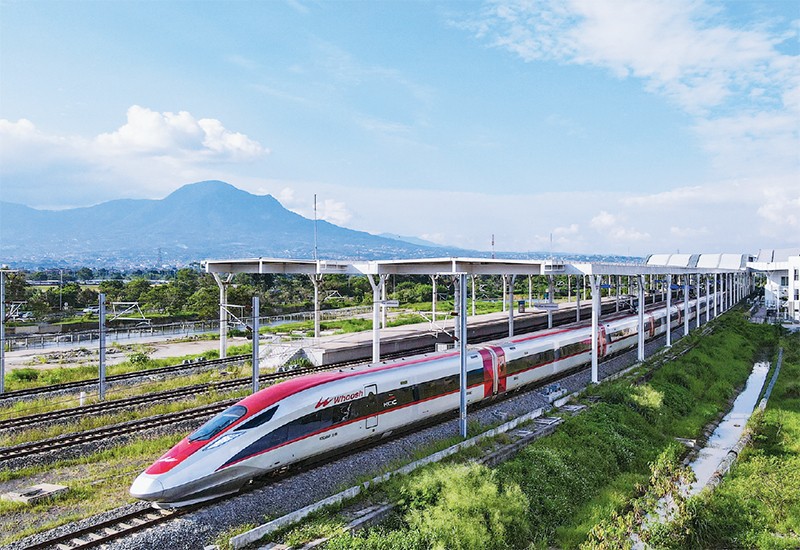
From a practical perspective, pragmatic cooperation among Asia-Pacific parties continues to expand, with trade and investment, industrial collaboration, connectivity, and personnel exchanges advancing simultaneously, deepening the pattern of integration and embedding. The average tariff level in the Asia-Pacific region has dropped from 17% over 30 years ago to 5% in recent years, with intra-regional trade accounting for over 68% of total member trade; Industries such as the digital economy, artificial intelligence, and new energy vehicles are flourishing, driving Asia-Pacific to become a global hub for innovation and growth; Landmark projects such as the Jakarta-Bandung High-Speed Railway and Qiankaigang have been completed and put into operation. The APEC Business Travel Card continues to enhance the convenience of business travelers' travel, making cross-border travel and cultural exchanges increasingly convenient; Chilean cherries enter Chinese household fruit platters faster and at lower cost, and young people in Southeast Asia can buy Chinese-made electronics on cross-border e-commerce platforms with just a tap of their phones...... Merchant ships flow continuously across the vast Pacific, with increasingly active movements of goods, capital, data, and personnel. The Asia-Pacific region has formed a deep integration pattern of "you in me, me in you." Practice has fully proven that the Asia-Pacific Community with a Shared Future is not an unattainable fantasy, but a tangible everyday reality, a reality that can be continuously unfolded through step-by-step pragmatic cooperation.
China is both the pioneer of the Asia-Pacific Community with a Shared Future concept and a leader in community building. On the Asia-Pacific ship, China's position is quite special. As one of the largest economies in this maritime area, China is a major trading partner for almost all regional economies and has signed free trade agreements with 15 other economies. This scale and weight determine that China's choices will profoundly affect the smooth course of the community's journey. Rooted in the Asia-Pacific, building the Asia-Pacific, and benefiting the Asia-Pacific, has always been China's clear stance. "The vines of sweet potatoes extend in all directions, but their tubers always grow at the root position." General Secretary Xi Jinping once used the metaphor of the "sweet potato" to vividly illustrate the deep logic that China's development has always been closely linked to Asia-Pacific prosperity. In recent years, China has continuously promoted institutional opening-up, proactively aligned with international high-standard economic and trade rules, fully removed foreign investment access restrictions in the manufacturing sector, achieved significant results in building platforms such as pilot free trade zones, accelerated formation of a network of high-standard free trade zones, and achieved remarkable results in high-quality joint construction of the "Belt and Road." In the first three quarters of 2026, China's imports and exports with other APEC economies reached 24.07 trillion yuan, a year-on-year increase of 23.9%. Research shows that China contributes over 60% to the Asia-Pacific region's economic growth, providing valuable certainty and stability for Asia-Pacific development. International observers generally believe that China is the driving force and driving force for Asia-Pacific regional cooperation. Peruvian scholar Carlos Aquino lamented: "In the current context of rising global economic uncertainty, China's commitment to stable growth and openness provides important confidence support for the development of the Asia-Pacific economy." ”
What is the focus of building an Asia-Pacific community with a shared future?
This year's APEC meeting theme was set as "Building the Asia-Pacific Community, Promoting Common Prosperity," clearly defining three priority areas: "Openness, Innovation, and Cooperation." This arrangement reflects General Secretary Xi Jinping's consistent advocacy for building an Asia-Pacific community with a shared future, continuing the APEC's long-standing cooperative aspiration and reflecting the common desire of all parties to advance Asia-Pacific cooperation to a new level. Since the launch of the APEC "China Year," China has held multiple senior officials' meetings and over 300 meetings including ministerial meetings on trade, finance, digital economy, artificial intelligence, and more, strongly uniting consensus and strength for unity and progress.
The construction of an Asia-Pacific community with a shared future is a process in which all parties continuously calibrate their direction, build mutual trust, and deepen their progress through joint consultation, joint construction, and shared benefits; it cannot be accomplished overnight. In recent years, the issue of "pan-security" has continuously disrupted and undermined the economic and trade order, and Asia-Pacific cooperation has faced challenges such as geopolitical tensions, rising unilateralism, and protectionism. At the same time, Asia-Pacific countries still have differences in rules and standards for emerging fields such as the digital economy and green transition. Some historical issues, such as territorial sovereignty and maritime rights disputes, occasionally escalated, testing the wisdom of regional countries in managing crises. Problems are not frightening; the key is to recognize that the basic pattern of interests and shared destiny among Asia-Pacific parties has not changed, and openness and cooperation remain the will of the people and the trend of the general trend. These difficulties and differences do not change the fundamentals of Asia-Pacific cooperation; instead, they highlight the necessity and urgency of all parties working together in concert. As long as all parties persist in dialogue and consultation, move toward each other, enhance mutual trust through managing differences, and expand cooperation in meeting challenges, the pace of the Asia-Pacific Community with a Shared Future will become increasingly solid, and the prospects will become ever broader.
Taking openness as the lifeline, we will consolidate the foundation for Asia-Pacific shared prosperity. Openness is the prerequisite for national progress; closure inevitably leads to backwardness. The IMF's Asia-Pacific Economic Outlook report points out that continuing to promote trade openness is key to sustaining economic growth. Asia-Pacific economies have diverse resource endowments, complementary industrial structures, and diverse development levels. It is precisely by relying on an open pattern that different economies can fully leverage their comparative advantages, develop in coordination, and achieve mutual benefit. Facing challenges such as the rise of protectionism, some countries building "small courtyards with high walls," and increasing unilateral measures, China's response is clear: to uphold genuine multilateralism, uphold the multilateral trading system centered on the World Trade Organization, and oppose politicizing and weaponizing economic and trade issues. General Secretary Xi Jinping put it well: adhere to "holding hands" rather than "letting go," and "extend the chain" instead of "breaking the chain." Only by firmly maintaining a free and open trade and investment environment can regional economic resilience be enhanced and shared prosperity in the Asia-Pacific region promoted. Asia-Pacific parties should further build consensus on openness, accelerate rule alignment, promote factor flows, drive industrial upgrading, and allow more Asia-Pacific economies to share in the benefits of openness.
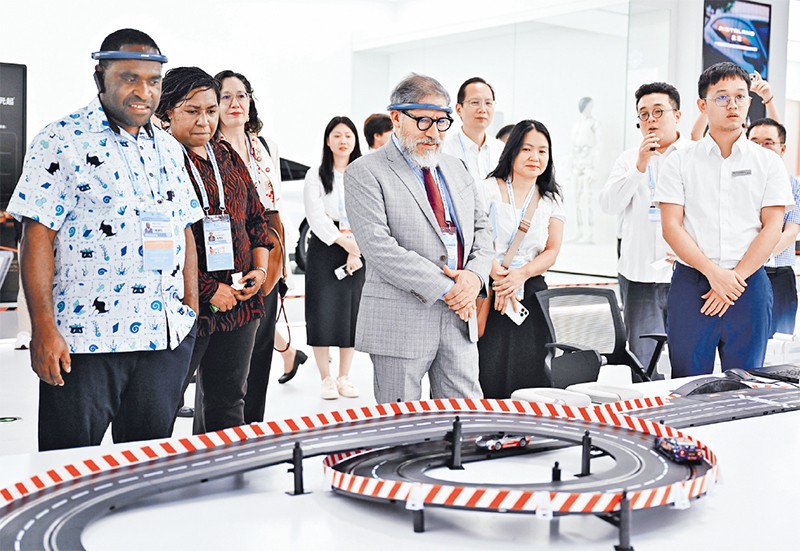
Driving through innovation, continuously shaping new drivers and advantages for Asia-Pacific development. "Innovation is the wings of the Asia-Pacific economy's takeoff." General Secretary Xi Jinping used this vivid metaphor to profoundly explain the important significance of innovation for Asia-Pacific development. In the past, Asia-Pacific growth relied more on resource development, demographic dividends, and export-oriented trade; With the leap in development stages, the marginal benefits of traditional growth drivers continue to diminish, making innovation-driven and efficiency transformation an inevitable direction. Currently, the wave of the digital economy is sweeping the globe, artificial intelligence iteration continues to accelerate, green and low-carbon transformation is advancing, and new industries, new models, and new business formats are emerging one after another. By advancing technological exchange and cooperation with a more proactive stance, accelerating digitalization, intelligence, and green transformation, the Asia-Pacific economy can continuously open up new growth opportunities. Chen Qiye, Chairman of the Singapore-Pacific Economic Cooperation Council, stated that China's AI technology research and application have achieved rapid development, and he looks forward to China's advanced practical experience and application systems being transformed into regional public goods, helping to bridge the digital divide and benefit more APEC members.
Consolidate the foundation of cooperation and unite the Asia-Pacific development forces. General Secretary Xi Jinping profoundly pointed out: "The Asia-Pacific is the space for our common development, and we are all sails sailing forward in the vast ocean of the Asia-Pacific." "Moving forward together on this vast sea, sail after sail has never been about one overpowering the other, but about dependence and symbiosis. When the winds are calm, thousands of sails compete and hundreds of boats compete, sharing the benefits of trade; When a storm arrives, if everyone acts on their own or even turns neighbors into a ravine, no matter how sturdy the ship's hull, it cannot withstand the raging waves. From the 1997 Asia-Pacific economies jointly responding to the Asian financial crisis, to the 2008 international financial crisis where collective action stabilized regional economic confidence, and then to promoting cross-border flows of critical medical supplies during the COVID-19 pandemic in 2020, it is unity and cooperation that have helped Asia-Pacific gain a foothold amid crises and expand vitality in recovery. Currently, various global challenges are long-term and systemic in nature. Climate change, public health risks, and waves of technological change have long exceeded the limits of a single economy's response. No economy can withstand multiple variables on its own. Asia-Pacific's significant advantage lies in integrating dispersed capabilities into collective strengths, pooling individual potential into common momentum. Julia Torreblanca, Peru's representative of the APEC Business Advisory Council, stated: "True progress comes from cooperation rather than isolation; we must return to a path of openness, dialogue, and trust." "On one hand, we must uphold the fundamental premise of peace and stability, adhere to a common, comprehensive, cooperative, and sustainable security concept, implement the Global Security Initiative, and resolve differences and disputes through dialogue and consultation. On the other hand, we must make good use of the autonomous, voluntary, consensus-based, and gradual "APEC approach," adhere to inclusiveness without exclusion, cooperation without alliance, and transform differences into opportunities for cooperation, forming a pattern of mutual achievement and common development among all parties.
