


"The Asia-Pacific is a world of our shared development"—Notes from President Xi Jinping's keynote speech at the opening ceremony of the APEC Business Leaders Summit
"Let us join hands to ease development difficulties through openness, drive growth through innovation, seek shared benefits through cooperation, build the Asia-Pacific community, and jointly create a bright future for the Asia-Pacific!" ”
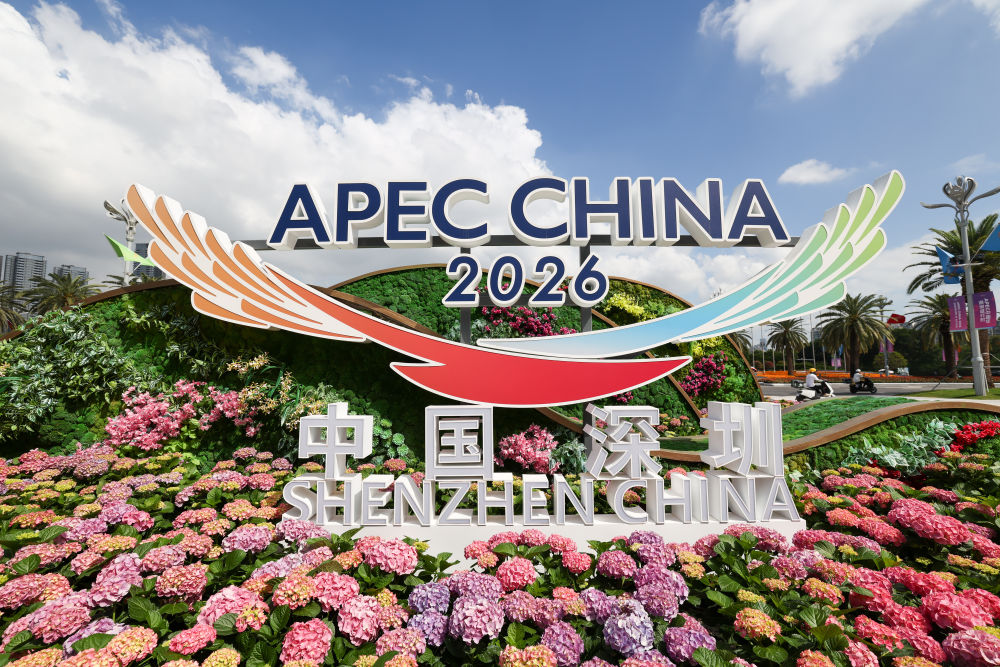
This is the "Peng Xiang Bi Lang" themed scenic spot at the Qianhai Special Zone Pavilion Plaza, Shenzhen (photo taken on November 5, 2026).
On the shore of the South China Sea, Shenzhen Qianhai International Conference Center. The "Peng Soars Over the Blue Waves" themed landscape spreads out like a brocade, with the golden characters "Promoting Prosperity Together, Win-Win the Future Together" shining brightly, highlighting yet another historic moment—
On November 18, 2026, the APEC Business Leaders Summit was held here. President Xi Jinping attended the opening ceremony and delivered a keynote speech, guiding the way forward for Asia-Pacific cooperation under the new circumstances.
This is the third time China has hosted the APEC Business Leaders Summit, following its 2001 in Shanghai and 2014 in Beijing.
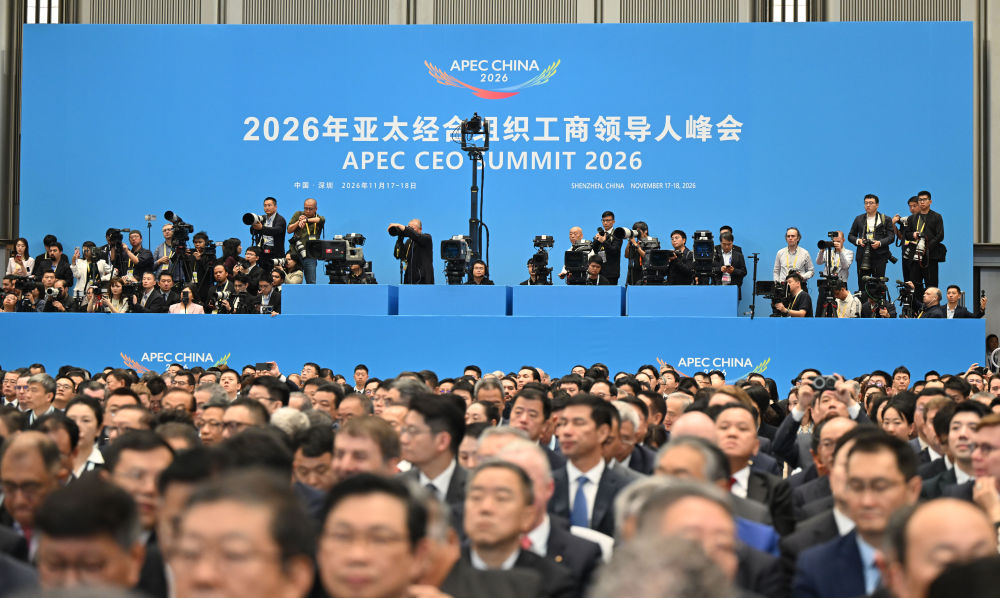
On the morning of November 18, 2026, the opening ceremony of the 2026 APEC Business Leaders Summit was held in Shenzhen. This is a reporter conducting an on-site interview.
From the banks of the Huangpu River, to the foot of Yanshan, and to the shores of the South China Sea, as a steadfast supporter, active participant, and important leader of Asia-Pacific cooperation, China has long been deeply integrated into the Asia-Pacific and the world, becoming a key engine and stabilizing force for global economic growth.
From last year's Gyeongju, South Korea to this year's Shenzhen, China, nearly 400 days and nights as host host, from theme setting to event preparation, China has joined hands with other APEC member economies to jointly discuss new economic landscapes and opportunities for cooperation in the Asia-Pacific.
At this moment, the world is focused on the Asia-Pacific, and the Asia-Pacific region is watching China.
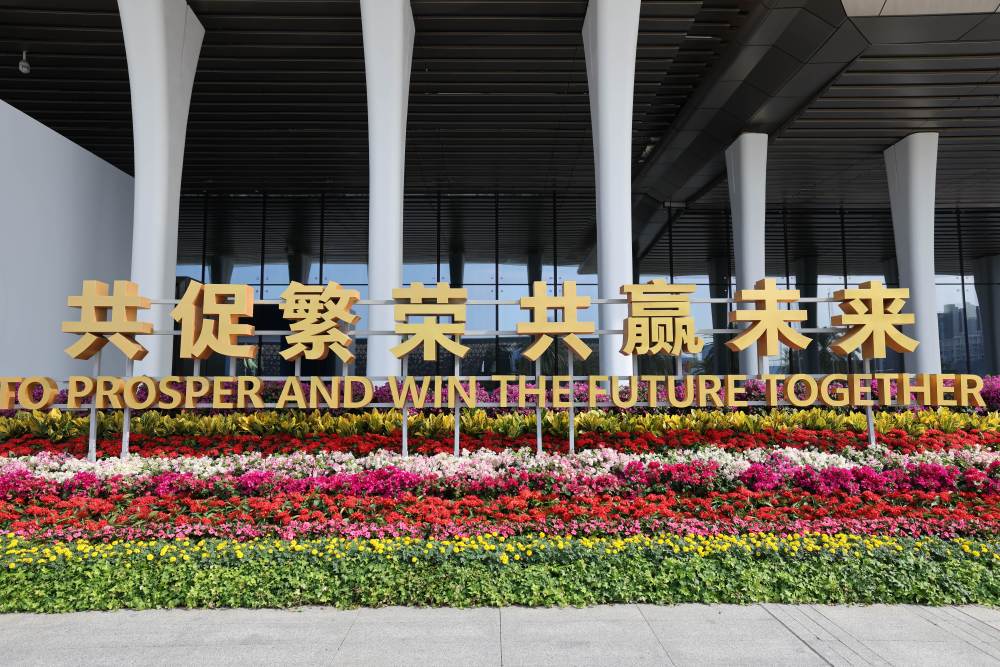
This is the "Promoting Prosperity Together, Win-Win Future" landscape outside the Qianhai International Convention Center in Shenzhen (photo taken on November 18, 2026).
Brilliant lights and flashing lenses captured this important moment by media from around the world—at 9:50 a.m., in the first-floor lobby of the Qianhai International Conference Center, President Xi Jinping took a group photo with representatives from the Asia-Pacific business community attending the event.
On the blue background behind them are the Chinese and English inscriptions of the "2026 APEC Business Leaders Summit" and the APEC "Year of China" logo. The 21 intertwined wings resemble a great roc spreading its wings, symbolizing the 21 economies riding the momentum and soaring together.
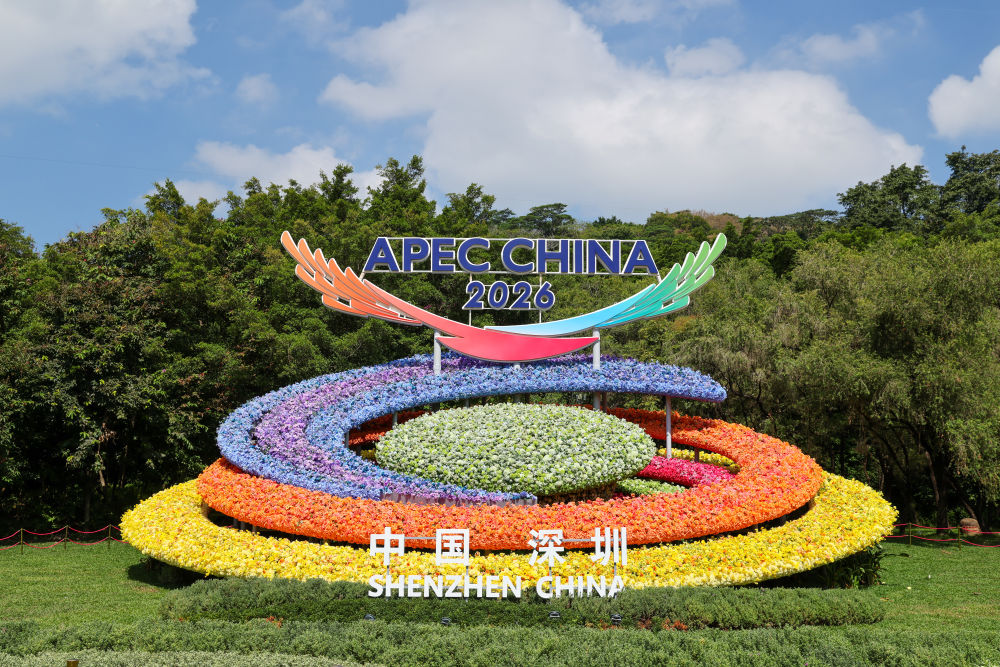
This is a giant APEC-themed flower bed in Shenzhen's Lotus Mountain Park (photographed on October 17, 2026).
Looking back, at every critical moment in Asia-Pacific development, one Chinese proposal after another confronts regional development challenges, demonstrating the foresight and responsibility of major power leaders in leading Asia-Pacific cooperation and practicing multilateralism.
Looking ahead, how APEC will promote the building of the Asia-Pacific Community and whether the Asia-Pacific region can continue to serve as a driving force for economic globalization is a topic of close attention to China's voice.
At exactly 10 a.m., in the main hall on the second floor of the conference center, as the magnificent music "Peace—Community of Shared Future" played, all guests stood up and applauded enthusiastically. President Xi Jinping strode onto the podium and delivered a keynote speech titled "Strengthen Confidence, Forge Ahead with Courage, Create a Bright Future for Asia-Pacific Together."
"Welcome to friends from the Asia-Pacific business community! We are very pleased to meet you all in Shenzhen. "The heartfelt greetings made the domestic and international guests feel as if they were bathed in a breath of spring."
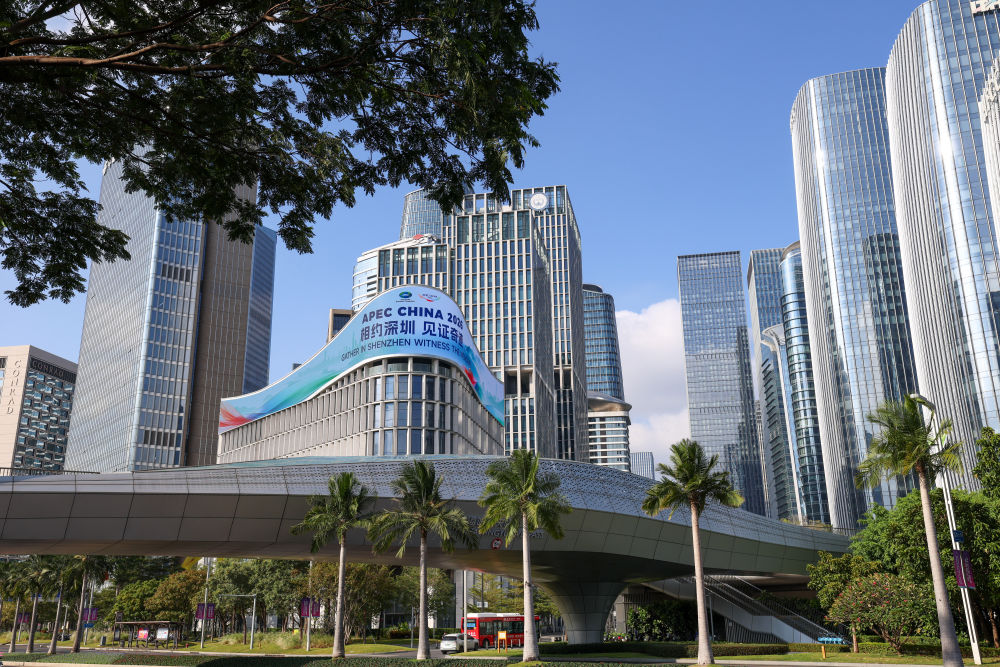
In Qianhai, Shenzhen, building screens scroll with APEC-themed promotional posters (photographed on November 3, 2026).
The summit's venue, Shenzhen, holds a unique place of special significance in President Xi Jinping's heart.
After the 18th National Congress of the Communist Party of China in 2012, he left Beijing for his first inspection visit to Qianhai, Shenzhen. In 2018, on the occasion of the 40th anniversary of reform and opening up, he returned to Shenzhen, and in 2020, he attended the celebration of the 40th anniversary of the establishment of the Shenzhen Special Economic Zone...... Wherever he went, he earnestly entrusted him with his mission, conveying to the world the firm determination to carry reform and opening up through to the end.
On the eve of this visit to Shenzhen to attend the conference, General Secretary Xi Jinping visited Zhongshan, Guangdong for an inspection. From the railing on the western artificial island of the Shenzhen-Zhongshan Corridor, you can gaze into the distance: to the west, the Shenzhen-Zhongshan Bridge is bustling with traffic, and to the southeast, the city skyline of Qianhai, Shenzhen is a magnificent sight.
"For more than 40 years, Shenzhen has stood at the forefront and forged ahead in the spring tide of China's reform and opening up, achieving a historic leap from a border town to an international metropolis, creating a miracle in the history of world development. Shenzhen's success offers many insights. "Inside the venue, President Xi Jinping's speech transcended time and space and carried profound meaning.
What was once a small fishing village transformed into today's city of miracles—how did Shenzhen's remarkable transformation happen? The answer is written in the word "openness"—it is not only the driving force behind the city's rapid growth, but also the deep foundation for Asia-Pacific's sustained prosperity.
Currently, the international situation is chaotic and intertwined, with insufficient global economic growth momentum, and unilateralism and protectionism rampant. Meanwhile, global trade has maintained growth despite the odds, emerging technologies are accelerating breakthroughs, profoundly shaping the global development landscape.
"What's wrong with the world? What about Asia-Pacific? Open or closed, cooperation or division, change or conservatism? "In his speech, the questions raised by President Xi Jinping are thought-provoking.
"China is willing to work with all parties to strengthen confidence and forge ahead with courage, working together to build the Asia-Pacific Community and promote common prosperity in the Asia-Pacific." Facing the challenges of the new era, President Xi Jinping's answer was resolute and resolute.
— To promote common prosperity in the Asia-Pacific, we must maintain peace and stability.
He proposed that the more complex the external situation, the more we must firmly safeguard the postwar international order, promote an equal and orderly multipolar world and inclusive economic globalization, and "the more we insist on resolving differences through dialogue and consultation, and meeting challenges through unity and cooperation, laying a solid foundation for long-term stability in the Asia-Pacific region."
— To promote common prosperity in the Asia-Pacific, we must build bridges of openness and cooperation.
It stressed the need to firmly uphold the multilateral trading system with the World Trade Organization at its core and rules-based, support free and open trade and investment, and maintain the stability and smooth flow of global industrial and supply chains; Steadily advance the Asia-Pacific Free Trade Area process, "paving the way and building bridges for Asia-Pacific economic integration."
— To promote common prosperity in the Asia-Pacific region, we must stimulate innovative growth momentum.
Focusing on actively building a technology innovation partnership, it emphasizes "deepening cooperation in the digital economy and artificial intelligence, promoting green and low-carbon transformation, continuously transforming innovation advantages into growth drivers, and providing strong momentum for Asia-Pacific economic growth."
— To promote common prosperity in the Asia-Pacific, we must expand mutually beneficial and win-win paths.
He pointed out that promoting Asia-Pacific cooperation "cannot be uniform and uniform," requiring both the elimination of trade and investment barriers to build an open Asia-Pacific economy while promoting inclusive and balanced development, balancing efficiency and fairness; We must adhere to a people-centered development philosophy, "allowing the fruits of development to benefit all economies and different social classes and groups."
President Xi Jinping, with a broad historical vision, put forward four proposals to promote common prosperity in the Asia-Pacific. The Chinese concept and Chinese solution once again inject abundant ideological momentum and provide clear guidance for the future development of the Asia-Pacific.
Building the Asia-Pacific Community and jointly creating a bright future for the Asia-Pacific.
The summit was held in Shenzhen, within the Guangdong-Hong Kong-Macao Greater Bay Area. The total economic output exceeded 15 trillion yuan, with three cities with regional GDP exceeding 3 trillion yuan...... The Guangdong-Hong Kong-Macao Greater Bay Area is continuously expanding channels for sharing cooperation opportunities with Asia-Pacific regions and continuously unleashing the dividends of openness.
In his speech, President Xi Jinping stated that China supports the establishment of the World Bay Area Economic Cooperation Alliance, deepening exchanges and interactions among the Bay Areas, and exploring new paths for Asia-Pacific economic cooperation.
Rooted in the Asia-Pacific, building the Asia-Pacific, and benefiting the Asia-Pacific, a more open China is continuously providing new opportunities for the Asia-Pacific and the world with new achievements in Chinese-style modernization.
The APEC "China Year" coincides with the start of China's "15th Five-Year Plan." "China's 15th Five-Year Plan is not only a blueprint for its own development, but also provides a list of opportunities for economic growth in the Asia-Pacific and even globally. It is China's invitation to cooperate with the global business community." President Xi Jinping pointed out.
Behind this invitation is a massive open market: from new energy vehicles to smart homes, from the silver economy to ice and snow tourism, "every new track brings new opportunities to global enterprises."
Behind this invitation lies a vast development potential: China will accelerate the construction of a modern industrial system, promote the deep integration of technological and industrial innovation, and "provide strong momentum for global enterprises' technological innovation and growth."
Behind this invitation is a mutually promoting cooperative environment: China has always practiced genuine multilateralism, firmly upheld the multilateral trading system, and "continuously injected stability and certainty into world economic growth and international economic and trade cooperation"; Unswervingly promoting high-quality development of the Belt and Road Initiative, we welcome active participation from Asia-Pacific enterprises to jointly seek development opportunities and share development achievements.
…………
Their consistent commitment to openness and firm determination for win-win cooperation won enthusiastic responses from the attending guests.
"President Xi's speech put forward a series of proposals to promote common prosperity in the Asia-Pacific, sending a clear signal that we must work together, which is very important for the world today." Listening to the speech live, American economist Jeffrey Sachs said this.
"This is a very important speech, and I will share it with my business friends as soon as possible." Frank Maguire from the Australia-China Business Council said he was deeply impressed by President Xi's concept of mutual benefit and win-win cooperation, and that China's innovative development will bring more new opportunities to Australian enterprises.
At this moment, in Qianhai, Shenzhen, the wave of openness and cooperation surged forward. Not far from the venue, the Qianhai Stone, shaped like "setting sail," stood facing the wind.
"Asia-Pacific is the world where we develop together, and also the stage where we work side by side." Starting from Shenzhen again, the future of Asia-Pacific is full of hope and bright prospects.
