


With domestic chips scaling up and cloud vendor customization, Renesas China's internal memory interface market target is doubling
DDR5 has now fully entered the mainstream market. Looking back at its commercial progress, in the second half of 2022, DDR5 was the first to be deployed in the server field; In 2023, as Intel and AMD shipped server CPUs supporting DDR5 in large quantities, mainstream data center manufacturers began accelerating product iteration; Since 2024, DDR5 has officially risen to become the mainstream configuration in the server memory market.
Starting from the second half of 2025, the storage market will enter a phase of structural shortages. Market research institutions and industry analysts point out that compared to the consumer market, the server sector has stricter requirements for performance, bandwidth, and reliability, but server manufacturers are relatively less sensitive to initial costs. This characteristic makes upstream pellet manufacturers more willing to shift limited capacity toward servers, thereby limiting supply in the consumer market. Against this backdrop, the industry generally predicts that the tight supply-demand situation for memory chips may continue beyond 2028.
Meanwhile, memory interface chips, as core components of memory modules (RDIMM), have also achieved rapid growth in recent years. Elliot Zhu, Business Development Director of Renesas Electronics' Memory Interface Division, pointed out that in 2026, demand for DDR5 in AI servers will remain strong, further driving market growth for memory interface chips. At CFMS | During MemoryS 2026, he provided insights on the latest developments in the memory interface chip market and Renesas Electronics' layout in this field.
DDR5 generational evolution: Architectural upgrades and technological continuity go hand in hand
If you observe how DDR5 has evolved, it's not hard to see that the technology has evolved both between generations and within each generation. The former uses the DDR standard released by JEDEC every few years as a benchmark, such as the leap from DDR4 to DDR5 and the transition from DDR5 to DDR6, which involves major architectural changes; The latter is based on the internal evolution of the DDR5 generation, which is driven by iterative upgrades of RCD (Registered Clock Driver) chips, process advances, and signal architecture optimizations, continuously achieving speed leaps. Widely mentioned first generation (Gen1), second generation (Gen2), etc., are all generational evolutions.
DDR5 core component RCDs have now iterated to the sixth generation (Gen6), with data transfer rates ranging from 4800MT/s, 6400MT/s, to 7200MT/s...... This has been increased to 9600MT/s, maintaining a high degree of continuity across generations in the overall architecture. Juli revealed that the 9600MT/s rate will be the final step in the development of RCDs in the DDR5 era, with future DDR5 advancements focusing on optimization in both process and functionality. Currently, the DDR6 protocol is still under industry discussion, its first-generation RCD has not been finalized, and the entire industry chain is still in the definition phase.
The pace of industrial migration is influenced by TCO and market patterns
Although DDR technology continues to advance across generations, the actual speed of market migration is constrained by multiple factors. By the first half of 2026, how will DDR5 be deployed in the server sector? On the system side, servers on the market are still dominated by DDR5 Gen 3 (supporting 6400MT/s), while Gen 4 is gradually being commercially deployed (supporting 7200MT/s); On the device side, DDR5 RCD has already iterated to the sixth generation (supporting 9600MT/s).
This means that memory interface chip manufacturers must prepare corresponding RCD products several years ahead of terminal server manufacturers. "Memory interface chip manufacturers are the core upstream participants in the industry," Zhu Li explained. "We started R&D and definition work 5 to 6 years before the end market scale scales up." ”
In fact, before releasing each generation of memory interface chips, Renesas Electronics must jointly establish technical directions and specification standards with industry partners, and only after repeated validation can new memory interface chips be brought to industrialization. It is precisely this "first mover" model that ensures Renesas maintains an industry-leading advantage whenever switching memory technologies.
In addition to the above factors, the continued price increases of DRAM chips and CPUs have pushed up system TCO (Total Cost of Ownership). There is a possibility that the transition pace between 8000MT/s and next-generation products will generally be delayed, with end customers preferring to "use old products first" and delay the introduction and validation of next-generation products. This poses challenges to the entire industry chain, especially DRAM chip manufacturers.
Looking at the market coexistence pattern, by 2026, 6400MT/s products are expected to account for over 50% of the market, and 5600MT/s about 30%. From 2027 to 2028, 8000MT/s is expected to exceed 50% of the market share, while 9600MT/s is expected to become mainstream between 2028 and 2029, at which point DDR6 will gradually enter the market view. Zhu Li believes that this gradual migration pace provides ample room for adjustment and profit for participants across all segments of the industry chain.
From mainstream servers to AI data centers, covering all scenarios
In servers running at high frequencies, if the CPU's memory controller is directly connected to multiple DRAM memory chips, two major problems can occur: first, long signal transmission distances can easily cause "attenuation and distortion"; second, too many connected chips can overload the controller. RCDs act like "intelligent repeaters," inserted between the memory controller and DRAM chips, first receiving signals that would otherwise be transmitted directly, then buffering and amplifying them before forwarding them. This not only solves signal attenuation issues but also reduces the controller's burden.
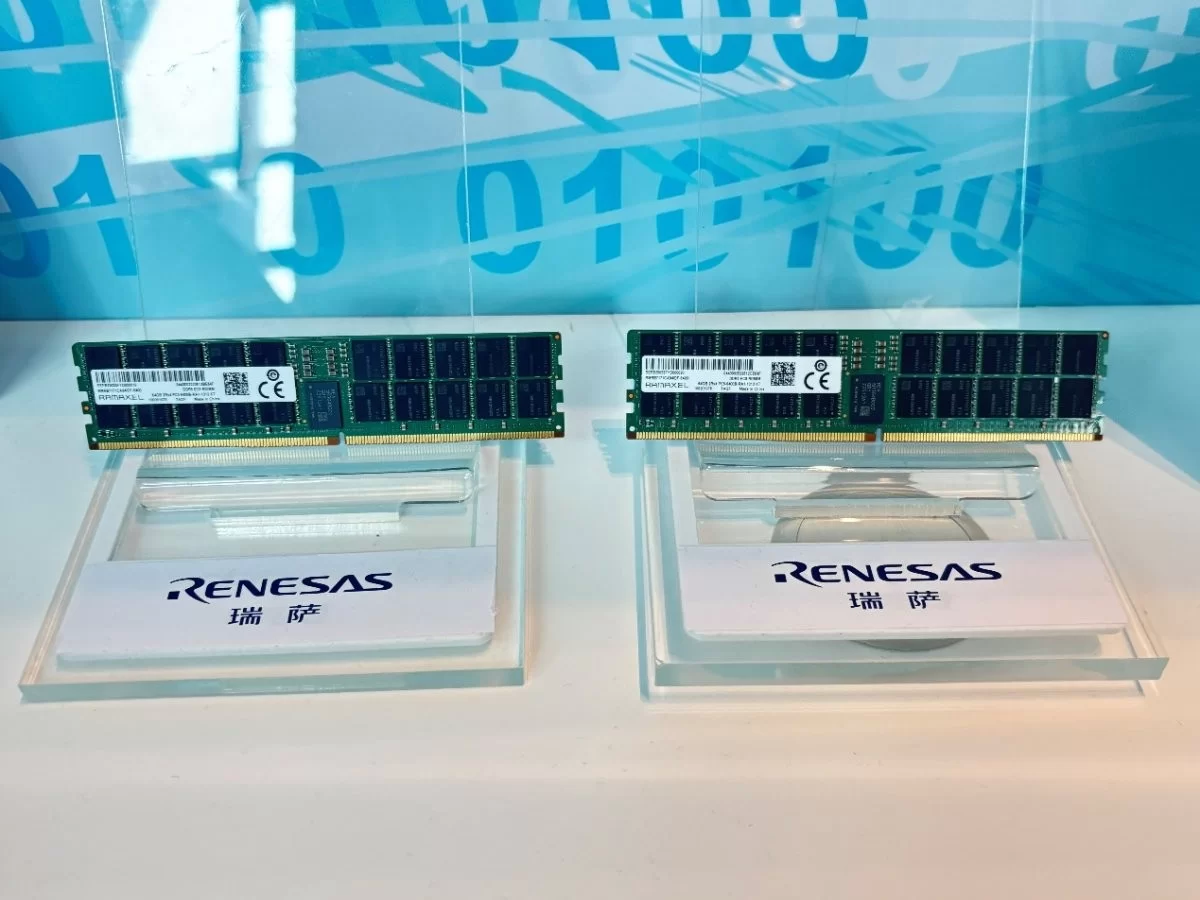
Renesas Electronics DDR5 memory interface solution
Renesas Electronics offers a variety of JEDEC-compliant RCDs, data buffers (DBs), power management ICs, temperature sensors, and SPD (Serial Presence Detection) hubs to meet the timing requirements of DIMM and other DRAM and NAND memory interface applications. Its memory interface chip products cover all scenario needs, from mainstream servers to AI data centers.
First is the RCD product line. Renesas DDR5 6th generation RCD offers a 10% increase in bandwidth compared to 5th generation, and significantly improves signal integrity and system reliability through enhanced DFE (Decision Feedback Equalization) architecture and DESTM system-level diagnostics. Currently, samples of this product have begun to be sent to all major DRAM suppliers, with mass production expected to begin in the first half of 2027.
Next is MRDIMM. MRDIMM is a new memory module technology designed specifically for AI and HPC data centers, jointly promoted by Renesas, Intel, and memory suppliers. This chipset adopts a "1+10" architecture—one MRCD (Registered Clock Driver) paired with ten MDBs (Multiplexed Data Buffers). By using dual columns of memory to access data simultaneously, memory bandwidth is increased by 6% to 33%, with capacity expandable to 256GB, far exceeding the standard RDIMM's 96GB.
Next is the I3C series. This is a new product category introduced in the DDR5 era, designed to unify the management of multiple components on the motherboard, such as RCDs and PMICs. Renesas separated this protocol from the SPD and designed a separate chip to meet one-to-many management needs such as dual CPUs, multiple memory modules, and multiple SSDs. The product has now passed motherboard certification from Intel and AMD.
AI servers drive MRDIMM demand beyond expectations
Against the macro backdrop of overall tight DRAM supply, MRDIMM will become one of Renesas Electronics' most promising incremental markets. According to Zhuli, the price of a single MRDIMM solution is several times that of a standard RCD kit, and in the high-value-density AI server sector, this premium is more likely to be accepted by customers.
The reason is that, in an environment where DRAM chip prices are rising rapidly, the cost share of MRDIMM in BOMs is diluted, customers are significantly less sensitive to price, and they are paying more attention to speed and capacity advantages. AI servers have more urgent demands for memory bandwidth and capacity. Compared to traditional RDIMM, MRDIMM can achieve higher capacity and greater bandwidth.
Based on this forecast, MRDIMM's penetration rate is expected to climb from a low single-digit level in 2026 to 8% to 10% in 2027, exceeding the previous forecast of 5% to 8%. AI servers and video streaming (such as Douyin, YouTube, etc.) are currently the two most clearly needed application scenarios. Currently, leading domestic companies have already shown clear interest in MRDIMM. Juli firmly believes that as AI capital expenditure continues to rise, MRDIMM is poised to capture an increasingly important share in Renesas Electronics' memory interface business.
Customized demand and the expansion of domestic pellets are driving growth in the Chinese market
Today, Renesas Electronics maintains long-term investment and high attention to the Chinese memory interface market. From the perspective of end-customer demand characteristics, China and the United States show significant differences. The pace of CPU iteration in the US market is relatively fast and mature, while Chinese cloud providers are rapidly releasing demand for customized memory solutions.
Zhu Li observed that Chinese customers have much higher demands for technical response speed and deep technical support than foreign countries, and domestic DRAM module capabilities are in a period of rapid growth. "Although the quality of domestic chips is close to first-tier standards, module design and system adaptation capabilities are still rapidly climbing," he added. Renesas Electronics has established a full-scale AE support team in China, distributed in Shanghai and Chengdu, achieving zero-time response to customer demands.
In recent years, China has shown enormous growth potential in the memory interface chip sector, becoming one of the fastest-growing regional markets. "DDR5's mainstream position in the server market will continue at least until 2030. Our Chinese market's memory interface chip revenue target this year is to grow by 100% year-on-year." Juli said, "Renesas MID is confident in achieving 100% growth in China by 2026. This is mainly due to the rapid increase in demand for domestic memory modules. As an important industry player, our business volume has also grown rapidly."
In summary, Renesas Electronics has adopted an active supply chain localization strategy in the Chinese market, aiming to ensure supply for customers and consolidate its competitive position in China.
