

Samsung, SK Hynix, and Micron Join Hands with SEMI to Promote Standardization of Wafer Fab Robot Charging
According to a report by Seoul Economic Daily on November 8, 2026, Samsung Electronics, SK Hynix, and Micron are jointly advancing a charging standardization project for mobile robots in wafer fbs with the International Semiconductor Equipment and Materials Association (SEMI). The three companies have formed an initial practical agreement to unify the battery specifications and charging station operation methods of each company's previously different robots.

(Seoul Economic Daily report)
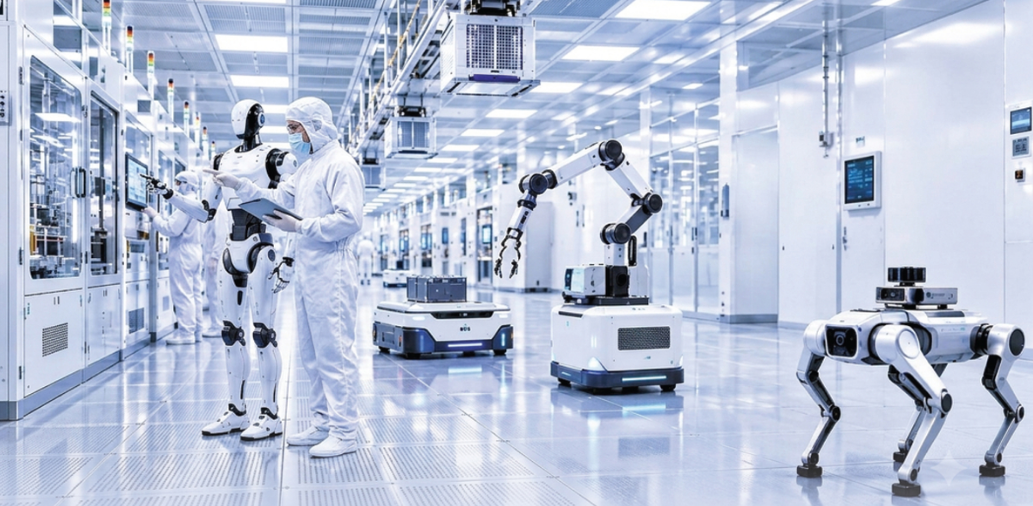
report revealed that the standardization scope covers battery specifications of various mobile robots, charging station communication and equipment, charger connection components, and battery management systems, limited to mobile robots deployed within chip factories. The three companies evaluated the models to be introduced, including humanoid robots, autonomous mobile robots (AMRs), and mobile robotic arms.
The confidence of these three memory giants sitting together at this time comes from the upward storage supercycle: research firm Counterpoint data shows that global DRAM revenue in Q3 2026 will grow 369% year-on-year, approaching $200 billion, with Samsung leading with a 38% share. Another agency, TrendForce, showed data for the second quarter of 2026 showing that Samsung, SK Hynix, and Micron had DRAM revenue shares of 39.4%, 24.9%, and 23.3% respectively that quarter.
source
of robot demand
The real driving force behind this round of standardization is the automated transformation of old factories. The report pointed out that some production lines at Samsung Cerebral's Heung Campus and SK Hynix's Cheongju Campus are considered representatives of the old plant. Although the new factory is equipped with automation equipment such as overhead cranes (OHT) and wafer storage systems (Stocker), the old factory still relies heavily on manual labor—tasks such as manual handling of wafer boxes, interlayer logistics movement, and removal of semi-finished product packaging are still performed by manual labor.
In fact, robots entering semiconductor fabs are no longer a concept. Korean robotics company MX Robotics is collaborating with SK and Bem Robotics to develop AMRs for semiconductor scenarios, and has revealed that supply to SK Hynix is progressing, with delivery expected in the second half of 2026.
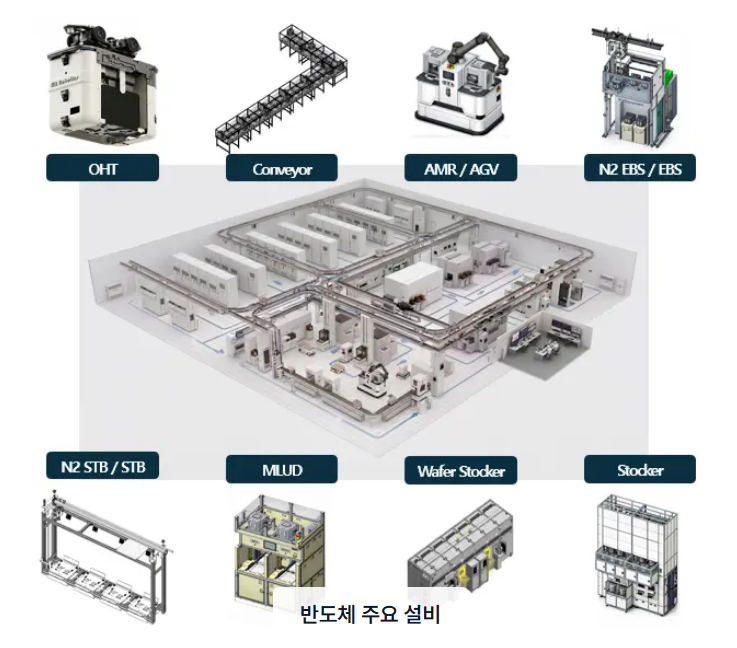
(Semiconductor Factory Automation Equipment, Image source: MX Robotics)
The idea of standardization itself is not new—the Seoul Economic Daily reports that discussions about factory robot standardization began ten years ago, only to be truly put on the agenda after the current global robot adoption boom combined with the storage supercycle.
heterogeneous robots entering the factory
Most mobile robots lack industry standard specifications, and each manufacturer has different product parameters and interfaces. The problem first emerged at charging stations: if each robot needed dedicated charging equipment, factories had to install stations in equal quantities according to robot type, while old factories simply did not have enough idle space. Once charging specifications are unified, fewer devices can serve robots of different brands, making compatibility the primary goal of standardization.
The second layer of trouble lies on the system side. Charging information needs to be integrated into the Manufacturing Execution System (MES) to allocate operation and charging time for individual robots according to production schedules—this effectively transfers management methods previously used for manual scheduling and eliminating production gaps onto robots, enabling collaborative optimization of different robots in hundreds of processes.
Safety and certification are the third layer. Suhan Park, professor of robotics at Kwangwoon University in South Korea, said that different robot charging methods mean the number of safety verification and management targets multiplies. Establishing standards will bring significant benefits, and he expects industry standards to shorten safety certification cycles and accelerate robot deployment.
limited
global precedent
Cross-vendor robot interface standards are not without precedent. The VDA5050 jointly developed by the German Association of the Automotive Industry (VDA) and the German Mechanical Equipment Manufacturers Association (VDMA) is a standardized communication interface between mobile robots and fleet management systems. Version 3.0, released in April 2026, was the first to incorporate features of free-navigation mobile robots and is now open-sourced on GitHub.
The International Federation of Robotics (IFR) defines this standard as a communication interface between AGVs and main control systems, rather than a complete control system. However, VDA5050 only addresses the "dialogue" problem, not hardware—it does not have a unified map format, does not include built-in safety models, and does not involve the physical specifications of batteries and charging devices.
Based on this, the Seoul Economic Daily judges that standardization attempts in the semiconductor industry, which integrate communications, components, and equipment together, have not yet been preceded worldwide. The Korea Society of Robotics' related assessments also pointed out that interoperability of heterogeneous robots is becoming a common issue in logistics, automotive, and other industries. Future competition will not only focus on single-machine performance but also on connectivity and stable operation among different robots.
Jang Young-jae, Director of KAIST's Manufacturing Physical AI Research Center, stated: "Setting standards is intended to prepare chip fabs for the use of various robots as production equipment." Making charging systems cross-vendor compatible can reduce the burden of introduced, verified, and maintained robots, and lessen dependence on a single supplier. "
This last sentence highlights the deeper meaning of standardization: when three buyers collectively controlling about 90% of the global DRAM market jointly define interfaces, robot manufacturers must compete around this standard—the unified standard is the connection layer, and what is unrestricted is the race for ontology capability
