


Nvidia's eyes turn red as it watches: Huawei takes 52.1% of domestic AI chip market share
No black, no blowing. Nvidia's dream has always been to return to the Chinese market and sell its AI chips to China without restrictions.
On the one hand, it is because the Chinese AI chip market is huge in scale and has enormous development potential. Nvidia is indeed unwilling to lose such a large market, and the losses are too great.
On the other hand, it is the Chinese AI chip market. Without Nvidia, there will be high-speed domestic substitution, and Nvidia will not be able to come back in the future.
In addition, China has the largest number of AI talents in the world. Once these AI talents break away from Nvidia's AI ecology and train AI in China's own AI ecology, then the future AI pattern may not be Nvidia's the final say, but China's say it all.
So Nvidia only wants to return to the Chinese market and sell a large number of AI chips to suppress the growth of other AI ecosystems, keeping everyone confined to Nvidia's CUDA ecosystem.
But this is just Nvidia's wishful thinking. The United States has still been holding onto Nvidia's AI chips, and advanced ones are still not allowed to be sold.
The domestic substitution of domestic AI chips is constantly accelerating. According to media reports, in the first half of 2026, the share of domestic AI chips in the Chinese market had already exceeded 50%, while Nvidia's share was only about 34%.
Among these domestically produced AI chips, Huawei has once again monopolized half of them. As shown in the figure below, this is the distribution of 1.1 million domestically produced AI chips according to IDC's statistics.
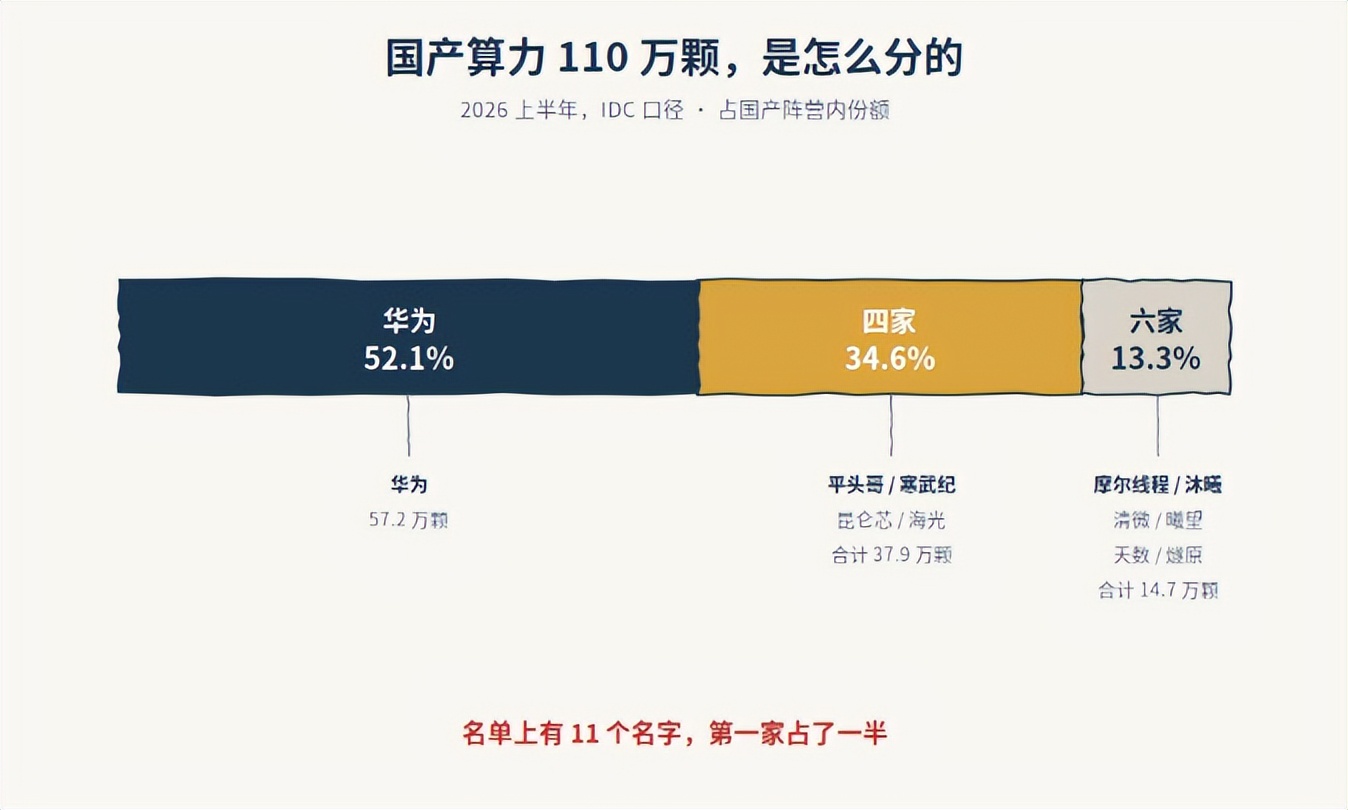
Huawei shipped 572000 units, accounting for 52.1%, followed by Pingtouge, Cambrian, Kunlun Chip, and Haiguang in the second tier, totaling 34.6%.
Another six companies in the third tier, including Moore Thread, Mu Xi, and Tian Tian, account for 13.3% of the market share.
However, there is still a certain difference between domestically produced AI chips and Nvidia chips, which is that Nvidia's chips are both general-purpose GPU chips, while domestically produced chips are more specialized rather than general-purpose GPUs.
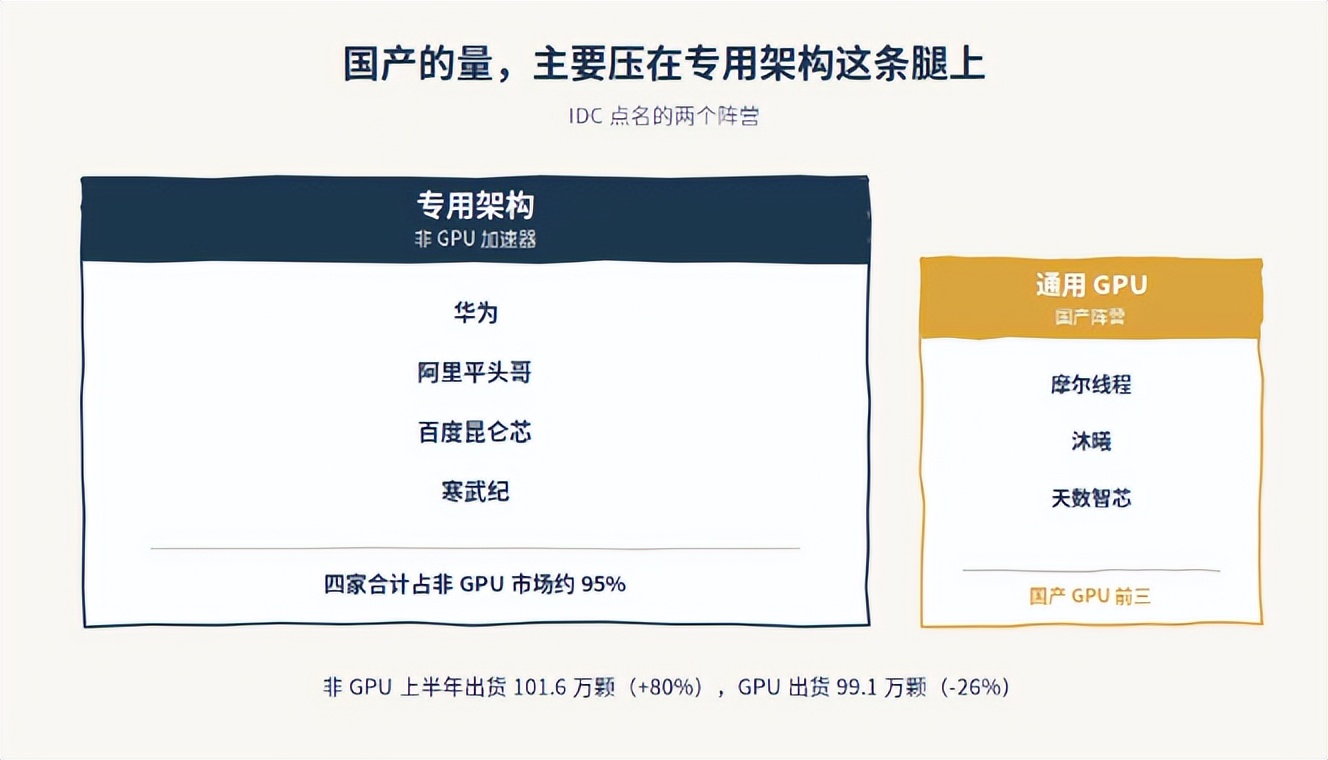
As shown in the above figure, non GPU chips account for over 90% of the domestic market, with 1.016 million units shipped, while GPU AI chips have less than 100000 units, which is very few.
It's not that non GPU AI chips are not as versatile, but the generality of non GPU chips is not as strong as GPU chips, because whether it's ASIC (such as TPU, NPU), FPGA, or reconfigurable architecture (RPU), they are designed for specific algorithms or scenarios, and will be less adaptable in the scene.
However, no matter what, Nvidia is still very anxious when it sees such data, because it represents that it is almost impossible for Nvidia to regain its dominant position in the Chinese market.
