

TSMC plans to raise prices for its CoWoS advanced packaging by 10% to 20%, putting cost pressure on Nvidia and AMD.
According to a report by Taiwan’s *Commercial Times*, citing supply chain sources, TSMC is considering a 10% to 20% price increase for its advanced packaging services. The primary focus of this potential hike is the CoWoS (Chip on Wafer on Substrate) packaging technology, which is essential for high-end AI chips.
CoWoS, which integrates chips with High-Bandwidth Memory (HBM) into a single package, has become a critical, indispensable process for high-end AI accelerator chips. The report notes that demand for CoWoS has expanded beyond GPUs to include server CPUs and custom ASICs. This rapid surge in demand has kept production capacity under persistent strain. Furthermore, the longer testing cycles required for AI chips have added further pressure on the supply of packaging and testing capacity.
It is worth noting that these price adjustments are still under consideration, and TSMC has not yet announced an official timeline for their implementation.
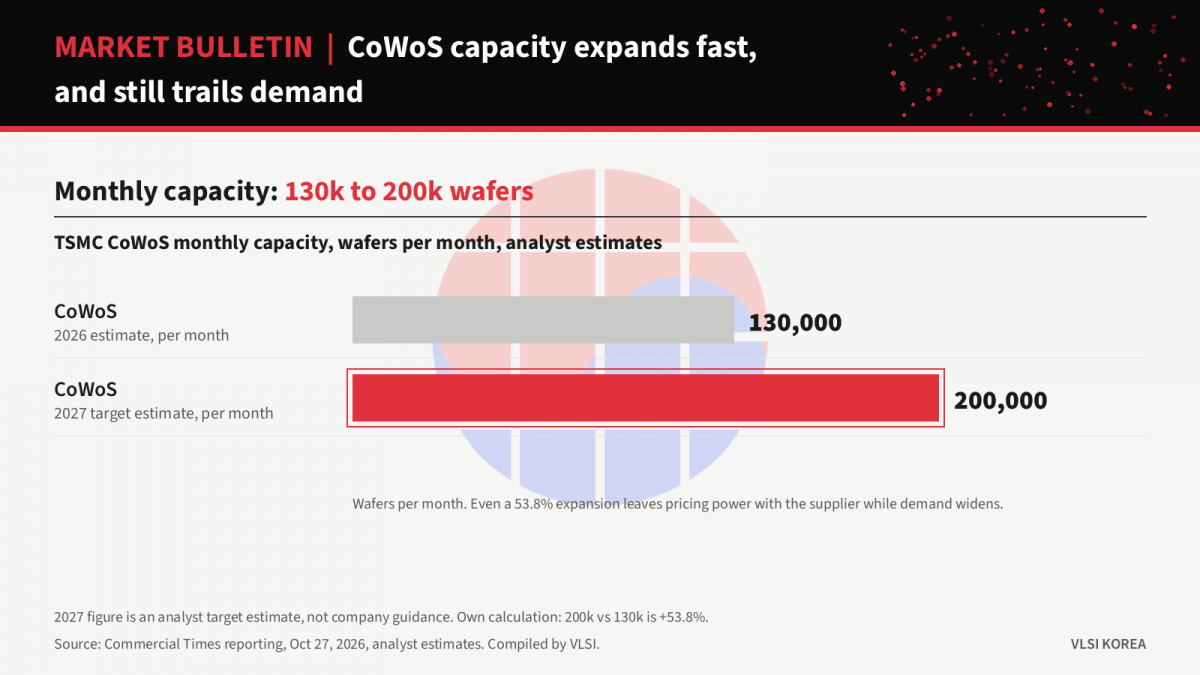
Monthly capacity to exceed 130,000 wafers this year, with projections reaching 200,000 next year.
Despite ongoing efforts to expand production, the supply crunch is unlikely to ease in the near term. Analysts estimate that TSMC’s monthly CoWoS capacity could surpass 130,000 wafers by 2026 and climb to over 200,000 by 2027. JPMorgan projects a supply gap of approximately 20% for advanced packaging between 2027 and 2028, with monthly capacity potentially reaching 220,000 wafers by the end of 2028.
During a recent earnings call, TSMC Chairman C.C. Wei stated that CoWoS remains the top choice for customers, noting that TSMC is currently the only manufacturer capable of mass-producing packages at a "five-reticle" (5x) scale. He revealed that TSMC has already achieved mass production of these 5x-reticle-sized packages with excellent yields. The company is also actively developing solutions for 9x and 14x reticle sizes, while advancing its CoPoS technology to accommodate larger package dimensions and reduce costs in the future.
How tight is the supply-demand balance? Equipment lead times have doubled, and customers have no time to haggle over prices.
The strain on capacity is also evident on the equipment side. Lead times for chip-manufacturing equipment have extended from the previous 3–6 months to 6–8 months. This is driven by a combination of chipmakers scrambling for delivery slots and equipment suppliers struggling to ramp up production capacity quickly. Industry insiders reveal that TSMC’s downstream clients no longer have the luxury of negotiating prices; they are placing orders simply based on a commitment to delivery timelines.
Equipment suppliers for TSMC have noted a shift in procurement practices. In previous years, TSMC would typically demand price reductions or additional features for the same price during annual equipment procurement cycles. This year, however, TSMC has opted not to renegotiate, placing orders at existing price points for equipment with unchanged specifications and functionality—a clear indicator of robust market demand.
Furthermore, TSMC has confirmed price hikes of 3% to 6% for its foundry services, effective from 2027. Should planned price increases for advanced packaging also take effect, the industry will face a "double price hike" across both foundry and packaging segments.
Nvidia and AMD Face Cost Pressures as Price Hikes Ripple Through the Supply Chain
If these price increases are implemented, Nvidia—which relies heavily on CoWoS (Chip-on-Wafer-on-Substrate) packaging for its data-center GPUs—will face the most immediate pressure on profit margins. Rising packaging costs could compress gross margins or force downstream customers to absorb higher procurement costs. Other chipmakers, such as AMD, are facing similar pressures.
As the world’s largest contract chip manufacturer, TSMC counts major chip designers like Broadcom, Qualcomm, and MediaTek among its key clients; its pricing decisions have a significant impact on the entire semiconductor supply chain. Analysts suggest that these price hikes underscore how the AI infrastructure boom—amid a race among companies to fulfill orders—is driving up costs across the entire semiconductor value chain. For Apple, the combination of rising packaging costs and previously increased memory chip prices could further intensify cost pressures on hardware products like the iPhone and MacBook, potentially leading to higher end-user prices. Market analysis further suggests that the shifting demand structure for CoWoS warrants attention: as demand expands from GPUs to server CPUs and custom ASICs, any potential price hikes in packaging would erode the cost advantage of ASICs relative to GPUs. Furthermore, the ongoing shortage in packaging capacity is likely to impact the capital expenditures of cloud service providers.
