


Domestic particle volume increases, cloud factory agrees to produce, Renesas China's memory interface market target doubles
DDR5 has now fully entered the mainstream market. Looking back at its commercial process, DDR5 will be the first to be deployed in the server field in the second half of 2022; In 2023, with the mass shipment of DDR5 supported server CPUs from Intel and AMD, mainstream data center manufacturers will begin to accelerate product iteration; Since 2024, DDR5 has officially become the mainstream configuration in the server memory market.
Starting from the second half of 2025, the storage market will enter a phase of structural shortage. Market research agencies and practitioners have analyzed that compared to the consumer market, the server sector has more stringent requirements for performance, bandwidth, and reliability, but server vendors are relatively less sensitive to initial costs. This characteristic makes upstream pellet factories more willing to tilt their limited production capacity towards the server side, resulting in limited supply in the consumer market. In this context, the industry generally predicts that the tight supply and demand situation of storage chips may continue beyond 2028.
At the same time, memory interface chips, as the core components of memory modules (RDIMMs), have also achieved rapid growth in the past few years. Elliot Zhu, Business Development Director of Renesas Electronics' Memory Interface Division, pointed out that the demand for DDR5 in AI servers will continue to be strong in 2026, further driving the market growth of memory interface chips. During CFMS | RememberS 2026, he interpreted the latest developments in the memory interface chip market and Renesas Electronics' layout in this field.
DDR5 Intergenerational Evolution: Parallel Architecture Upgrades and Technological Continuity
If we observe the evolution of DDR5, it is not difficult to find that there is intergenerational evolution and internal evolution within each generation. The former is based on the DDR standard released by JEDEC every few years, such as the transition from DDR4 to DDR5 and from DDR5 to DDR6, which involves significant changes at the architecture level; The latter is based on the evolution within the DDR5 generation, which is reflected in the core driving forces of RCD (Register Clock Driver) chip iteration, process technology advancement, and signal architecture optimization, continuously achieving speed leaps. The widely mentioned first generation (Gen1), second generation (Gen2), etc. belong to the evolution within the generation.
The DDR5 core component RCD has now been iterated to the sixth generation (Gen6), with data transfer rates increasing from 4800MT/s, 6400MT/s, 7200MT/s, etc. to 9600MT/s. This iteration within the generation maintains a high degree of continuity in the overall architecture. Zhu Li revealed that the 9600MT/s rate will be the culmination of RCD development in the DDR5 era, and the subsequent evolution of DDR5 will mainly focus on process and functional optimization. At present, the protocol of DDR6 is still under discussion in the industry, and its first generation RCD has not yet been finalized. The entire industry chain is in the defining stage.
The pace of industrial migration is influenced by TCO and market pattern
Despite the continuous advancement of DDR technology across generations, the actual speed of market migration is constrained by multiple factors. What is the deployment progress of DDR5 in the server field by the first half of 2026? From a system perspective, the servers on the market are still mainly DDR5 third-generation (supporting 6400MT/s rate), and the fourth generation is gradually being commercially deployed (supporting 7200MT/s rate); From the device perspective, DDR5 RCD has been iterated to the sixth generation (supporting 9600MT/s).
This also means that memory interface chip manufacturers need to prepare corresponding RCD products several years ahead of terminal server manufacturers. Memory interface chip manufacturers are core participants in the upstream of the industry, "Zhu Li introduced." We started research and development and definition work 5 to 6 years earlier than the large-scale end market.
In fact, before the release of each generation of memory interface chips by Renesas Electronics, it is necessary to jointly establish the technical direction and specification standards with industry partners, and then repeatedly verify before pushing the new memory interface chip products into industrialization. It is precisely this "pioneer" model that ensures Renesas can occupy the industry's first mover advantage in every generation of memory technology switching.
In addition to the above factors, the continuous price increase of DRAM chips and CPUs has pushed up the total cost of ownership (TCO) of the system. There is a possibility that the switching pace of 8000MT/s and the new generation products may be generally delayed, and end customers are more inclined to "use old products first" and postpone the import verification of the next generation products. This poses challenges to the entire industry chain, especially DRAM chip manufacturers.
From the perspective of market coexistence pattern, the market share of 6400MT/s products is expected to exceed 50% by 2026, with 5600MT/s accounting for approximately 30%. From 2027 to 2028, 8000MT/s is expected to exceed 50% market share, while 9600MT/s is expected to become mainstream in 2028 to 2029, at which time DDR6 will gradually enter the market vision. Zhu Li believes that this gradual migration rhythm provides ample adjustment and profit space for participants in various links of the industrial chain.
From mainstream servers to AI data centers, covering all scenarios
In servers running at high frequencies, if the CPU's memory controller is directly connected to multiple DRAM memory chips, two major problems are likely to occur: first, signal transmission over long distances can cause "attenuation distortion", and second, connecting too many chips can overload the controller. And RCD is like an "intelligent relay station", inserted between the memory controller and DRAM chips, receiving signals that were originally intended to be transmitted directly, buffering and amplifying them before forwarding them out, which not only solves the problem of signal attenuation but also reduces the burden on the controller.
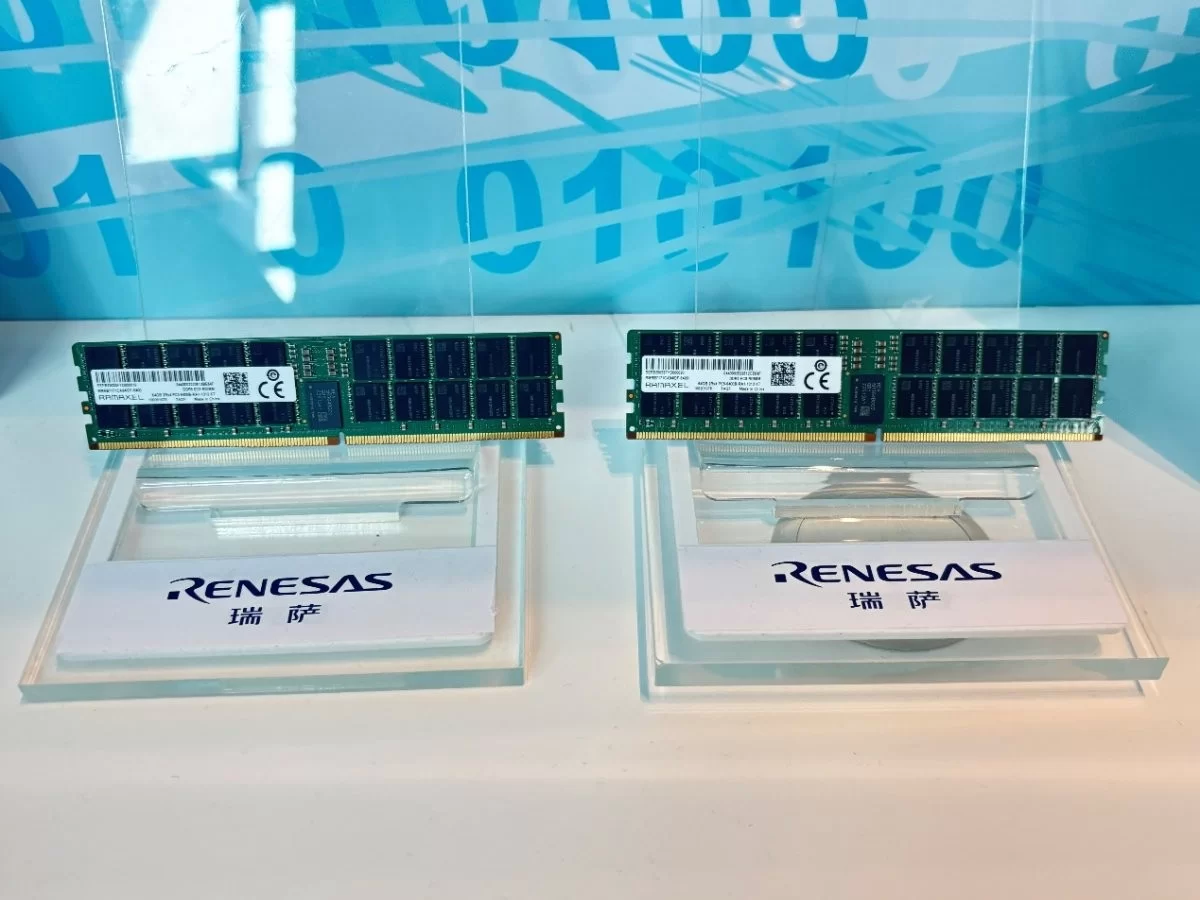
Renesas Electronics DDR5 Memory Interface Solution
Renesas Electronics provides various JEDEC compliant RCDs, data buffers (DBs), power management ICs, temperature sensors, and SPD (Serial Presence Detection) hubs to meet the timing requirements of DIMM and other DRAM and NAND memory interface applications. Its memory interface chip products cover all scenario requirements from mainstream servers to AI data centers.
Firstly, the RCD product line. The bandwidth of Renesas DDR5's sixth generation RCD has increased by 10% compared to the fifth generation, while also significantly improving signal integrity and system reliability through enhanced DFE (Decision Feedback Equalization) architecture and DESTM system level diagnostic capabilities. At present, the product has started sending samples to all mainstream DRAM suppliers and is expected to start mass production in the first half of 2027.
Next is MRIMM. MRDIMM is a new memory module technology designed specifically for AI and HPC data centers, jointly promoted by Renesas, Intel, and memory suppliers. This chipset adopts a "1+10" architecture - one MRCD (clock driver) paired with ten MDBs (multiplexed data buffers), which access data simultaneously through dual row memory, increasing memory bandwidth by 6% to 33% and expanding capacity to 256GB, far exceeding the standard RDIMM's 96GB.
Once again, it's the I3C series. This is a newly launched product category in the DDR5 era, aimed at unified management of multiple devices such as RCD and PMIC on motherboards. Renesas has separated the protocol from SPD and designed a separate chip to meet one to many management requirements such as dual CPUs, multiple memory modules, and multiple SSDs. This product has now passed the motherboard certification of Intel and AMD.
The demand for AI server driven MRDIMM exceeds expectations
In the macro context of tight overall DRAM supply, MRIMM will become one of the most anticipated incremental markets for Renesas Electronics. According to Zhu Li, the price of a single MRDIMM solution is several times that of a standard RCD kit, and in the high-value density AI server field, this premium is more likely to be accepted by customers.
The reason for this is that in the rapidly rising price environment of DRAM chips, the cost proportion of MRDIMM in the BOM table is diluted, and customers' sensitivity to price is significantly reduced, shifting their focus to speed and capacity advantages. The demand for memory bandwidth and capacity in AI servers is more urgent. Compared to traditional RDIMM, MRIMM can achieve higher capacity and larger bandwidth.
Based on this prediction, the penetration rate of MRIMM is expected to climb from low single digits in 2026 to 8% to 10% in 2027, exceeding the previous expectation of 5% to 8%. AI server and video stream (for example, Tiktok, YouTube, etc.) are the two application scenarios with the most clear requirements at present. At present, some leading domestic enterprises have shown clear interest in MRIMM. Zhuli firmly believes that as AI capital expenditures continue to rise, MRIMM is expected to occupy an increasingly important share in Renesas Electronics' memory interface business.
Customized demand and domestic particle volume drive the growth of the Chinese market
Nowadays, Renesas Electronics maintains long-term investment and high attention to the Chinese memory interface market. From the perspective of the demand characteristics of end customers, there are significant differences between China and the United States. The pace of CPU iteration in the US market is relatively fast and mature, while Chinese cloud vendors are rapidly releasing their demand for customized memory solutions.
Zhu Li observed that Chinese customers have much higher requirements for technical response speed and technical support depth than foreign countries, and the domestic DRAM module capability is in a period of rapid growth. Although the quality of domestically produced particles has approached the forefront level, module design and system adaptation capabilities are still rapidly climbing, "he added. Renesas Electronics has established a complete AE support team in China, distributed in Shanghai and Chengdu, achieving zero time response to customer needs.
In recent years, China has enormous growth potential in the field of memory interface chips and has become one of the fastest-growing regional markets. The mainstream position of DDR5 in the server market will continue at least until 2030, and our revenue target for memory interface chips in the Chinese market this year is to increase by 100% year-on-year. ”Zhu Li said, 'Renesas MID is confident in achieving 100% growth in China by 2026.'. This is mainly due to the rapid increase in demand for domestic memory modules, and as an important participant in the industry, our business volume has also grown rapidly.
In summary, Renesas Electronics has adopted an active supply chain localization strategy in the Chinese market, aimed at ensuring supply for customers and consolidating its competitive position in the Chinese market.
